
Mapa mental
ACCESS TO THE NETWORK
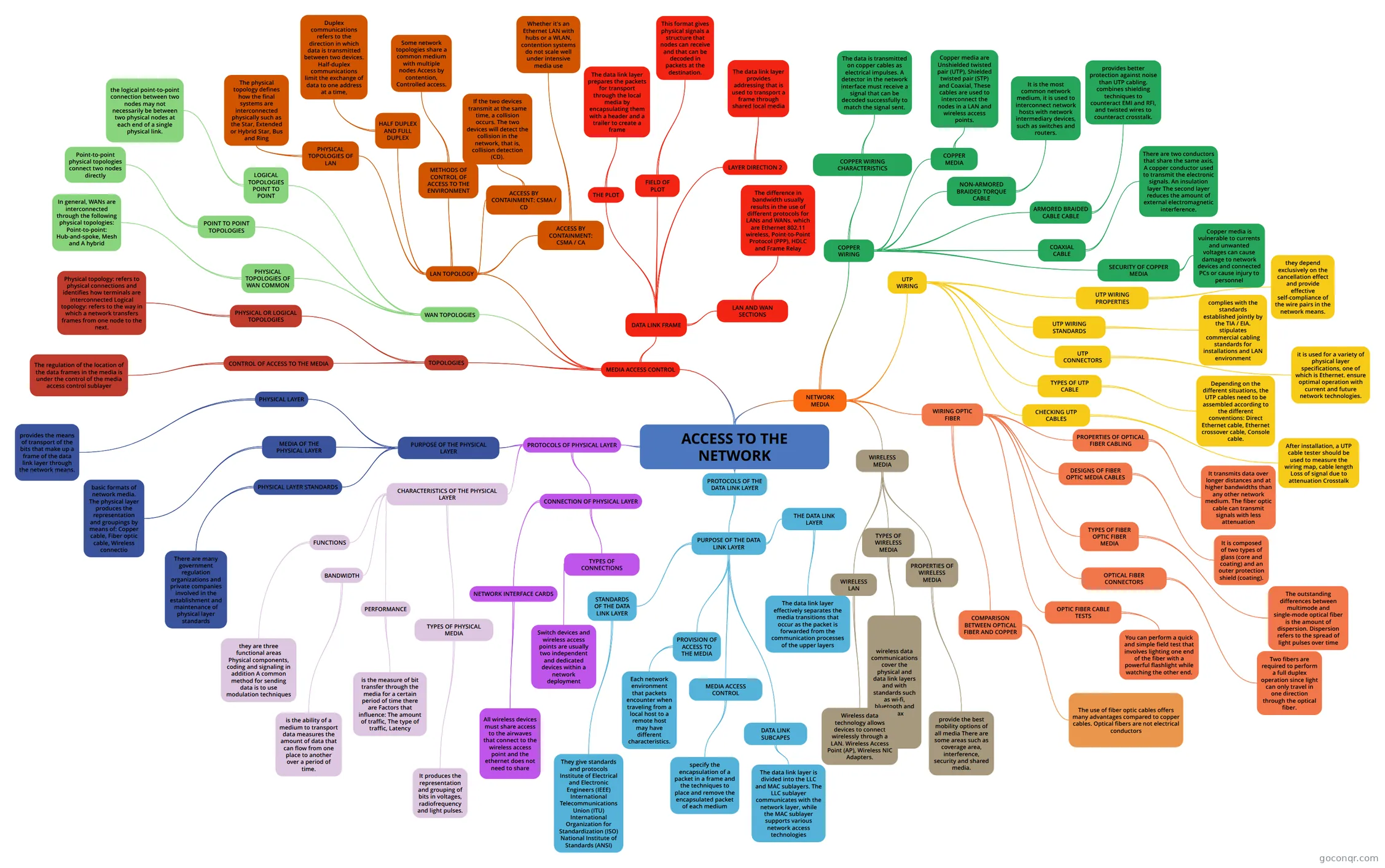
Mind map: Access to the network
Conteúdo do mapa
ACCESS TO THE NETWORK
PROTOCOLS OF PHYSICAL LAYER
- CONNECTION OF PHYSICAL LAYER
- TYPES OF CONNECTIONS
- Switch devices and wireless access points are usually two independent and dedicated devices within a network deployment
- NETWORK INTERFACE CARDS
- All wireless devices must share access to the airwaves that connect to the wireless access point and the ethernet does not need to share
- TYPES OF CONNECTIONS
- PURPOSE OF THE PHYSICAL LAYER
- PHYSICAL LAYER
- provides the means of transport of the bits that make up a frame of the data link layer through the network means.
- MEDIA OF THE PHYSICAL LAYER
- basic formats of network media. The physical layer produces the representation and groupings by means of: Copper cable, Fiber optic cable, Wireless connectio
- PHYSICAL LAYER STANDARDS
- There are many government regulation organizations and private companies involved in the establishment and maintenance of physical layer standards
- PHYSICAL LAYER
- CHARACTERISTICS OF THE PHYSICAL LAYER
- FUNCTIONS
- they are three functional areas Physical components, coding and signaling in addition A common method for sending data is to use modulation techniques
- BANDWIDTH
- is the ability of a medium to transport data measures the amount of data that can flow from one place to another over a period of time.
- PERFORMANCE
- is the measure of bit transfer through the media for a certain period of time there are Factors that influence: The amount of traffic, The type of traffic, Latency
- TYPES OF PHYSICAL MEDIA
- It produces the representation and grouping of bits in voltages, radiofrequency and light pulses.
- FUNCTIONS
- CONNECTION OF PHYSICAL LAYER
NETWORK MEDIA
- COPPER WIRING
- COPPER WIRING CHARACTERISTICS
- The data is transmitted on copper cables as electrical impulses. A detector in the network interface must receive a signal that can be decoded successfully to match the signal sent.
- COPPER MEDIA
- Copper media are Unshielded twisted pair (UTP), Shielded twisted pair (STP) and Coaxial, These cables are used to interconnect the nodes in a LAN and wireless access points.
- NON-ARMORED BRAIDED TORQUE CABLE
- It is the most common network medium, it is used to interconnect network hosts with network intermediary devices, such as switches and routers.
- ARMORED BRAIDED CABLE CABLE
- provides better protection against noise than UTP cabling. combines shielding techniques to counteract EMI and RFI, and twisted wires to counteract crosstalk.
- COAXIAL CABLE
- There are two conductors that share the same axis, A copper conductor used to transmit the electronic signals. An insulation layer The second layer reduces the amount of external electromagnetic interference.
- SECURITY OF COPPER MEDIA
- Copper media is vulnerable to currents and unwanted voltages can cause damage to network devices and connected PCs or cause injury to personnel
- COPPER WIRING CHARACTERISTICS
- UTP WIRING
- UTP WIRING PROPERTIES
- they depend exclusively on the cancellation effect and provide effective self-compliance of the wire pairs in the network means.
- UTP WIRING STANDARDS
- complies with the standards established jointly by the TIA / EIA. stipulates commercial cabling standards for installations and LAN environment
- UTP CONNECTORS
- it is used for a variety of physical layer specifications, one of which is Ethernet. ensure optimal operation with current and future network technologies.
- TYPES OF UTP CABLE
- Depending on the different situations, the UTP cables need to be assembled according to the different conventions: Direct Ethernet cable, Ethernet crossover cable, Console cable.
- CHECKING UTP CABLES
- After installation, a UTP cable tester should be used to measure the wiring map, cable length Loss of signal due to attenuation Crosstalk
- UTP WIRING PROPERTIES
- WIRING OPTIC FIBER
- PROPERTIES OF OPTICAL FIBER CABLING
- It transmits data over longer distances and at higher bandwidths than any other network medium. The fiber optic cable can transmit signals with less attenuation
- DESIGNS OF FIBER OPTIC MEDIA CABLES
- It is composed of two types of glass (core and coating) and an outer protection shield (coating).
- TYPES OF FIBER OPTIC FIBER MEDIA
- The outstanding differences between multimode and single-mode optical fiber is the amount of dispersion. Dispersion refers to the spread of light pulses over time
- OPTICAL FIBER CONNECTORS
- Two fibers are required to perform a full duplex operation since light can only travel in one direction through the optical fiber.
- OPTIC FIBER CABLE TESTS
- You can perform a quick and simple field test that involves lighting one end of the fiber with a powerful flashlight while watching the other end.
- COMPARISON BETWEEN OPTICAL FIBER AND COPPER
- The use of fiber optic cables offers many advantages compared to copper cables. Optical fibers are not electrical conductors
- PROPERTIES OF OPTICAL FIBER CABLING
- WIRELESS MEDIA
- PROPERTIES OF WIRELESS MEDIA
- provide the best mobility options of all media There are some areas such as coverage area, interference, security and shared media.
- TYPES OF WIRELESS MEDIA
- wireless data communications cover the physical and data link layers and with standards such as wi-fi, bluetooth and wimax
- WIRELESS LAN
- Wireless data technology allows devices to connect wirelessly through a LAN. Wireless Access Point (AP), Wireless NIC Adapters.
- PROPERTIES OF WIRELESS MEDIA
- COPPER WIRING
PROTOCOLS OF THE DATA LINK LAYER
- PURPOSE OF THE DATA LINK LAYER
- THE DATA LINK LAYER
- The data link layer effectively separates the media transitions that occur as the packet is forwarded from the communication processes of the upper layers
- DATA LINK SUBCAPES
- The data link layer is divided into the LLC and MAC sublayers. The LLC sublayer communicates with the network layer, while the MAC sublayer supports various network access technologies
- MEDIA ACCESS CONTROL
- specify the encapsulation of a packet in a frame and the techniques to place and remove the encapsulated packet of each medium
- PROVISION OF ACCESS TO THE MEDIA
- Each network environment that packets encounter when traveling from a local host to a remote host may have different characteristics.
- STANDARDS OF THE DATA LINK LAYER
- They give standards and protocols Institute of Electrical and Electronic Engineers (IEEE) International Telecommunications Union (ITU) International Organization for Standardization (ISO) National Institute of Standards (ANSI)
- THE DATA LINK LAYER
- PURPOSE OF THE DATA LINK LAYER
MEDIA ACCESS CONTROL
- TOPOLOGIES
- CONTROL OF ACCESS TO THE MEDIA
- The regulation of the location of the data frames in the media is under the control of the media access control sublayer
- PHYSICAL OR LOGICAL TOPOLOGIES
- Physical topology: refers to physical connections and identifies how terminals are interconnected Logical topology: refers to the way in which a network transfers frames from one node to the next.
- CONTROL OF ACCESS TO THE MEDIA
- WAN TOPOLOGIES
- PHYSICAL TOPOLOGIES OF WAN COMMON
- In general, WANs are interconnected through the following physical topologies: Point-to-point: Hub-and-spoke, Mesh and A hybrid
- POINT TO POINT TOPOLOGIES
- Point-to-point physical topologies connect two nodes directly
- LOGICAL TOPOLOGIES POINT TO POINT
- the logical point-to-point connection between two nodes may not necessarily be between two physical nodes at each end of a single physical link.
- PHYSICAL TOPOLOGIES OF WAN COMMON
- LAN TOPOLOGY
- PHYSICAL TOPOLOGIES OF LAN
- The physical topology defines how the final systems are interconnected physically such as the Star, Extended or Hybrid Star, Bus and Ring
- HALF DUPLEX AND FULL DUPLEX
- Duplex communications refers to the direction in which data is transmitted between two devices. Half-duplex communications limit the exchange of data to one address at a time,
- METHODS OF CONTROL OF ACCESS TO THE ENVIRONMENT
- Some network topologies share a common medium with multiple nodes Access by contention, Controlled access.
- ACCESS BY CONTAINMENT: CSMA / CD
- If the two devices transmit at the same time, a collision occurs. The two devices will detect the collision in the network, that is, collision detection (CD).
- ACCESS BY CONTAINMENT: CSMA / CA
- Whether it's an Ethernet LAN with hubs or a WLAN, contention systems do not scale well under intensive media use
- PHYSICAL TOPOLOGIES OF LAN
- DATA LINK FRAME
- THE PLOT
- The data link layer prepares the packets for transport through the local media by encapsulating them with a header and a trailer to create a frame
- FIELD OF PLOT
- This format gives physical signals a structure that nodes can receive and that can be decoded in packets at the destination.
- LAYER DIRECTION 2
- The data link layer provides addressing that is used to transport a frame through shared local media
- LAN AND WAN SECTIONS
- The difference in bandwidth usually results in the use of different protocols for LANs and WANs. which are Ethernet 802.11 wireless, Point-to-Point Protocol (PPP), HDLC and Frame Relay
- THE PLOT
- TOPOLOGIES
Informações
- Descrição
- Mapa Mental sobre ACCESS TO THE NETWORK, criado por ale monje em 11-09-2018.
- Criado por
- ale monje
- Visualizações
- 0
- Avaliação