
Mapa mental
Budgeting Projects (Chapter 9)
Conteúdo do mapa
Budgeting Projects (Chapter 9)
Plan Cost Management
- Is “ the process that establishes the policies, procedures, and documentation for planning, managing, expending, and controlling project costs.”
- Cost Management Plan
- is “a component of the project management plan that describes how costs will be planned, structured, and controlled.
- Includes
- Costs included (such as internal and external, contingency, etc.), • Activity resource estimating, • Cost estimating, • Budget determination, and • Cost control, including metrics, reporting, and change approvals
Estimate Cost
- is “ the process of developing an approximation of the monetary resources needed to complete project activities
- Fixed vs Variable Costs
- Fixed costs are those that remain the same regardless of the size or volume of work.
- Variable costs are those that vary directly with volume of use.
- Direct vs Indirect costs
- Direct costs are those that only occur because of the project and are often classified as either direct labor or other direct costs.
- Other direct costs may include such items as materials, travel, consultants, subcontracts, purchased parts, and computer time.
- Indirect costs are those that are necessary to keep the organization running, but are not associated with one specific project.
- The salaries of the company executives and the cost of company buildings, utilities, insurance, and clerical assistance are examples.
- Direct costs are those that only occur because of the project and are often classified as either direct labor or other direct costs.
- Recurring vs nonrecurring costs
- Recurring costs are those that repeat as the project work continues, such as the cost of writing code or laying bricks.
- Nonrecurring costs tend to occur during project planning and closing, while recurring costs tend to occur during project execution.
- Nonrecurring costs are those that happen only once during a project, such as developing a design that, once approved, guides the project team.
- Recurring costs are those that repeat as the project work continues, such as the cost of writing code or laying bricks.
- Regular versus expedited costs
- Regular costs are preferred and occur when progress can be made by normal work hours and purchasing agreements.
- The comparison of these costs shows why it is vital to understand schedule pressures and resource demands as costs are estimated.
- Expedited costs occur when the project must be conducted faster than normal and overtime for workers and/or extra charges for rapid delivery from suppliers are necessary
- Regular costs are preferred and occur when progress can be made by normal work hours and purchasing agreements.
- Estimate vs Reserve
- Estimate is “a quantified assessment of the likely amount… It should always include an indication of accuracy.
- Reserve is a provision in the project management plan to mitigate cost and/or schedule risk.
- Management Reserve vs Contigency reserve
- Management reserve is “an amount of the project budget withheld for management control purposes… for unforeseen work that is within the scope.”
- contingency reserve is “budget within the cost baseline that is allocated for identified risks that are accepted and for which contingent or mitigating responses are developed.
- Accuracy and Timing of Cost Estimates
- Order of magnitude estimates
- estimates go by several different names
- The early estimates are often created during the project initiating stage when very little detail is known about the project.
- Budget and definitive estimates
- detailed planning stage, it is generally possible to create a more accurate cost estimate.
- At the end of project planning, cost estimates should have a small enough margin of error that they can be used to create a project budget, show cash flow needs, and be used as a basis for controlling the project.
- Order of magnitude estimates
- Methods of Estimating Costs
- Analogous estimating
- is “a technique for estimating the duration or cost of an activity or a project using historical data from a similar project.
- Parametric estimating
- is an estimating technique in which an algorithm is used to calculate cost or duration based on historical data and project parameters.
- Essentially, a parametric estimate is determined by identifying the unit cost or duration and the number of units required for the project or activity.
- uses the relationship between variables to calculate the cost or duration.
- Essentially, a parametric estimate is determined by identifying the unit cost or duration and the number of units required for the project or activity.
- is an estimating technique in which an algorithm is used to calculate cost or duration based on historical data and project parameters.
- Bottom-UP estimating
- “ a method of estimating project duration or cost by aggregating the estimates of the lower-level components of the WBS.
- In an elevator for example details to be estimated included exactly how many buttons the control panel had, exactly what kind of light fixtures were mounted in the ceiling, what kind of finish was requested, and so on.
- One important caution on bottom up estimating is to ensure that every item is included.
- “ a method of estimating project duration or cost by aggregating the estimates of the lower-level components of the WBS.
- Analogous estimating
- Project Cost estimating issues
- Supporting detail
- includes describing the scope, method used to create the estimate, assumptions, constraints, and range of possible outcomes.
- Assumptions that are not true often cause more work or other problems for a project.
- Causes of variation
- Normal variation comes from many small causes that are inherent in a work process.
- Special cause variation, on the other hand, is when something out of the ordinary occurs. For example, a lightning strike could cause such a large power surge that it overwhelms the normal protectors and destroys some of the computers.
- Vendor Bid-Analysis
- is used to determine whether the price being asked by the vendors appears to be reasonable
- Value engineering
- is “ “an approach used to optimize project life cycle costs, save time, increase profits, improve quality, expand market share, solve problems, and/or use resources more effectively.”
- Activity based costing (ABC)
- ABC is another accounting approach, by which indirect costs are allocated to fixed costs based upon four different types of drivers.
- ABC also helps to support process improvement and justify spending money on expensive equipment
- ABC requires more involved methods for allocating indirect costs, but yields more accurate cost information
- Project managers need to understand how costs are allocated in their organization so they can accurately estimate the amount of indirect costs that will be assigned to their projects.
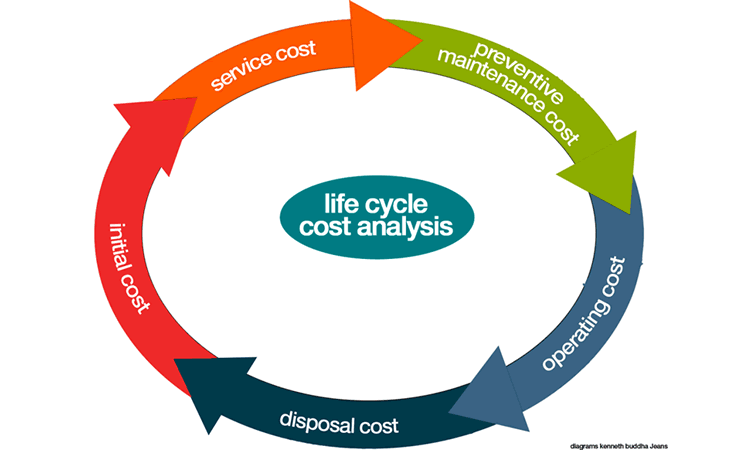
- Life cycle costing
- Many project selection decisions are made based upon the total costs of both creating the project and of using the result of the project during its useful life.
- In an age when environ mental concerns are appropriately being considered more heavily, to calculate total life cycle costs, a project manager may also need to consider disposition costs of the product after its useful life is complete. This can entail designing more recyclable parts (even at a higher cost) into the product.
- Time value of money and international currency fluctuations
- project managers need to understand how to calculate the time value of money.
- One dollar today is presumably worth more than one dollar next year.
- Project managers need to discount future dollars by the appropriate factor.
- Supporting detail
Determine Budget
- is “ the process of aggregating the estimated costs of individual activities or work packages to establish an authorized cost baseline.
- Aggregating costs
- cost baseline, which is the approved version of the time-phased project budget, excluding any management reserves, which can be changed only through formal change control procedures and is used as a basis for comparing actual results.
- The project budget can be aggregted from the work packages
- Analyzing Reserve needs
- Variation in project costs (and schedules) can be partially explained by the presence of certain events.
- These events are classified as known knowns, known unknowns, or unknown unknowns depending on the extent to which they are understood and predicted.
- The amount placed into management reserve is determined by how much uncertainty management feels exists in the project.
- Determine Cash flow
- the timing of cash coming in and going out for a project is just as important as the amount of money required.
- A project manager needs to ensure that the cumulative amount of cash coming into the project either from internal budgeting or from customer pay ments meets or exceeds the demands for paying cash out.
Imagens e arquivos do mapa













Informações
- Descrição
- Mapa Mental sobre Budgeting Projects (Chapter 9), criado por Gustavo Valenzuela em 01-10-2018.
- Criado por
- Gustavo Valenzuela
- Visualizações
- 0
- Avaliação