
Mapa mental
STRUCTURE & DESIGN
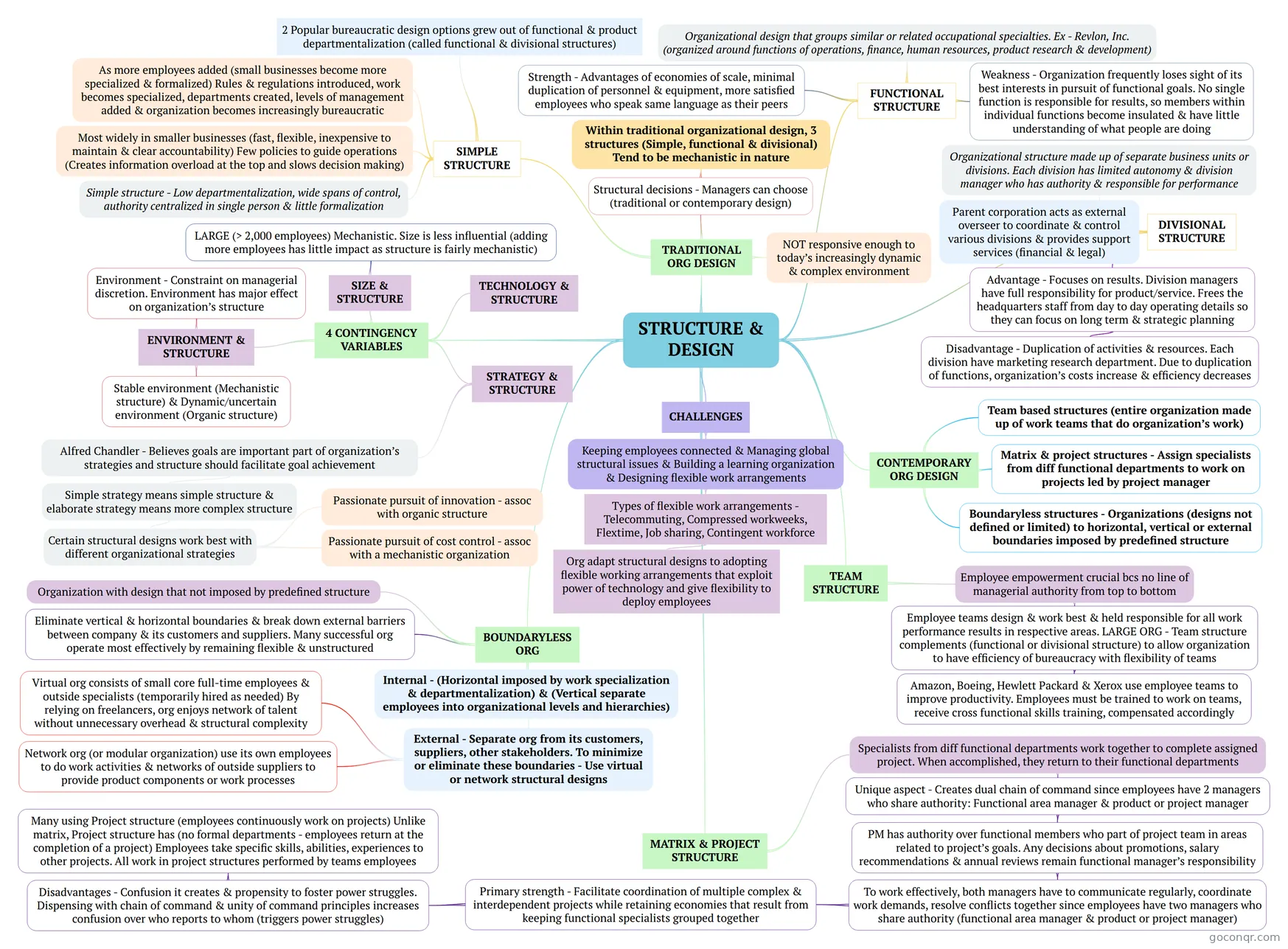
Mind map: Organizational structure and design
Conteúdo do mapa
STRUCTURE & DESIGN
4 CONTINGENCY VARIABLES
- SIZE & STRUCTURE
- LARGE (> 2,000 employees) Mechanistic. Size is less influential (adding more employees has little impact as structure is fairly mechanistic)
- STRATEGY & STRUCTURE
- Alfred Chandler - Believes goals are important part of organization’s strategies and structure should facilitate goal achievement
- Simple strategy means simple structure & elaborate strategy means more complex structure
- Certain structural designs work best with different organizational strategies
- Passionate pursuit of innovation - assoc with organic structure
- Passionate pursuit of cost control - assoc with a mechanistic organization
- Certain structural designs work best with different organizational strategies
- Simple strategy means simple structure & elaborate strategy means more complex structure
- Alfred Chandler - Believes goals are important part of organization’s strategies and structure should facilitate goal achievement
- TECHNOLOGY & STRUCTURE
- ENVIRONMENT & STRUCTURE
- Environment - Constraint on managerial discretion. Environment has major effect on organization’s structure
- Stable environment (Mechanistic structure) & Dynamic/uncertain environment (Organic structure)
- SIZE & STRUCTURE
TRADITIONAL ORG DESIGN
- Structural decisions - Managers can choose (traditional or contemporary design)
- Within traditional organizational design, 3 structures (Simple, functional & divisional) Tend to be mechanistic in nature
- SIMPLE STRUCTURE
- Simple structure - Low departmentalization, wide spans of control, authority centralized in single person & little formalization
- Most widely in smaller businesses (fast, flexible, inexpensive to maintain & clear accountability) Few policies to guide operations (Creates information overload at the top and slows decision making)
- As more employees added (small businesses become more specialized & formalized) Rules & regulations introduced, work becomes specialized, departments created, levels of management added & organization becomes increasingly bureaucratic
- 2 Popular bureaucratic design options grew out of functional & product departmentalization (called functional & divisional structures)
- NOT responsive enough to today’s increasingly dynamic & complex environment
- Structural decisions - Managers can choose (traditional or contemporary design)
FUNCTIONAL STRUCTURE
- Organizational design that groups similar or related occupational specialties. Ex - Revlon, Inc. (organized around functions of operations, finance, human resources, product research & development)
- Strength - Advantages of economies of scale, minimal duplication of personnel & equipment, more satisfied employees who speak same language as their peers
- Weakness - Organization frequently loses sight of its best interests in pursuit of functional goals. No single function is responsible for results, so members within individual functions become insulated & have little understanding of what people are doing
DIVISIONAL STRUCTURE
- Organizational structure made up of separate business units or divisions. Each division has limited autonomy & division manager who has authority & responsible for performance
- Parent corporation acts as external overseer to coordinate & control various divisions & provides support services (financial & legal)
- Advantage - Focuses on results. Division managers have full responsibility for product/service. Frees the headquarters staff from day to day operating details so they can focus on long term & strategic planning
- Disadvantage - Duplication of activities & resources. Each division have marketing research department. Due to duplication of functions, organization’s costs increase & efficiency decreases
CONTEMPORARY ORG DESIGN
- Team based structures (entire organization made up of work teams that do organization’s work)
- Matrix & project structures - Assign specialists from diff functional departments to work on projects led by project manager
- Boundaryless structures - Organizations (designs not defined or limited) to horizontal, vertical or external boundaries imposed by predefined structure
TEAM STRUCTURE
- Employee empowerment crucial bcs no line of managerial authority from top to bottom
- Employee teams design & work best & held responsible for all work performance results in respective areas. LARGE ORG - Team structure complements (functional or divisional structure) to allow organization to have efficiency of bureaucracy with flexibility of teams
- Amazon, Boeing, Hewlett Packard & Xerox use employee teams to improve productivity. Employees must be trained to work on teams, receive cross functional skills training, compensated accordingly
- Employee teams design & work best & held responsible for all work performance results in respective areas. LARGE ORG - Team structure complements (functional or divisional structure) to allow organization to have efficiency of bureaucracy with flexibility of teams
- Employee empowerment crucial bcs no line of managerial authority from top to bottom
MATRIX & PROJECT STRUCTURE
- Specialists from diff functional departments work together to complete assigned project. When accomplished, they return to their functional departments
- Unique aspect - Creates dual chain of command since employees have 2 managers who share authority: Functional area manager & product or project manager
- PM has authority over functional members who part of project team in areas related to project’s goals. Any decisions about promotions, salary recommendations & annual reviews remain functional manager’s responsibility
- To work effectively, both managers have to communicate regularly, coordinate work demands, resolve conflicts together since employees have two managers who share authority (functional area manager & product or project manager)
- Primary strength - Facilitate coordination of multiple complex & interdependent projects while retaining economies that result from keeping functional specialists grouped together
- Disadvantages - Confusion it creates & propensity to foster power struggles. Dispensing with chain of command & unity of command principles increases confusion over who reports to whom (triggers power struggles)
- Many using Project structure (employees continuously work on projects) Unlike matrix, Project structure has (no formal departments - employees return at the completion of a project) Employees take specific skills, abilities, experiences to other projects. All work in project structures performed by teams employees
- Disadvantages - Confusion it creates & propensity to foster power struggles. Dispensing with chain of command & unity of command principles increases confusion over who reports to whom (triggers power struggles)
- Primary strength - Facilitate coordination of multiple complex & interdependent projects while retaining economies that result from keeping functional specialists grouped together
- To work effectively, both managers have to communicate regularly, coordinate work demands, resolve conflicts together since employees have two managers who share authority (functional area manager & product or project manager)
- PM has authority over functional members who part of project team in areas related to project’s goals. Any decisions about promotions, salary recommendations & annual reviews remain functional manager’s responsibility
- Unique aspect - Creates dual chain of command since employees have 2 managers who share authority: Functional area manager & product or project manager
- Specialists from diff functional departments work together to complete assigned project. When accomplished, they return to their functional departments
BOUNDARYLESS ORG
- Organization with design that not imposed by predefined structure
- Eliminate vertical & horizontal boundaries & break down external barriers between company & its customers and suppliers. Many successful org operate most effectively by remaining flexible & unstructured
- Internal - (Horizontal imposed by work specialization & departmentalization) & (Vertical separate employees into organizational levels and hierarchies)
- External - Separate org from its customers, suppliers, other stakeholders. To minimize or eliminate these boundaries - Use virtual or network structural designs
- Virtual org consists of small core full-time employees & outside specialists (temporarily hired as needed) By relying on freelancers, org enjoys network of talent without unnecessary overhead & structural complexity
- Network org (or modular organization) use its own employees to do work activities & networks of outside suppliers to provide product components or work processes
CHALLENGES
- Keeping employees connected & Managing global structural issues & Building a learning organization & Designing flexible work arrangements
- Types of flexible work arrangements - Telecommuting, Compressed workweeks, Flextime, Job sharing, Contingent workforce
- Org adapt structural designs to adopting flexible working arrangements that exploit power of technology and give flexibility to deploy employees
- Types of flexible work arrangements - Telecommuting, Compressed workweeks, Flextime, Job sharing, Contingent workforce
- Keeping employees connected & Managing global structural issues & Building a learning organization & Designing flexible work arrangements
Informações
- Descrição
- Mapa Mental sobre STRUCTURE & DESIGN, criado por Izzati Zakaria em 03-03-2019.
- Criado por
- Izzati Zakaria
- Visualizações
- 1
- Histórico
-
- Criado por Izzati Zakaria · 3 mar 2019
- Copiado por Izzati Zakaria · 3 mar 2019
- Avaliação
Mais sobre Strategy and Factors Affecting Structure