
Mapa mental
peripheral vascular diseases
Conteúdo do mapa
peripheral vascular diseases
Vasculitis
- Inflammation of the blood vessel wall
- Nonspecific symptoms of inflammation (e.g., fever, fatigue, weight loss, and myalgias)
- Symptoms of organ ischemia—due to luminal narrowing or thrombosis of the inflamed vessels
- Nonspecific symptoms of inflammation (e.g., fever, fatigue, weight loss, and myalgias)
- Inflammation of the blood vessel wall
HTN
- PRIMARY HTN
- . HTN of unknown etiology (95% of cases)
- Risk factors include age, race (increased risk in African Americans, decreased risk in Asians), obesity, stress, lack of physical activity, and high-salt diet.
- . HTN of unknown etiology (95% of cases)
- SECONDARY HTN
- HTN due to an identifiable etiology (5% of cases)
- Renal artery stenosis is a common cause (renovascular hypertension)
- HTN due to an identifiable etiology (5% of cases)
- PRIMARY HTN
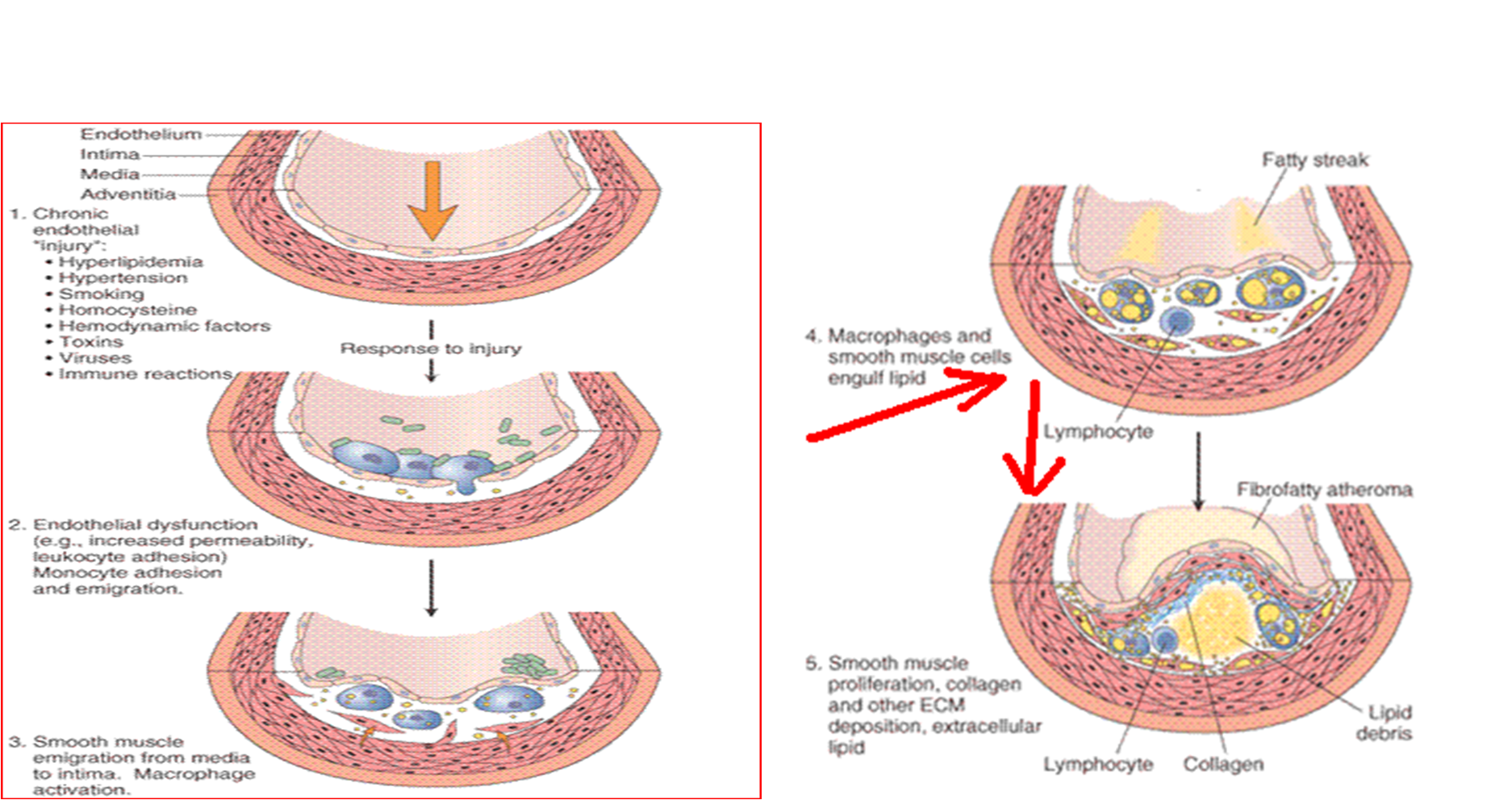
ATHEROSCLEROSIS
- Risk factors :
- Arterial HT... Tobacco smoke... Hereditary... Endocrine.. Reduced physical activity... Obesity... Male gender... Age ...stress
- Causes of intermittent claudication
- Most commonly, intermittent (or vascular or arterial) claudication is due to peripheral arterial disease which implies significant atherosclerotic blockages resulting in arterial insufficiency.
- Complications :
- aneurysmal dilatation and thrombo –embolism.
- Ischemic Heart Disease & Myocardial Infarction
- chronic ischemia, infarction.
- ischemic bowel disease, infarction.
- intermittent claudication
- Diagnosis
- Magnetic resonance angiography... Duplex ultrasonography
- Risk factors :
arterioloscelrosis
- A. Narrowing of small arterioles; divided into hyaline and hyperplastic types
- Hyaline arteriolosclerosis is caused by proteins leaking into the vessel wall, producing vascular thickening; proteins are seen as pink hyaline on microscopy.
- Hyperplastic arteriolosclerosis
- involves thickening of vessel wall by hyperplasia of smooth muscle ('onion-skin appearance).
- 1. Consequence of malignant hypertension
- 2. Results in reduced vessel caliber with end-organ ischemia
- MONCKEBERG MEDIAL CALCIFIC SCLEROSIS
- A. Calcification of the media of muscular (medium-sized) arteries; nonobstructive
- B. Not clinically significant; seen as an incidental finding on x-ray or mammography
Aortic dissection
- A. Intimal tear with dissection of blood through media of the aortic wail
- B. Occurs in the proximal 10 cm of the aorta (high stress region) with preexisting weakness of the media
- Most common cause is hypertension (older adults); also associated with inherited defects of connective tissue (younger individuals)
- D. Presents as sharp, tearing chest pain that radiates to the back
- Most common cause is hypertension (older adults); also associated with inherited defects of connective tissue (younger individuals)
- B. Occurs in the proximal 10 cm of the aorta (high stress region) with preexisting weakness of the media
- A. Intimal tear with dissection of blood through media of the aortic wail
Aneurysm
- THORACIC ANEURYSM
- Due to weakness in the aortic wall. Classically seen in tertiary syphilis; endarteritis of the vasa vasorum results in luminal narrowing, decreased flow, and atrophy of the vessel wall. Results in a 'tree-bark' appearance of the aorta
- C. Major complication is dilation of the aortic valve root, resulting in aortic valve insufficiency
- Due to weakness in the aortic wall. Classically seen in tertiary syphilis; endarteritis of the vasa vasorum results in luminal narrowing, decreased flow, and atrophy of the vessel wall. Results in a 'tree-bark' appearance of the aorta
- ABDOMINAL AORTIC ANEURYSM
- Balloon-like dilation of the abdominal aorta; usually arises below the renal arteries, but above the aortic bifurcation
- D. Major complication is rupture, especially when > 5 cm in diameter; presents with triad of hypotension, pulsatile abdominal mass, and flank pain
- Balloon-like dilation of the abdominal aorta; usually arises below the renal arteries, but above the aortic bifurcation
- THORACIC ANEURYSM
Bruits
- Carotid bruits
- Carotid stenosis
- Carotid bruits
Imagens e arquivos do mapa
Informações
- Descrição
- Mapa Mental sobre peripheral vascular diseases, criado por daliya ahmed em 11-03-2019.
- Criado por
- daliya ahmed
- Visualizações
- 29
- Avaliação