
Mapa mental
how is villainy presented in macbeth?
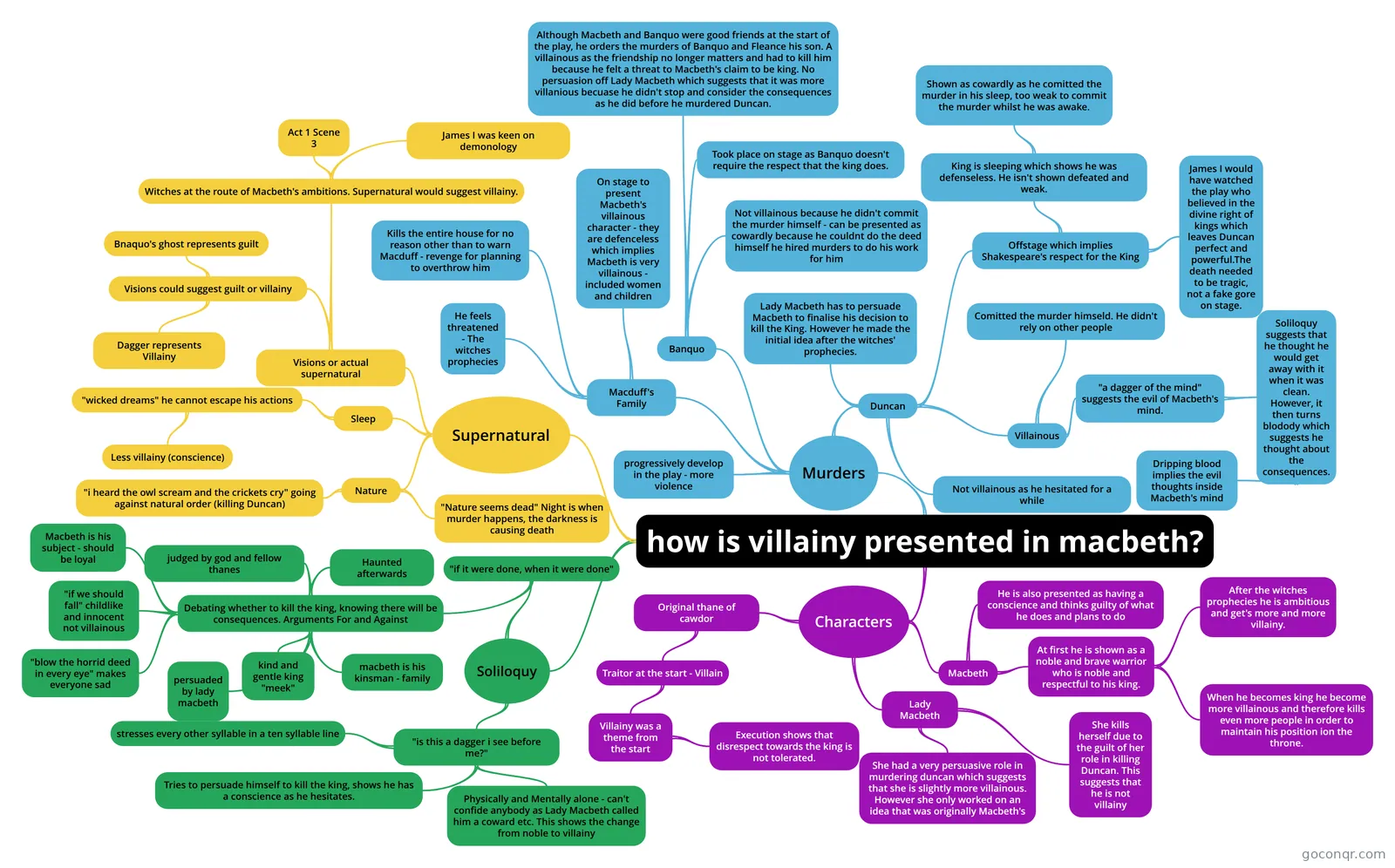
Mind map: villainy in Macbeth
Conteúdo do mapa
how is villainy presented in macbeth?
Murders
- progressively develop in the play - more violence
- Macduff's Family
- Kills the entire house for no reason other than to warn Macduff - revenge for planning to overthrow him
- He feels threatened - The witches prophecies
- On stage to present Macbeth's villainous character - they are defenceless which implies Macbeth is very villainous - included women and children
- Banquo
- Not villainous because he didn't commit the murder himself - can be presented as cowardly because he couldnt do the deed himself he hired murders to do his work for him
- Took place on stage as Banquo doesn't require the respect that the king does.
- Although Macbeth and Banquo were good friends at the start of the play, he orders the murders of Banquo and Fleance his son. A villainous as the friendship no longer matters and had to kill him because he felt a threat to Macbeth's claim to be king. No persuasion off Lady Macbeth which suggests that it was more villanious becuase he didn't stop and consider the consequences as he did before he murdered Duncan.
- Duncan
- Offstage which implies Shakespeare's respect for the King
- King is sleeping which shows he was defenseless. He isn't shown defeated and weak.
- Shown as cowardly as he comitted the murder in his sleep, too weak to commit the murder whilst he was awake.
- James I would have watched the play who believed in the divine right of kings which leaves Duncan perfect and powerful.The death needed to be tragic, not a fake gore on stage.
- King is sleeping which shows he was defenseless. He isn't shown defeated and weak.
- Lady Macbeth has to persuade Macbeth to finalise his decision to kill the King. However he made the initial idea after the witches' prophecies.
- Not villainous as he hesitated for a while
- Villainous
- "a dagger of the mind" suggests the evil of Macbeth's mind.
- Soliloquy suggests that he thought he would get away with it when it was clean. However, it then turns blodody which suggests he thought about the consequences.
- Dripping blood implies the evil thoughts inside Macbeth's mind
- Soliloquy suggests that he thought he would get away with it when it was clean. However, it then turns blodody which suggests he thought about the consequences.
- Comitted the murder himseld. He didn't rely on other people
- "a dagger of the mind" suggests the evil of Macbeth's mind.
- Offstage which implies Shakespeare's respect for the King
Characters
- Macbeth
- At first he is shown as a noble and brave warrior who is noble and respectful to his king.
- After the witches prophecies he is ambitious and get's more and more villainy.
- When he becomes king he become more villainous and therefore kills even more people in order to maintain his position ion the throne.
- He is also presented as having a conscience and thinks guilty of what he does and plans to do
- At first he is shown as a noble and brave warrior who is noble and respectful to his king.
- Lady Macbeth
- She kills herself due to the guilt of her role in killing Duncan. This suggests that he is not villainy
- She had a very persuasive role in murdering duncan which suggests that she is slightly more villainous. However she only worked on an idea that was originally Macbeth's
- Original thane of cawdor
- Traitor at the start - Villain
- Villainy was a theme from the start
- Execution shows that disrespect towards the king is not tolerated.
- Villainy was a theme from the start
- Traitor at the start - Villain
- Macbeth
Supernatural
- Visions or actual supernatural
- Witches at the route of Macbeth's ambitions. Supernatural would suggest villainy.
- Act 1 Scene 3
- James I was keen on demonology
- Visions could suggest guilt or villainy
- Bnaquo's ghost represents guilt
- Dagger represents Villainy
- Witches at the route of Macbeth's ambitions. Supernatural would suggest villainy.
- Nature
- "i heard the owl scream and the crickets cry" going against natural order (killing Duncan)
- "Nature seems dead" Night is when murder happens, the darkness is causing death
- Sleep
- "wicked dreams" he cannot escape his actions
- Less villainy (conscience)
- "wicked dreams" he cannot escape his actions
- Visions or actual supernatural
Soliloquy
- "if it were done, when it were done"
- Debating whether to kill the king, knowing there will be consequences. Arguments For and Against
- Haunted afterwards
- judged by god and fellow thanes
- Macbeth is his subject - should be loyal
- "if we should fall" childlike and innocent not villainous
- persuaded by lady macbeth
- "blow the horrid deed in every eye" makes everyone sad
- kind and gentle king "meek"
- macbeth is his kinsman - family
- Debating whether to kill the king, knowing there will be consequences. Arguments For and Against
- "is this a dagger i see before me?"
- Tries to persuade himself to kill the king, shows he has a conscience as he hesitates.
- Physically and Mentally alone - can't confide anybody as Lady Macbeth called him a coward etc. This shows the change from noble to villainy
- stresses every other syllable in a ten syllable line
- "if it were done, when it were done"
Informações
- Descrição
- Mapa Mental sobre how is villainy presented in macbeth?, criado por adamjackson98 em 02-12-2014.
- Criado por
- adamjackson98
- Visualizações
- 425
- Avaliação