
Mapa mental
Types of Reading
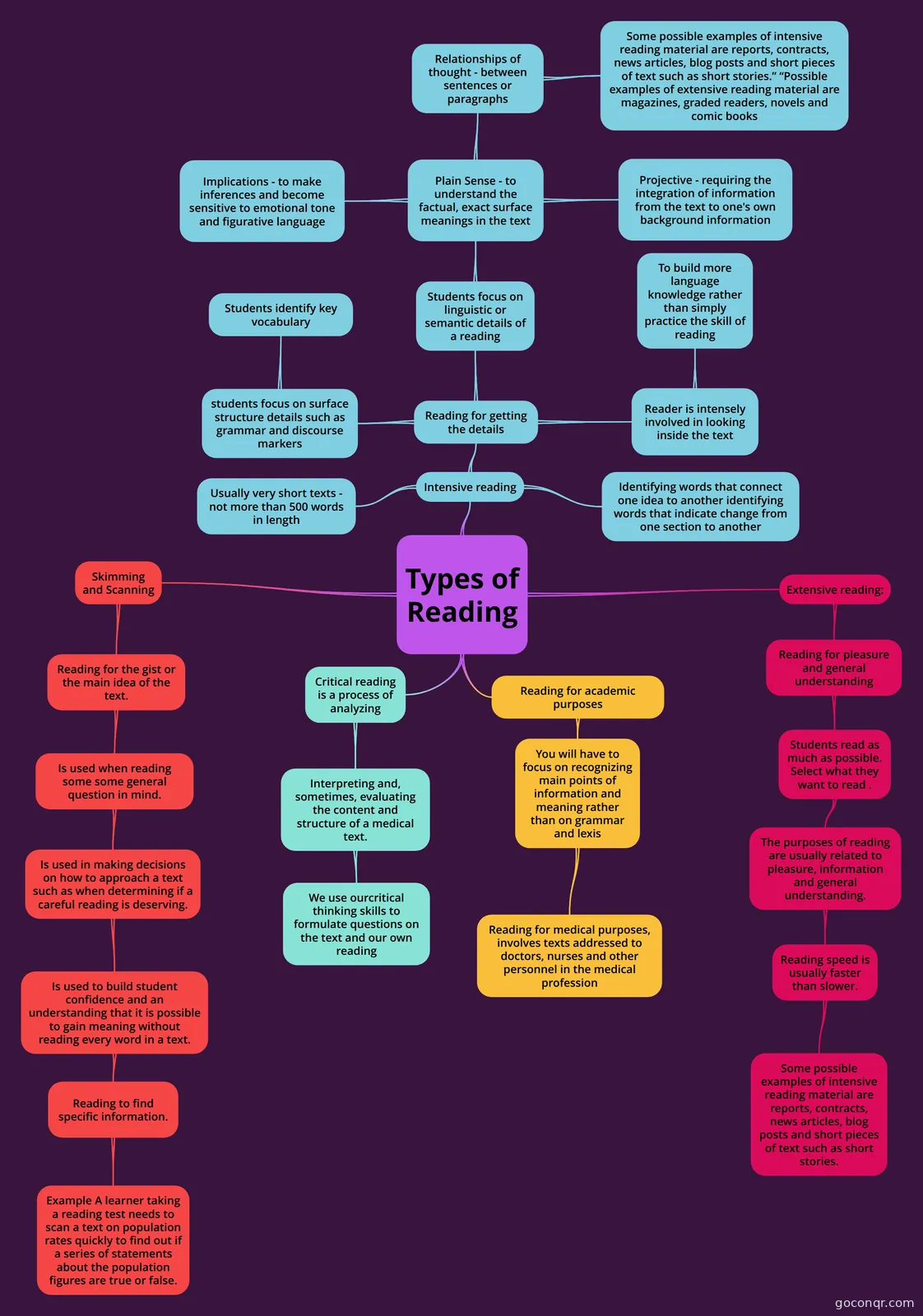
Mind map: Types of reading
Conteúdo do mapa
Types of Reading
Extensive reading:
- Reading for pleasure and general understanding
- Students read as much as possible. Select what they want to read .
- The purposes of reading are usually related to pleasure, information and general understanding.
- Reading speed is usually faster than slower.
- Some possible examples of intensive reading material are reports, contracts, news articles, blog posts and short pieces of text such as short stories.
- Reading speed is usually faster than slower.
- The purposes of reading are usually related to pleasure, information and general understanding.
- Students read as much as possible. Select what they want to read .
- Reading for pleasure and general understanding
Skimming and Scanning
- Reading for the gist or the main idea of the text.
- Is used when reading some some general question in mind.
- Is used in making decisions on how to approach a text such as when determining if a careful reading is deserving.
- Is used to build student confidence and an understanding that it is possible to gain meaning without reading every word in a text.
- Reading to find specific information.
- Example A learner taking a reading test needs to scan a text on population rates quickly to find out if a series of statements about the population figures are true or false.
- Reading to find specific information.
- Is used to build student confidence and an understanding that it is possible to gain meaning without reading every word in a text.
- Is used in making decisions on how to approach a text such as when determining if a careful reading is deserving.
- Is used when reading some some general question in mind.
- Reading for the gist or the main idea of the text.
Intensive reading
- Reading for getting the details
- Reader is intensely involved in looking inside the text
- To build more language knowledge rather than simply practice the skill of reading
- Students focus on linguistic or semantic details of a reading
- Plain Sense - to understand the factual, exact surface meanings in the text
- Implications - to make inferences and become sensitive to emotional tone and figurative language
- Projective - requiring the integration of information from the text to one's own background information
- Relationships of thought - between sentences or paragraphs
- Some possible examples of intensive reading material are reports, contracts, news articles, blog posts and short pieces of text such as short stories.” “Possible examples of extensive reading material are magazines, graded readers, novels and comic books
- Plain Sense - to understand the factual, exact surface meanings in the text
- students focus on surface structure details such as grammar and discourse markers
- Students identify key vocabulary
- Reader is intensely involved in looking inside the text
- Usually very short texts - not more than 500 words in length
- Identifying words that connect one idea to another identifying words that indicate change from one section to another
- Reading for getting the details
Critical reading is a process of analyzing
- Interpreting and, sometimes, evaluating the content and structure of a medical text.
- We use ourcritical thinking skills to formulate questions on the text and our own reading
- Interpreting and, sometimes, evaluating the content and structure of a medical text.
Reading for academic purposes
- You will have to focus on recognizing main points of information and meaning rather than on grammar and lexis
- Reading for medical purposes, involves texts addressed to doctors, nurses and other personnel in the medical profession
- You will have to focus on recognizing main points of information and meaning rather than on grammar and lexis
Informações
- Descrição
- Mapa Mental sobre Types of Reading, criado por Lily Reyes em 13-05-2019.
- Criado por
- Lily Reyes
- Visualizações
- 0
- Avaliação