
Mapa mental
English topics
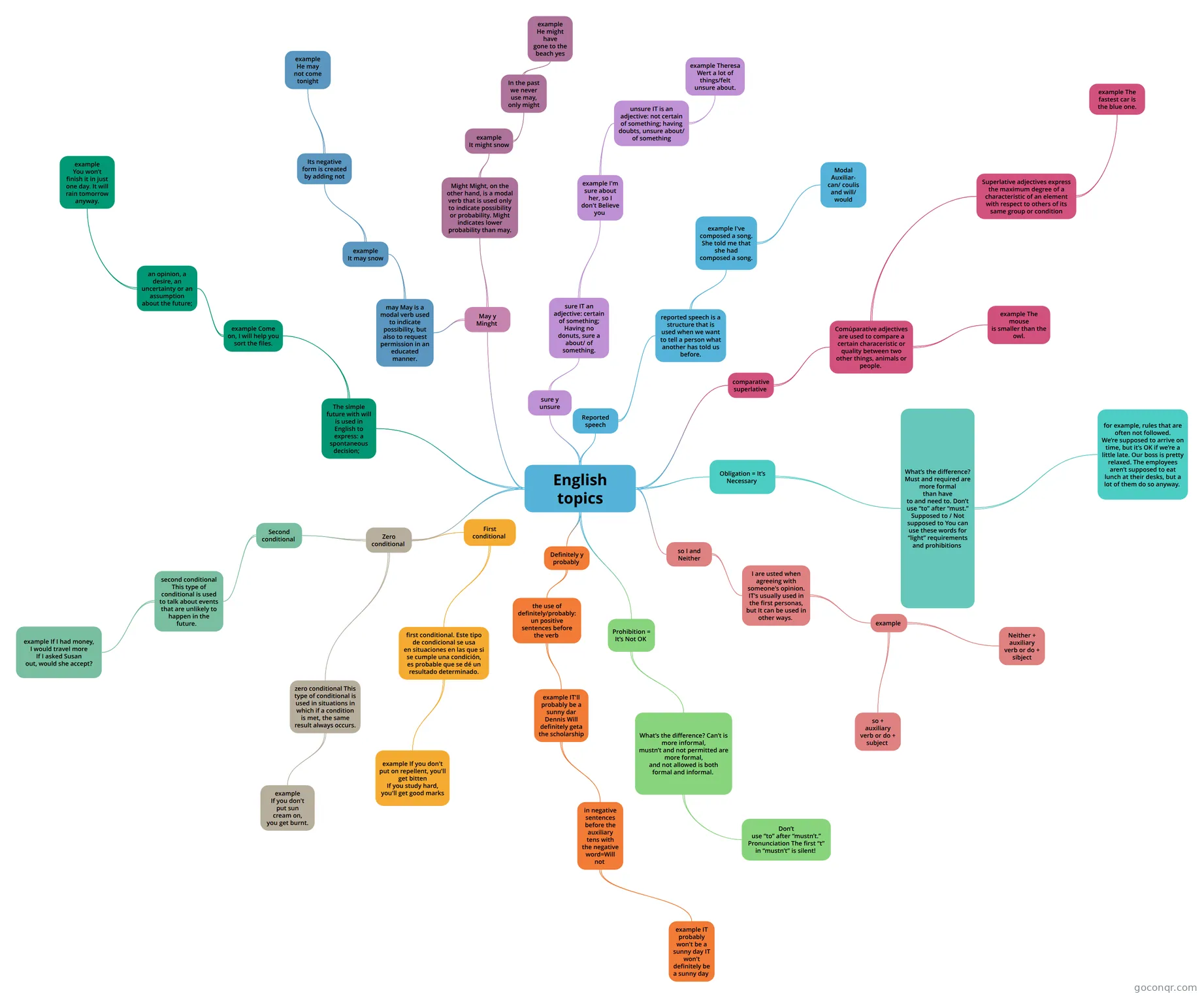
Mapa mental: temas de inglés
Conteúdo do mapa
English topics
Obligation = It’s Necessary
- English words used for obligation: have to need to must required
- What’s the difference? Must and required are more formal than have to and need to. Don’t use “to” after “must.” Supposed to / Not supposed to You can use these words for “light” requirements and prohibitions
- English words used for obligation: have to need to must required
- for example, rules that are often not followed. We’re supposed to arrive on time, but it’s OK if we’re a little late. Our boss is pretty relaxed. The employees aren’t supposed to eat lunch at their desks, but a lot of them do so anyway.
Prohibition = It’s Not OK
- What’s the difference? Can’t is more informal, mustn’t and not permitted are more formal, and not allowed is both formal and informal.
- Don’t use “to” after “mustn’t.” Pronunciation The first “t” in “mustn’t” is silent!
- What’s the difference? Can’t is more informal, mustn’t and not permitted are more formal, and not allowed is both formal and informal.
The simple future with will is used in English to express: a spontaneous decision;
- example Come on, I will help you sort the files.
- an opinion, a desire, an uncertainty or an assumption about the future;
- example You won’t finish it in just one day. It will rain tomorrow anyway.
- an opinion, a desire, an uncertainty or an assumption about the future;
- example Come on, I will help you sort the files.
comparative superlative
- Comúparative adjectives are used to compare a certain characeristic or quality between two other things, animals or people.
- example The mouse is smaller than the owl.
- Superlative adjectives express the maximum degree of a characteristic of an element with respect to others of its same group or condition
- example The fastest car is the blue one.
- Comúparative adjectives are used to compare a certain characeristic or quality between two other things, animals or people.
Definitely y probably
- the use of definitely/probably: un positive sentences before the verb
- example IT'll probably be a sunny dar Dennis Will definitely geta the scholarship
- in negative sentences before the auxiliary tens with the negative word=Will not
- example IT probably won't be a sunny day IT won't definitely be a sunny day
- in negative sentences before the auxiliary tens with the negative word=Will not
- example IT'll probably be a sunny dar Dennis Will definitely geta the scholarship
- the use of definitely/probably: un positive sentences before the verb
sure y unsure
- sure IT an adjective: certain of something; Having no donuts, sure a about/ of something.
- example I'm sure about her, so I don't Believe you
- unsure IT is an adjective: not certain of something; having doubts, unsure about/ of something
- example Theresa Wert a lot of things/felt unsure about.
- unsure IT is an adjective: not certain of something; having doubts, unsure about/ of something
- example I'm sure about her, so I don't Believe you
- sure IT an adjective: certain of something; Having no donuts, sure a about/ of something.
May y Minght
- may May is a modal verb used to indicate possibility, but also to request permission in an educated manner.
- example It may snow
- Its negative form is created by adding not
- example He may not come tonight
- Its negative form is created by adding not
- example It may snow
- Might Might, on the other hand, is a modal verb that is used only to indicate possibility or probability. Might indicates lower probability than may.
- example It might snow
- In the past we never use may, only might
- example He might have gone to the beach yes
- In the past we never use may, only might
- example It might snow
- may May is a modal verb used to indicate possibility, but also to request permission in an educated manner.
Zero conditional
- zero conditional This type of conditional is used in situations in which if a condition is met, the same result always occurs.
- example If you don't put sun cream on, you get burnt.
- First conditional
- first conditional. Este tipo de condicional se usa en situaciones en las que si se cumple una condición, es probable que se dé un resultado determinado.
- example If you don't put on repellent, you'll get bitten If you study hard, you'll get good marks
- first conditional. Este tipo de condicional se usa en situaciones en las que si se cumple una condición, es probable que se dé un resultado determinado.
- Second conditional
- second conditional This type of conditional is used to talk about events that are unlikely to happen in the future.
- example If I had money, I would travel more If I asked Susan out, would she accept?
- second conditional This type of conditional is used to talk about events that are unlikely to happen in the future.
- zero conditional This type of conditional is used in situations in which if a condition is met, the same result always occurs.
so I and Neither
- I are usted when agreeing with someone's opinion. IT's usually used in the first personas, but It can be used in other ways.
- example
- so + auxiliary verb or do + subject
- Neither + auxiliary verb or do + sibject
- example
- I are usted when agreeing with someone's opinion. IT's usually used in the first personas, but It can be used in other ways.
Reported speech
- reported speech is a structure that is used when we want to tell a person what another has told us before.
- example I've composed a song. She told me that she had composed a song.
- Modal Auxiliar- can/ coulis and will/ would
- example I've composed a song. She told me that she had composed a song.
- reported speech is a structure that is used when we want to tell a person what another has told us before.
Informações
- Descrição
- Mapa Mental en English topics, creado por Lizbeth Garcia en 21/05/2019.
- Criado por
- Lizbeth Garcia
- Visualizações
- 9
- Avaliação