
Mapa mental
Chapter 1: Introduction
Conteúdo do mapa
Chapter 1: Introduction
What is Macroeconomics?
- Large questions + issues faced by many people and nations
- Ues economic models
- based on microeconomic principles
- focuses on long-run growth and business cycles
- Long-run growth is the increase in a nation's productive capacity and the average standard of living over a long time
- Business cycles are the short-run ups and downs/booms and recessions in aggregate economic activity
GDP, Economic Growth, Business Cycles
- GDP is the quantity of goods and services produced within a country's borders during some specified period of time.
- quantity of income earned by those contributing to domestic output
- fluctuations in economic growth are business cycles
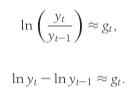
- Natural log is used to calculate growth rate
- This is the slope of the graph AKA the growth rate of time series
- difference between ln real GDP/capita and ln of actual real GDP/capital is business cycle
- economic models must be simple but useful
- structure of an economic model describes specific things
- consumers and firms interacting in economy
- set of goods consumers wish to consume
- consumers' preference over goods
- technology available to firms for producing goods
- resources available
- models must be used to make predictions
- consumers and firms goals? to optimize
- how is consistency achieved? equilibrium
- competitive equilibrium: goods are bought and sold in markets where consumers are price-takers
- run experiments to see if they are consistent and then use them for experiments
- structure of an economic model describes specific things
- GDP is the quantity of goods and services produced within a country's borders during some specified period of time.
Microeconomic priniciples
- macro behavior is the sum of micro decisions
- adding more micro to macro generally more agreed upon in 1970s
- rational expectations revolution / Lucas critique 1976
- macro behavior is the sum of micro decisions
Disagreement in macroeconomicss
- Solow and endogenous growth models generally accepted
- Disagreement about business cycles + role of govt
- Keynesian
- Old Keynesian models
- wages/prices sticky in short run + do not change quickly enough for sufficient outcomes
- monetary and fiscal policy can fix inefficiencies in private markets
- coordination thought
- stuck in bad equilibrium because economic agents are self-fulfillingly pessimistic
- New Keynesian
- sticky wages/prices BUT use micro tools
- Old Keynesian models
- Non-Keynesian
- real business cycle theory brought by RER
- govt policy to smooth business cycles is ineffective/detrimental
- real business cycle theory brought by RER
- Keynesian
what do we learn from macroeconomic analysis
- what is produced and consumed is determined by both economic productive capacity and consumers' preferences
- free market economies - strong forces that produce socially efficient economic outcomes
- unemployment is painful but necessary for modern economy
- improving standard of living is by long run tech advancement
- tax cut is not a free lunch
- govt will have to borrow more to pay of debt to keep spending constant so taxes in future will be higher
- credit markets/banks play key roles
- consumers and firms' future anticipation affects current events
- Society is better with money than without it,
- once we have money changing the quantity doesn't matter
- business cycles are similar but can have many causes
- trading can be good but also a shock to domestic economy
- inflation is caused by growth in money supply
- there is no long-run trade of between aggregate output and inflation
- Philips Curve
- Unstable + no long-run impact
- Philips Curve
Understanding recent and current macroeconomic events
- Aggregate productivity
- average labor productivity
- {Y (aggregate output)/ N (employment)}
- determines growth in loving standards in long-run
- late 60s to early 80s = productivity slowdown
- two reasons for this
- measuring problem
- adjustment period for adoption of new technology
- two reasons for this
- average labor productivity
- unemployment and vacancies
- socially useful search activity
- efficiently searching firms and workers are matched
- determined by productivity, govt provided unemployment insurance, matching efficiency
- Beveridge curve
- socially useful search activity
- Taxes, govt spending, govt deficit
- Increased govt spending = crowding out private economic activity
- govt competes for resources with rest of economy
- reduction in spending and consumption in private firms
- Difference between taxes and spending = total govt surplus/saving
- negative govt surplus = govt. deficit
- debt we owe ourselves
- redistribution of tax burden
- Ricardian equivalence theorem = no consequences to deficit
- negative govt surplus = govt. deficit
- Increased govt spending = crowding out private economic activity
- Inflation
- rate of change in the average level of prices
- explained in long run by growth supply of money
- long-run inflation is costly
- reduces employment, output, consumption
- controlled by central bank
- rate of change in the average level of prices
- Interest rates
- affect private economic decisions
- how much consumers borrow/lend
- how much firms invest
- nominal interest rate
- interest rate in money terms of 91-day US Treasury Bills
- rises and falls with inflation rate
- real interest rate
- = nominal interest rate - rate of inflation
- fluctuates a lot over time
- affect private economic decisions
- Business cycles in the US
- deviations from trend in aggregate economic activity
- recessions have many reasons
- increase in price of energy
- depleting optimism
- monetary policy
- Credit Markets and the Financial Crisis
- 2008 caused by credit marker "frictions"
- Asymmetric info
- good borrowers affected due to default premium
- should have checked credit-worthiness
- limited commitment
- borrower's lack of incentive to pay in credit market
- post collateral
- Asymmetric info
- 2008 caused by credit marker "frictions"
- current account surplus
- measure of balance of trade
- net exports of goods/services + net factor payments
- when negative = current account deficit
- goods/services bought from abroad by domestic > goods bought by domestic from domestic
- not necessarily bad
- smooth aggregate consumption
- finance additions to productive capacity for higher future standard of living
- influenced by govt spending, and domestic and foreign income
- measure of balance of trade
- Aggregate productivity