
Mapa mental
Local motor control
Conteúdo do mapa
Local motor control
Motor neurones: many muscle fibres. Smallest neurones innervating the tonic and fatigable muscle fibres, recruited first.
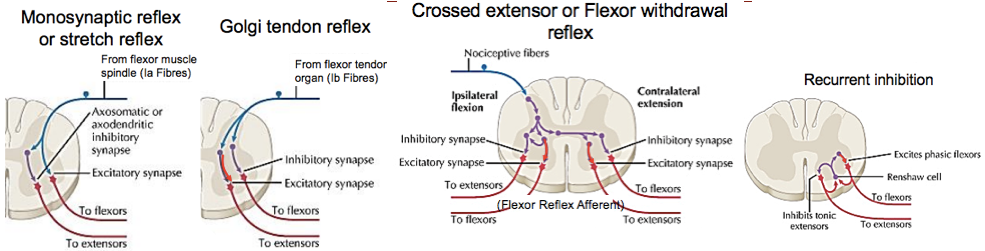
- Renshaw cell: lateral inhibition, discourage synchronization.
- Somatotopic organisation: Medial neurones innervate trunk. Lateral n innervate distal limbs. Flexors and extensors governed by dorsal & ventral groups.
- =Mechanism: withdrawal or flexion reflex: rapid flexion when skin touched by hot object/ noxious stimulus.
Descending Pathways
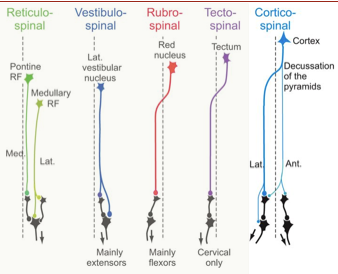
- Reticular formation: extrapyramidal tract, direct contact with MN. Located in Sc. Stretches from: superior cervical SC intralaminar thalamic nuclei. Dendritic fields perpendicular to axis of brainstem: isodendritic core receive collaterals from sensory fibres. 3 zones: raphe, medial & lateral. Level activity & gen rhythm.
- Clinical aspects: reduced conscious states, cushing reflex & abnormal respiratory patterns.
- Project cerebellum & BG.
- Vestibular nuclei: movement head & gravity, lateral vestibulospina- uncrossed, end interneurons, excite monosynaptically.
- Medial tract exists: bilaterally from medial VNcervical and upper thoracic regions.
- Maintain posture, control extensors.
- Red nucleus: rubrospinal. Flexion.
- Superior colliculus: Tectospinal, vision & hearing, spier reflex.
- Corticospinal: cerebral cortex, 80% cross in the medulla, descend as lateral CST, uncrossed become anterior. 30% white matter. Internal capsule- site of ischaemic stroke= paralysis. Fine, skilled voluntary movements.
- SC isolated from brain=
- flaccid paralysis: loss voluntary movements and muscle tone.
- below cerebral cortex: spasticity: resistance to passive stretch.
- level of colliculi- rigidity: hyperactive= rigid
- Reticular formation: extrapyramidal tract, direct contact with MN. Located in Sc. Stretches from: superior cervical SC intralaminar thalamic nuclei. Dendritic fields perpendicular to axis of brainstem: isodendritic core receive collaterals from sensory fibres. 3 zones: raphe, medial & lateral. Level activity & gen rhythm.
Sensory feedback from muscles
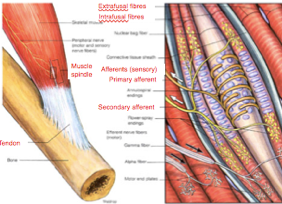
- Proprioception: sense of oneself in space muscles & joints. Exteroception: sense of external world. >Proprioceptive feedback: Primary 1a from spindle (direct input onto MN), Golgi 1b detect stretch & contraction.
- Sensory receptors in muscle
- Golgi tendon: Force transducer, clasp-knife reflex- transduce loading of muscle. 1b afferents. –ve feedback to reg tension.
- Muscle spindles: Muscle length, modified y-efferent fibres to intrafusal fibres. parallel to muscle fibres= regulation of muscle contraction and matches F gen to motor task.
- Proprioceptive afferents (in joint capsules): protect & respond extreme flexion & extension- 1 limb extended other positioned similarly.= if disturbed= reposition to inappropriate location.
- Sensory input: 1a sense stretch.
- Spindle reflex: 1a afferents monosynaptically excite MN= reflex arc. Normal people response feeble, in patients the contraction is ^.
- Muscle Tone: Spindles maintain the attitude of the body against forces of gravity. A innervate extrafusal and y innervate intrafusal.
- Simple Servo hypothesis: Sensory endings: difference between amount of y activity & shortness of muscle- spindle is comparator generator
- Load: Controlling manipulation: feedforward to predict and regulate output. If load increases the cerebellum would need to constantly monitor and review the situation- instead decided position.
- Servoassistance: 1. Positon command- tells muscle via y & spindles what the length is meant to be. 2. Force command: estimate of load. Spindles= stretch reflex to correct the response & modify ballistic programs for future.
- Load: Controlling manipulation: feedforward to predict and regulate output. If load increases the cerebellum would need to constantly monitor and review the situation- instead decided position.
Imagens e arquivos do mapa
Informações
- Descrição
- Local motor control
- Criado por
- NAGIREDDYGARI HARSHAREDDY
- Visualizações
- 5
- Histórico
-
- Criado por Jessica Law · 3 jan 2017
- Copiado por NAGIREDDYGARI HARSHAREDDY · 26 mai 2020
- Avaliação
Mais sobre Spinal Motor Circuits and Reflexes