
Mapa mental
Physics P1
Conteúdo do mapa
Physics P1
Transferring energy
- Colours
- Dark/Matt - Good radiation emitter and absorber
- Light/Shiny - Bad radiation emitter and absorber
- Methods
- Conduction - When particles in a solid vibrate and collide
- Convection - When particles in al liguid or gas are given more energy, they spread out so the hot material rises
- Radiation - All particles emit infra-red radiation
- Evaporation - When a liquid gains more energy and escapes as a gas (Increased by temperatur, surface area and wind)
- Condensation - When a gas loses energy it returns to a liquid
- U-Values
- They tell us how much heat passes through a material. Lower=Less heat
- Energy loss(J) = U-value(W/M^2/°C) x Area(M^2) x Temperature difference(°C)
- Specific Heat Capacity
- How much energy is require to raise the temperature of an object by 1°C
- Energy(J) = Mass(Kg) x SHC(J/Kg°C) x Temperature change(°C)
- Colours
Energy efficiency
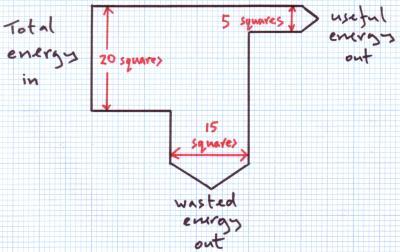
- Energy cannot be created or destroyed only transferred.
- We use sankey diagrams to represent energy efficiency
Electricity
- Cost
- We need to know the energy transferred in a given time
- Energy transferred(J) = Power(W) x Time(S)
- We also need to know kilowatt-hours
- Energy transferred(KWH) = Power(KW) x Time(H)
- 1 Watt = 1 Joule/Second
- We need to know the energy transferred in a given time
- Generating Electrcity
- Non-Renewable
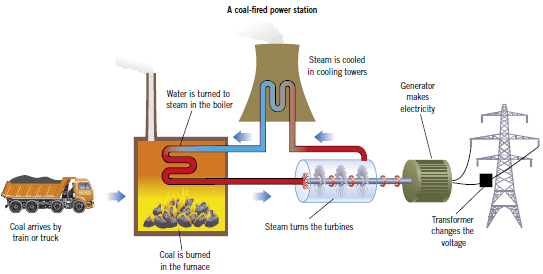
- Fossil fuels (Coal, oil, gas)
- Nuclear fission (The splitting of atoms)
- Renewable
- Wind - Turbines drive generators. Many are required and the wind is unreliable but the turbines require very little maintenance
- Hydroelectric - Falling water from rivers or reservoirs turn turbines. it is reliable but dams are expensive to construct
- Tidal - Seawater is trapped at high tide and then at low tide it is released which drives turbines. It is reliable but barrages are expensive to construct
- Waves - The rise/fall of waves drives turbines but it is unpredictable and very rarely used
- Geothermal - Water is superheated underground into steam which on the surface drives turbines. It is reliable but there are limited areas of use e.g. Iceland
- Solar cell - They turn sunlight into energy. They are expensive and only convert 20% of the Sun's energy. They only work when the sun is visisble
- Non-Renewable
- The national grid
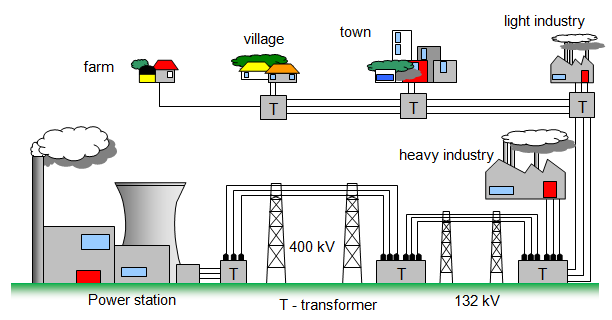
- When energy travels along a wire some disspates. Increasing the voltage reduces the energy lost. Transformers are use to in crease/decrease the voltage
- Cost
Waves
- Types
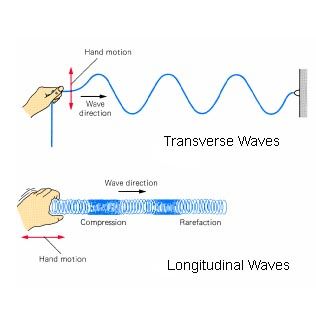
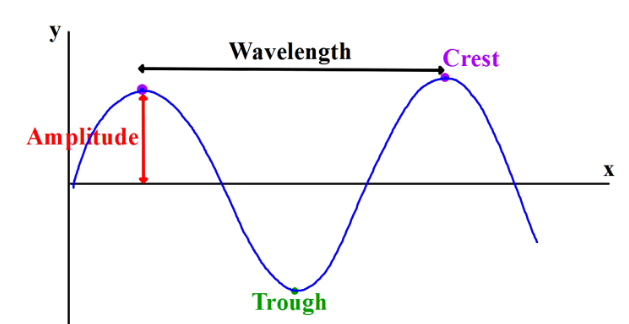
- Transverse - The oscillations are at aright angle to the direction of travel and energy transfer
- Longitudinal - The oscillations are in the same direction as the travel and energy transfer
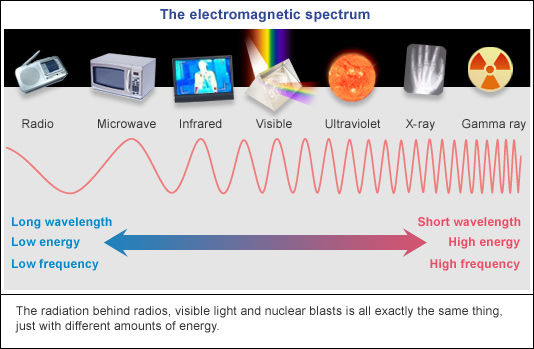
- Electromagnetic
- All these transverse waves travel at the same speed in a vacuum and form a continuous spectrum
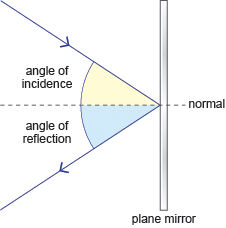
- Reflection - When a wave bounces off an interface between two materials. The wave changes direction but doesn't cross the interface
- Refraction - When a wave crosses an interface between two materials. The wave changes direction unless the rays hit the interface at right angles
- Diffraction - When waves pass through a gap or over an obstacle that is similar in size to the wavelength of the wave. The wave spreads out through the gap
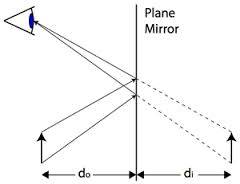
- Mirrors
- The angle of incidence is equal to the angle of reflection
- Types
The Universe
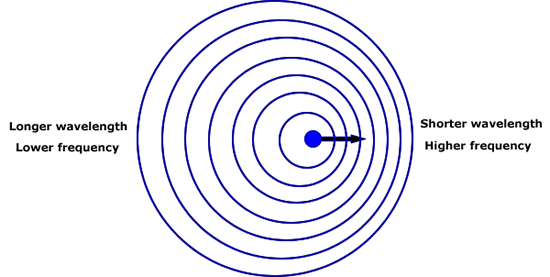
- Doppler Effect
- If a source is moving towards us we hear a high-pitched sound
- Because Waves in front of a source become squashed so frequency increases and wavelength decreases
- If the source is moving away from us we hear a low-pitched sound
- Because waves behind a source become stretched so frequency decreases and wavelength increases
- If a source is moving towards us we hear a high-pitched sound
- Expanding
- Red-Shift
- When objects have longer wavelengths they move to the red end of the electromagnetic spectrum so therefore if we see more red the object is moving away from us
- This used as evidence as for the big bang (expansion from a single point)
- Cosmic Microwave Background Radiation (CMBR)
- Is found throughout the universe and shows how the wavelengths have increased over time
- Red-Shift
- Doppler Effect
Imagens e arquivos do mapa
Informações
- Descrição
- Mapa Mental sobre Physics P1, criado por miles.a.moran em 22-03-2015.
- Criado por
- miles.a.moran
- Visualizações
- 71
- Tags
- Avaliação