
Mapa mental
Study Plans
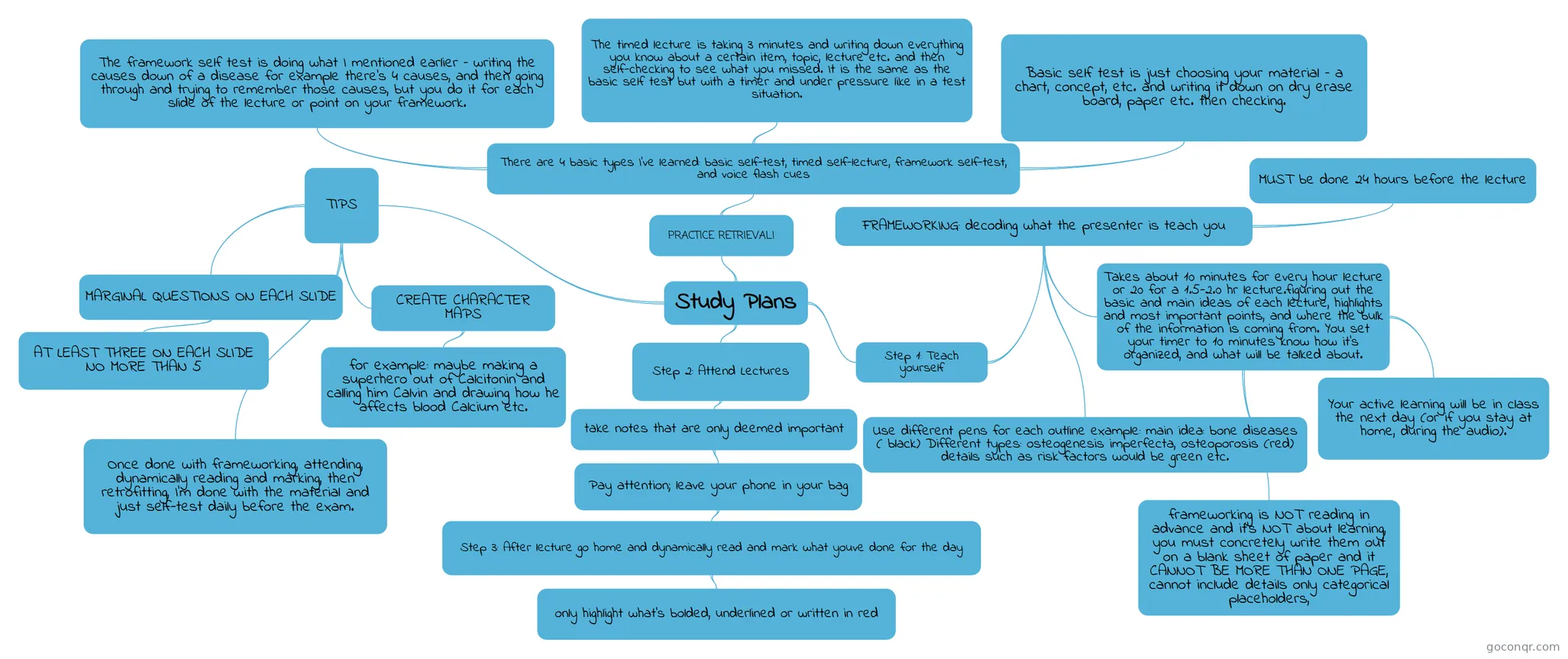
Mind map: study plans
Conteúdo do mapa
Study Plans
Step 1: Teach yourself
- FRAMEWORKING: decoding what the presenter is teach you
- Takes about 10 minutes for every hour lecture or 20 for a 1.5-2.0 hr lecture.figuring out the basic and main ideas of each lecture, highlights and most important points, and where the bulk of the information is coming from. You set your timer to 10 minutes know how it’s organized, and what will be talked about.
- Your active learning will be in class the next day (or if you stay at home, during the audio).
- frameworking is NOT reading in advance and it’s NOT about learning, you must concretely write them out on a blank sheet of paper and it CANNOT BE MORE THAN ONE PAGE, cannot include details only categorical placeholders,
- Use different pens for each outline example: main idea: bone diseases ( black) Different types: osteogenesis imperfecta, osteoporosis (red) details such as risk factors would be green etc.
- MUST be done 24 hours before the lecture
- Takes about 10 minutes for every hour lecture or 20 for a 1.5-2.0 hr lecture.figuring out the basic and main ideas of each lecture, highlights and most important points, and where the bulk of the information is coming from. You set your timer to 10 minutes know how it’s organized, and what will be talked about.
- FRAMEWORKING: decoding what the presenter is teach you
Step 2: Attend Lectures
- take notes that are only deemed important
- Pay attention; leave your phone in your bag
- Step 3: After lecture go home and dynamically read and mark what youve done for the day
- only highlight what's bolded, underlined or written in red
- Step 3: After lecture go home and dynamically read and mark what youve done for the day
- Pay attention; leave your phone in your bag
- take notes that are only deemed important
TIPS
- MARGINAL QUESTIONS ON EACH SLIDE
- AT LEAST THREE ON EACH SLIDE NO MORE THAN 5
- CREATE CHARACTER MAPS
- for example: maybe making a superhero out of Calcitonin and calling him Calvin and drawing how he affects blood Calcium etc.
- Once done with frameworking, attending, dynamically reading and marking, then retrofitting, I’m done with the material and just self-test daily before the exam.
- MARGINAL QUESTIONS ON EACH SLIDE
PRACTICE RETRIEVAL!
- There are 4 basic types I’ve learned: basic self-test, timed self-lecture, framework self-test, and voice flash cues
- Basic self test is just choosing your material – a chart, concept, etc. and writing it down on dry erase board, paper etc. then checking.
- The timed lecture is taking 3 minutes and writing down everything you know about a certain item, topic, lecture etc. and then self-checking to see what you missed. It is the same as the basic self test but with a timer and under pressure like in a test situation.
- The framework self test is doing what I mentioned earlier – writing the causes down of a disease for example there’s 4 causes, and then going through and trying to remember those causes, but you do it for each slide of the lecture or point on your framework.
- There are 4 basic types I’ve learned: basic self-test, timed self-lecture, framework self-test, and voice flash cues
Informações
- Descrição
- How to study efficiently
- Criado por
- keithlycuaresma
- Visualizações
- 405
- Tags
- Avaliação