
Mapa mental
Tariff Wars and Supply Chains
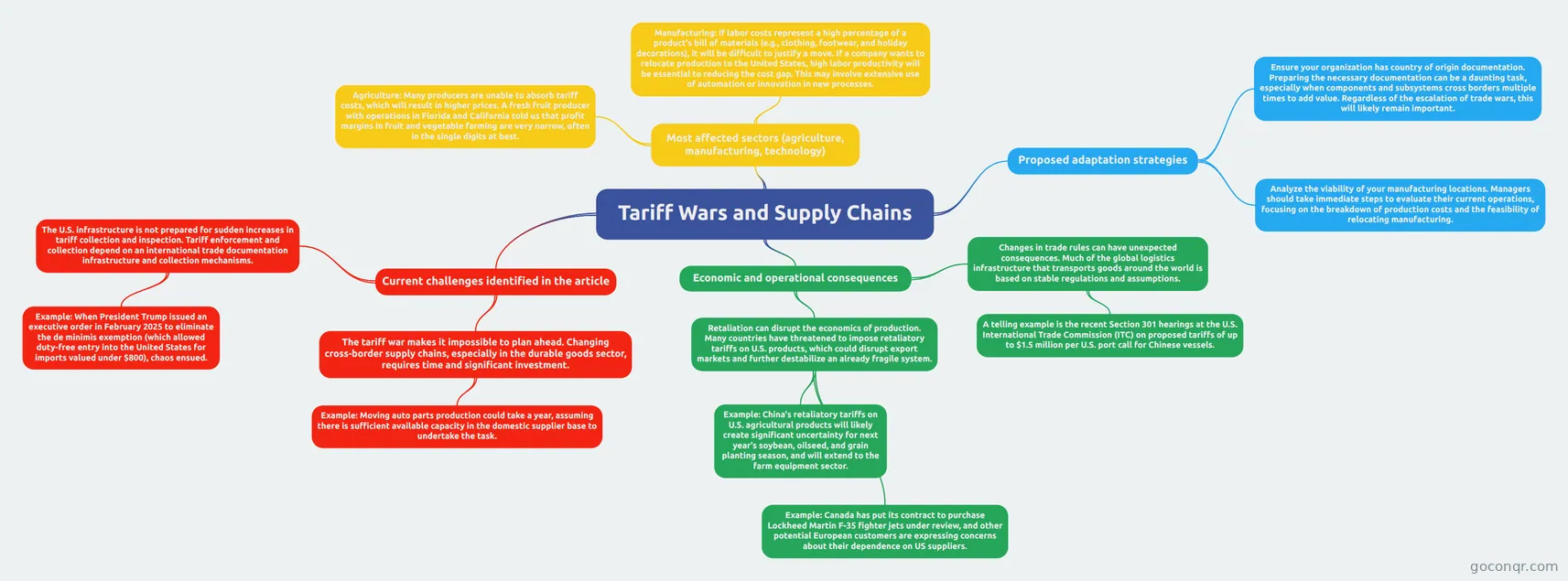
Mind map: Tariff wars and supply chains
Conteúdo do mapa
Tariff Wars and Supply Chains
Current challenges identified in the article
- The tariff war makes it impossible to plan ahead. Changing cross-border supply chains, especially in the durable goods sector, requires time and significant investment.
- Example: Moving auto parts production could take a year, assuming there is sufficient available capacity in the domestic supplier base to undertake the task.
- The U.S. infrastructure is not prepared for sudden increases in tariff collection and inspection. Tariff enforcement and collection depend on an international trade documentation infrastructure and collection mechanisms.
- Example: When President Trump issued an executive order in February 2025 to eliminate the de minimis exemption (which allowed duty-free entry into the United States for imports valued under $800), chaos ensued.
- The tariff war makes it impossible to plan ahead. Changing cross-border supply chains, especially in the durable goods sector, requires time and significant investment.
Economic and operational consequences
- Retaliation can disrupt the economics of production. Many countries have threatened to impose retaliatory tariffs on U.S. products, which could disrupt export markets and further destabilize an already fragile system.
- Example: China's retaliatory tariffs on U.S. agricultural products will likely create significant uncertainty for next year's soybean, oilseed, and grain planting season, and will extend to the farm equipment sector.
- Example: Canada has put its contract to purchase Lockheed Martin F-35 fighter jets under review, and other potential European customers are expressing concerns about their dependence on US suppliers.
- Changes in trade rules can have unexpected consequences. Much of the global logistics infrastructure that transports goods around the world is based on stable regulations and assumptions.
- A telling example is the recent Section 301 hearings at the U.S. International Trade Commission (ITC) on proposed tariffs of up to $1.5 million per U.S. port call for Chinese vessels.
- Retaliation can disrupt the economics of production. Many countries have threatened to impose retaliatory tariffs on U.S. products, which could disrupt export markets and further destabilize an already fragile system.
Most affected sectors (agriculture, manufacturing, technology)
- Agriculture: Many producers are unable to absorb tariff costs, which will result in higher prices. A fresh fruit producer with operations in Florida and California told us that profit margins in fruit and vegetable farming are very narrow, often in the single digits at best.
- Manufacturing: If labor costs represent a high percentage of a product's bill of materials (e.g., clothing, footwear, and holiday decorations), it will be difficult to justify a move. If a company wants to relocate production to the United States, high labor productivity will be essential to reducing the cost gap. This may involve extensive use of automation or innovation in new processes.
Proposed adaptation strategies
- Ensure your organization has country of origin documentation. Preparing the necessary documentation can be a daunting task, especially when components and subsystems cross borders multiple times to add value. Regardless of the escalation of trade wars, this will likely remain important.
- Analyze the viability of your manufacturing locations. Managers should take immediate steps to evaluate their current operations, focusing on the breakdown of production costs and the feasibility of relocating manufacturing.
Informações
- Descrição
- Mapa Mental sobre Tariff Wars and Supply Chains, criado por Jose Samuel Trivinos Diaz em 05-07-2020.
- Criado por
- Jose Samuel Trivinos Diaz
- Visualizações
- 20
- Avaliação