
Mapa mental
Sonnet 43
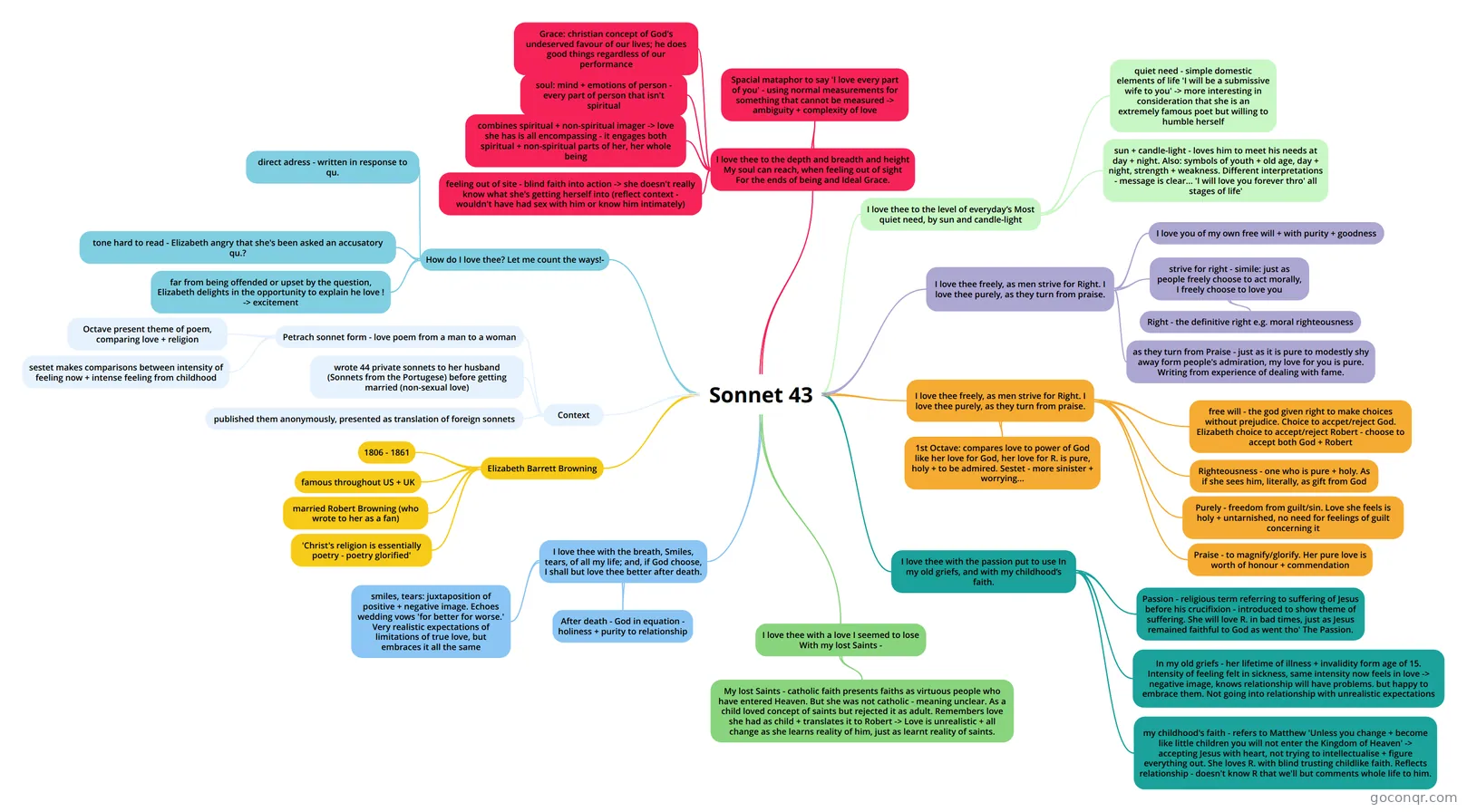
Mind map: Sonnet 43 Elizabeth Barrett Browning
Conteúdo do mapa
Sonnet 43
I love thee to the depth and breadth and height My soul can reach, when feeling out of sight For the ends of being and Ideal Grace.
- soul: mind + emotions of person - every part of person that isn't spiritual
- Grace: christian concept of God's undeserved favour of our lives; he does good things regardless of our performance
- combines spiritual + non-spiritual imager -> love she has is all encompassing - it engages both spiritual + non-spiritual parts of her, her whole being
- Spacial mataphor to say 'I love every part of you' - using normal measurements for something that cannot be measured -> ambiguity + complexity of love
- feeling out of site - blind faith into action -> she doesn't really know what she's getting herself into (reflect context - wouldn't have had sex with him or know him intimately)
Context
- Petrach sonnet form - love poem from a man to a woman
- Octave present theme of poem, comparing love + religion
- sestet makes comparisons between intensity of feeling now + intense feeling from childhood
- wrote 44 private sonnets to her husband (Sonnets from the Portugese) before getting married (non-sexual love)
- published them anonymously, presented as translation of foreign sonnets
- Petrach sonnet form - love poem from a man to a woman
I love thee freely, as men strive for Right. I love thee purely, as they turn from praise.
- I love you of my own free will + with purity + goodness
- strive for right - simile: just as people freely choose to act morally, I freely choose to love you
- Right - the definitive right e.g. moral righteousness
- as they turn from Praise - just as it is pure to modestly shy away form people's admiration, my love for you is pure. Writing from experience of dealing with fame.
I love thee with a love I seemed to lose With my lost Saints -
- My lost Saints - catholic faith presents faiths as virtuous people who have entered Heaven. But she was not catholic - meaning unclear. As a child loved concept of saints but rejected it as adult. Remembers love she had as child + translates it to Robert -> Love is unrealistic + all change as she learns reality of him, just as learnt reality of saints.
I love thee freely, as men strive for Right. I love thee purely, as they turn from praise.
- free will - the god given right to make choices without prejudice. Choice to accpet/reject God. Elizabeth choice to accept/reject Robert - choose to accept both God + Robert
- Righteousness - one who is pure + holy. As if she sees him, literally, as gift from God
- Purely - freedom from guilt/sin. Love she feels is holy + untarnished, no need for feelings of guilt concerning it
- Praise - to magnify/glorify. Her pure love is worth of honour + commendation
- 1st Octave: compares love to power of God like her love for God, her love for R. is pure, holy + to be admired. Sestet - more sinister + worrying...
Elizabeth Barrett Browning
- 1806 - 1861
- famous throughout US + UK
- married Robert Browning (who wrote to her as a fan)
- 'Christ's religion is essentially poetry - poetry glorified'
I love thee with the breath, Smiles, tears, of all my life; and, if God choose, I shall but love thee better after death.
- smiles, tears: juxtaposition of positive + negative image. Echoes wedding vows 'for better for worse.' Very realistic expectations of limitations of true love, but embraces it all the same
- After death - God in equation - holiness + purity to relationship
I love thee with the passion put to use In my old griefs, and with my childhood’s faith.
- Passion - religious term referring to suffering of Jesus before his crucifixion - introduced to show theme of suffering. She will love R. in bad times, just as Jesus remained faithful to God as went tho' The Passion.
- In my old griefs - her lifetime of illness + invalidity form age of 15. Intensity of feeling felt in sickness, same intensity now feels in love -> negative image, knows relationship will have problems. but happy to embrace them. Not going into relationship with unrealistic expectations
- my childhood's faith - refers to Matthew 'Unless you change + become like little children you will not enter the Kingdom of Heaven' -> accepting Jesus with heart, not trying to intellectualise + figure everything out. She loves R. with blind trusting childlike faith. Reflects relationship - doesn't know R that we'll but comments whole life to him.
I love thee to the level of everyday’s Most quiet need, by sun and candle-light
- quiet need - simple domestic elements of life 'I will be a submissive wife to you' -> more interesting in consideration that she is an extremely famous poet but willing to humble herself
- sun + candle-light - loves him to meet his needs at day + night. Also: symbols of youth + old age, day + night, strength + weakness. Different interpretations - message is clear... 'I will love you forever thro' all stages of life'
How do I love thee? Let me count the ways!-
- direct adress - written in response to qu.
- far from being offended or upset by the question, Elizabeth delights in the opportunity to explain he love ! -> excitement
- tone hard to read - Elizabeth angry that she's been asked an accusatory qu.?
Informações
- Descrição
- AS - Level Poetry Mapa Mental sobre Sonnet 43, criado por Alice Love em 04-04-2015.
- Criado por
- Alice Love
- Visualizações
- 152
- Tags
- Avaliação