
Mapa mental
Jupiter (Outer Planet)
Conteúdo do mapa
Jupiter (Outer Planet)
Atmosphere
- Jupiter HAS an atmosphere
- Parallel, alternating light & dark bands = Clouds
- The Great Red Spot & smaller spots = Storms
- = contain 2~3 size of Earth
- Reddish colour by complex organic molecules - Red Phosphorous/another sulfur compound
- TGRS existed continuously for more than 300years
- Earth's storm only lasts several days
- somehow sustained by Jupiter's large-scale atmospheric motion
- the spot being "rolled" between 2 oppositely directed flows
- Composition
- (Molecular) Hydrogen = Most abundant gas
- followed by Helium
- Such abundance = direct consequence of the planet's strong gravity
- followed by Helium
- (Molecular) Hydrogen = Most abundant gas
- Clouds
- Rapid rotation caused the cloud to wrap all the way around the planet
- Forming bands parallel to equator
- light-coloured bands
- clouds at high altitude
- More exposed to the Sun
- Reflecting the sunlight
- More exposed to the Sun
- clouds at high altitude
- light-coloured bands
- Rotation of 9h50m
- Forming bands parallel to equator
- Composed of ammonia crystals & possibly ammonium hydrosulfide
- ammonia ice reflect sunlight effectively
- Orange & Brown colouration
- caused by upwelling compounds that change colour when they are exposed to UV light from the Sun
- Substances: believed to be P/S/hydrocarbons
- Rapid rotation caused the cloud to wrap all the way around the planet
- Jupiter HAS an atmosphere
Moons
- 67 known moons
- 4 largest moons
- Gallilean moons
- discovered by Galileo Galilei in 1610
- named after mythological lovers of Jupiter
- arranged in 1 line
- 1. Europa (nearest to Jupiter)
- surface composed of water ice
- Hypothesis that a water ocean exists beneath the surface
- conceivably serve as an abode for extraterrestrial life
- Hypothesis that a water ocean exists beneath the surface
- [Hypothesis] Heat from tidal flexing causes the ocean to remain liquid
- The surface's immense network of criss-crossing cracks serves as a record of the stresses caused by massive tides in the global ocean
- The surface must stretch to accommodate these changes
- Too much stress = it cracks
- The surface must stretch to accommodate these changes
- The surface's immense network of criss-crossing cracks serves as a record of the stresses caused by massive tides in the global ocean
- Water Plumes
- may be erupting off Europa's surface
- similar to the volcanic plumes erupting off Io's surface
- may be erupting off Europa's surface
- surface composed of water ice
- 2. Io
- Bright yellow
- from sulfur & molten silicate rock
- Active volcanoes
- Orbits very close to Jupiter
- Jupiter's huge gravitational force exerts strong tidal forces on Io
- In a (slightly) non-circular orbit, the enormous tidal stresses continually flex & squeeze Io's interior
- generate large amounts of heat w/i Io
- = Tidal Heating
- generate large amounts of heat w/i Io
- In a (slightly) non-circular orbit, the enormous tidal stresses continually flex & squeeze Io's interior
- Jupiter's huge gravitational force exerts strong tidal forces on Io
- Bright yellow
- 3. Ganymede
- Surface (Types of terrain)
- A. Lighter surface = enriched in water ice
- B. Dark regions = old terrain
- Might have ice & oceans stacked up in several layers
- Surface (Types of terrain)
- 4. Callisto
- Old surface
- one large ice-field laced with impact craters
- may also have a subsurface ocean of liquid water
- Old surface
- discovered by Galileo Galilei in 1610
- Gallilean moons
- Large, spherical
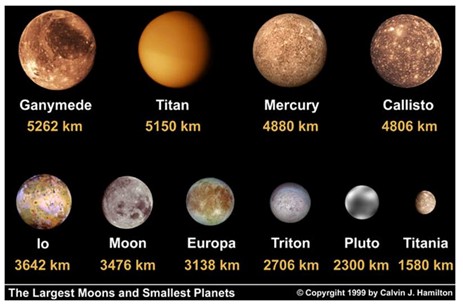
- Size: Ganymede > Callisto > Io > Earth Moon > Europa
- Small moons
- observed by robot spacecraft - Galileo
- Eg) Thebe, Amalthea & Metis
- composed of mostly ice & much smaller than Galilean Moons
- observed by robot spacecraft - Galileo
Imagens e arquivos do mapa
Informações
- Descrição
- Mapa Mental sobre Jupiter (Outer Planet), criado por hssue94712 em 11-04-2015.
- Criado por
- hssue94712
- Visualizações
- 2
- Avaliação