
Mapa mental
Saturn (Outer Planet)
Conteúdo do mapa
Saturn (Outer Planet)
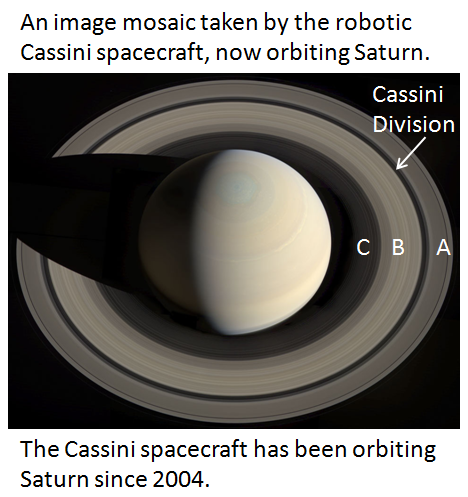
Ring system
- Brightest among all other outer planet's ring system
- Main rings
- A & B rings are separated by the Cassini Division
- Cassini Division
- populated by ring material bearing such similarity to the C Ring
- Cassini Division
- A &B rings are bright
- C ring is almost translucent
- A & B rings are separated by the Cassini Division
- Density waves
- Rings contain concentric regions of alternating high & low concentrations of ring particles
- induced by the gravitational perturbation of some nearby moons
- Ringlets = high-density peaks
- Rings contain concentric regions of alternating high & low concentrations of ring particles
- Thin ring plane
- rings are composed of a great no. of small water ice particles, all independently orbiting Saturn
- Water ice = prime constituent of the bright rings
- reflect sunlight effectively = appears bright
- Young rings
- brightness & purity of water ice in the rings
- Evidence: rings are much younger than Saturn
- about 150 mn years old
- Saturn formed 4.6bn y/a
- brightness & purity of water ice in the rings
Formation of the Rings
- [Theory] Icy moon of Saturn was hit by a comet & was destroyed
- Pieces of the moon then pursued their own individual orbits around Saturn
- eventually spreading all the way around it in the form of rings
- Pieces of the moon then pursued their own individual orbits around Saturn
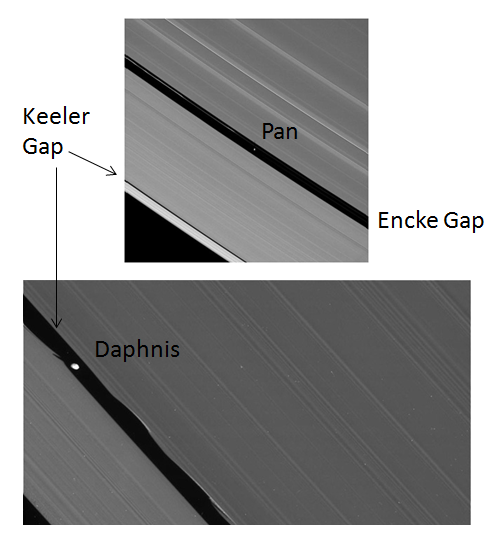
- Saturn's rings have numerous gaps where particle density drops sharply
- Pan & Daphnis are small moons orbitting w/i Encke Gap & Keeler Gap respectively in Saturn's A ring
- The gaps are thought to be kept clear by the gravitational action of the small moons
- such small moons can survive w/i the RL
- held tgt mostly by IMF not by gravity
- such small moons can survive w/i the RL
- The gaps are thought to be kept clear by the gravitational action of the small moons
- Pan & Daphnis are small moons orbitting w/i Encke Gap & Keeler Gap respectively in Saturn's A ring
- [Theory] Icy moon of Saturn was hit by a comet & was destroyed
Tidal Force
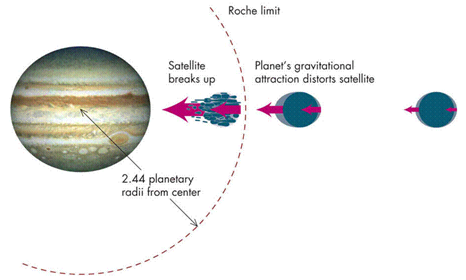
- Pieces that have not aggregated into a moon ever since cuz they lie w/i the Roche limit
- A planet's Roche Limit = 2.4 times the radius of the planet
- Inside the RL: Saturn's tidal force is strong enough to tear a moon apart
- => Prevent formation of any moon
- Roche Limit
- a moon is held tgt by its own gravity
- A planet's tidal force is to stretch a moon
- creating a tidal bulge
- The tidal for INCREASES with DECREASING distance from the planet
- A planet's tidal force is to stretch a moon
- [D] the critical distance inside of which the planet's tidal force becomes greater than the moon's internal gravitational force
- a moon is held tgt by its own gravity
- Inside the RL: Saturn's tidal force is strong enough to tear a moon apart
- A planet's Roche Limit = 2.4 times the radius of the planet
- Pieces that have not aggregated into a moon ever since cuz they lie w/i the Roche limit
Moons
- many known moons
- 53 of them have formal names
- 1. Large Moon
- Titan (only 1)
- 2nd largest moon in the solar system
- HAS an atmosphere
- thick, uniform layer of haze that envelops the moon
- completely obscures the spacecraft's view of its surface
- thicker & denser than Earth
- Atmosphere contains 10 times more gas than Earth's
- atmospheric pressure at ground level is 60% greater than on Earth
- far more substantial than any other moons
- mostly nitrogen (~90%) & argon (at most 10%) with a small % of methane
- thick, uniform layer of haze that envelops the moon
- Formation of atmosphere
- Titan formed at a considerably low temp, with water ice making up the bulk of its interior
- Water ice could absorb methane & ammonia that were present in abundance at those early times
- trapped gas -> forming thick ammonia atmos.
- Sunlight split NH3 into N & H
- H escaped into space
- N remained in the atmos.
- Sunlight split NH3 into N & H
- trapped gas -> forming thick ammonia atmos.
- Water ice could absorb methane & ammonia that were present in abundance at those early times
- Titan formed at a considerably low temp, with water ice making up the bulk of its interior
- Low Temp
- distance from the Sun is great
- Surface temp = 94K
- methane may behave rather like the water on Earth
- Liquid methane
- only object besides Earth for which has stable bodies of surface liquid
- Suggested that life can exist in liquid methane lakes (just as Earth's org live in water)
- only object besides Earth for which has stable bodies of surface liquid
- Liquid methane
- methane may behave rather like the water on Earth
- Surface temp = 94K
- distance from the Sun is great
- dense + opaque atmos = prevent observing its surface
- Cassini-Huygens Mission 2004
- orbiter & lander
- Radar Mapping & Direct Images
- Cassini Orbiter
- entered orbit around July 1, 2004
- radar image its surface during close fly-bys
- entered orbit around July 1, 2004
- Huygens lander reached Titan on Jan 13, 2005
- obtained the first direct images of Titan's surface
- photographed: pale hills with dark "rivers"
- periodically rains liquid methane & other dark organic cpd
- Cassini spacecraft discovered liquid HC lakes in its polar regions
- photographed: pale hills with dark "rivers"
- obtained the first direct images of Titan's surface
- Cassini Orbiter
- Cassini-Huygens Mission 2004
- Titan (only 1)
- 2. Medium Moons
- [Cassini SC] water-rich plumes venting from Enceladus' south polar region
- strong evidence that Enceladus has an ocean with an energy source
- Saturn has a diffuse E ring which lies beyond the main 3 rings
- Enceladus orbits in the densest part of the E ring
- released most of the material making up the E ring
- Enceladus orbits in the densest part of the E ring
- [Cassini SC] water-rich plumes venting from Enceladus' south polar region
- 3. Small Moons
- many small moons
- irregularly shaped chunks of ice
- Eg) Prometheus, Pandora
- aka "Shepherd Satellites"
- orbit on either side of Saturn's faint, narrow F ring
- Their gravitational influence on the F-ring particles keeps the ring tightly confined in its narrow orbit
- orbit on either side of Saturn's faint, narrow F ring
- aka "Shepherd Satellites"
- many small moons
- many known moons
Imagens e arquivos do mapa
Informações
- Descrição
- Mapa Mental sobre Saturn (Outer Planet), criado por hssue94712 em 11-04-2015.
- Criado por
- hssue94712
- Visualizações
- 0
- Avaliação