
Mapa mental
Education
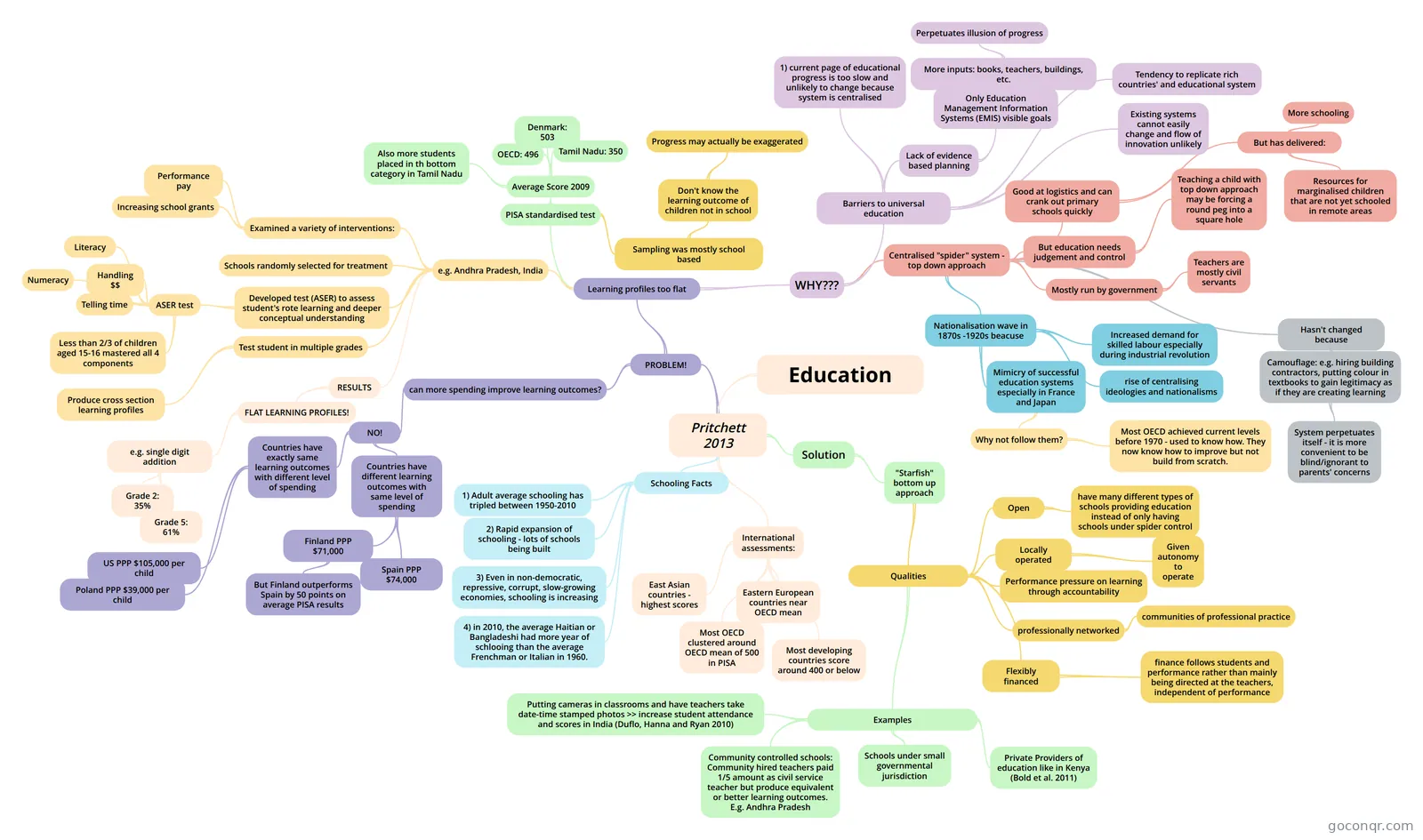
Mind map: Education
Conteúdo do mapa
Education
Pritchett 2013
- Schooling Facts
- 1) Adult average schooling has tripled between 1950-2010
- 2) Rapid expansion of schooling - lots of schools being built
- 3) Even in non-democratic, repressive, corrupt, slow-growing economies, schooling is increasing
- 4) in 2010, the average Haitian or Bangladeshi had more year of schlooing than the average Frenchman or Italian in 1960.
- PROBLEM!
- Learning profiles too flat
- e.g. Andhra Pradesh, India
- Examined a variety of interventions:
- Performance pay
- Increasing school grants
- Schools randomly selected for treatment
- Developed test (ASER) to assess student's rote learning and deeper conceptual understanding
- ASER test
- Literacy
- Numeracy
- Telling time
- Handling $$
- Less than 2/3 of children aged 15-16 mastered all 4 components
- ASER test
- Test student in multiple grades
- Produce cross section learning profiles
- RESULTS
- FLAT LEARNING PROFILES!
- e.g. single digit addition
- Grade 2: 35%
- Grade 5: 61%
- e.g. single digit addition
- FLAT LEARNING PROFILES!
- Examined a variety of interventions:
- PISA standardised test
- Average Score 2009
- OECD: 496
- Denmark: 503
- Tamil Nadu: 350
- Also more students placed in th bottom category in Tamil Nadu
- Sampling was mostly school based
- Don't know the learning outcome of children not in school
- Progress may actually be exaggerated
- Don't know the learning outcome of children not in school
- Average Score 2009
- WHY???
- Barriers to universal education
- 1) current page of educational progress is too slow and unlikely to change because system is centralised
- Lack of evidence based planning
- Only Education Management Information Systems (EMIS) visible goals
- More inputs: books, teachers, buildings, etc.
- Perpetuates illusion of progress
- More inputs: books, teachers, buildings, etc.
- Only Education Management Information Systems (EMIS) visible goals
- Tendency to replicate rich countries' and educational system
- Existing systems cannot easily change and flow of innovation unlikely
- Centralised "spider" system - top down approach
- Good at logistics and can crank out primary schools quickly
- But has delivered:
- More schooling
- Resources for marginalised children that are not yet schooled in remote areas
- But has delivered:
- But education needs judgement and control
- Teaching a child with top down approach may be forcing a round peg into a square hole
- Mostly run by government
- Teachers are mostly civil servants
- Nationalisation wave in 1870s -1920s beacuse
- Increased demand for skilled labour especially during industrial revolution
- rise of centralising ideologies and nationalisms
- Mimicry of successful education systems especially in France and Japan
- Why not follow them?
- Most OECD achieved current levels before 1970 - used to know how. They now know how to improve but not build from scratch.
- Why not follow them?
- Hasn't changed because
- Camouflage: e.g. hiring building contractors, putting colour in textbooks to gain legitimacy as if they are creating learning
- System perpetuates itself - it is more convenient to be blind/ignorant to parents' concerns
- Camouflage: e.g. hiring building contractors, putting colour in textbooks to gain legitimacy as if they are creating learning
- Good at logistics and can crank out primary schools quickly
- Barriers to universal education
- e.g. Andhra Pradesh, India
- can more spending improve learning outcomes?
- NO!
- Countries have exactly same learning outcomes with different level of spending
- US PPP $105,000 per child
- Poland PPP $39,000 per child
- Countries have different learning outcomes with same level of spending
- Finland PPP $71,000
- But Finland outperforms Spain by 50 points on average PISA results
- Spain PPP $74,000
- Finland PPP $71,000
- Countries have exactly same learning outcomes with different level of spending
- NO!
- Learning profiles too flat
- International assessments:
- East Asian countries - highest scores
- Most OECD clustered around OECD mean of 500 in PISA
- Eastern European countries near OECD mean
- Most developing countries score around 400 or below
- Solution
- "Starfish" bottom up approach
- Qualities
- Examples
- Community controlled schools: Community hired teachers paid 1/5 amount as civil service teacher but produce equivalent or better learning outcomes. E.g. Andhra Pradesh
- Private Providers of education like in Kenya (Bold et al. 2011)
- Schools under small governmental jurisdiction
- Putting cameras in classrooms and have teachers take date-time stamped photos >> increase student attendance and scores in India (Duflo, Hanna and Ryan 2010)
- Open
- have many different types of schools providing education instead of only having schools under spider control
- Locally operated
- Given autonomy to operate
- Performance pressure on learning through accountability
- professionally networked
- communities of professional practice
- Flexibly financed
- finance follows students and performance rather than mainly being directed at the teachers, independent of performance
- Examples
- Qualities
- "Starfish" bottom up approach
- Schooling Facts