
Mapa mental
ROMANTIC AGE (1760-1837)
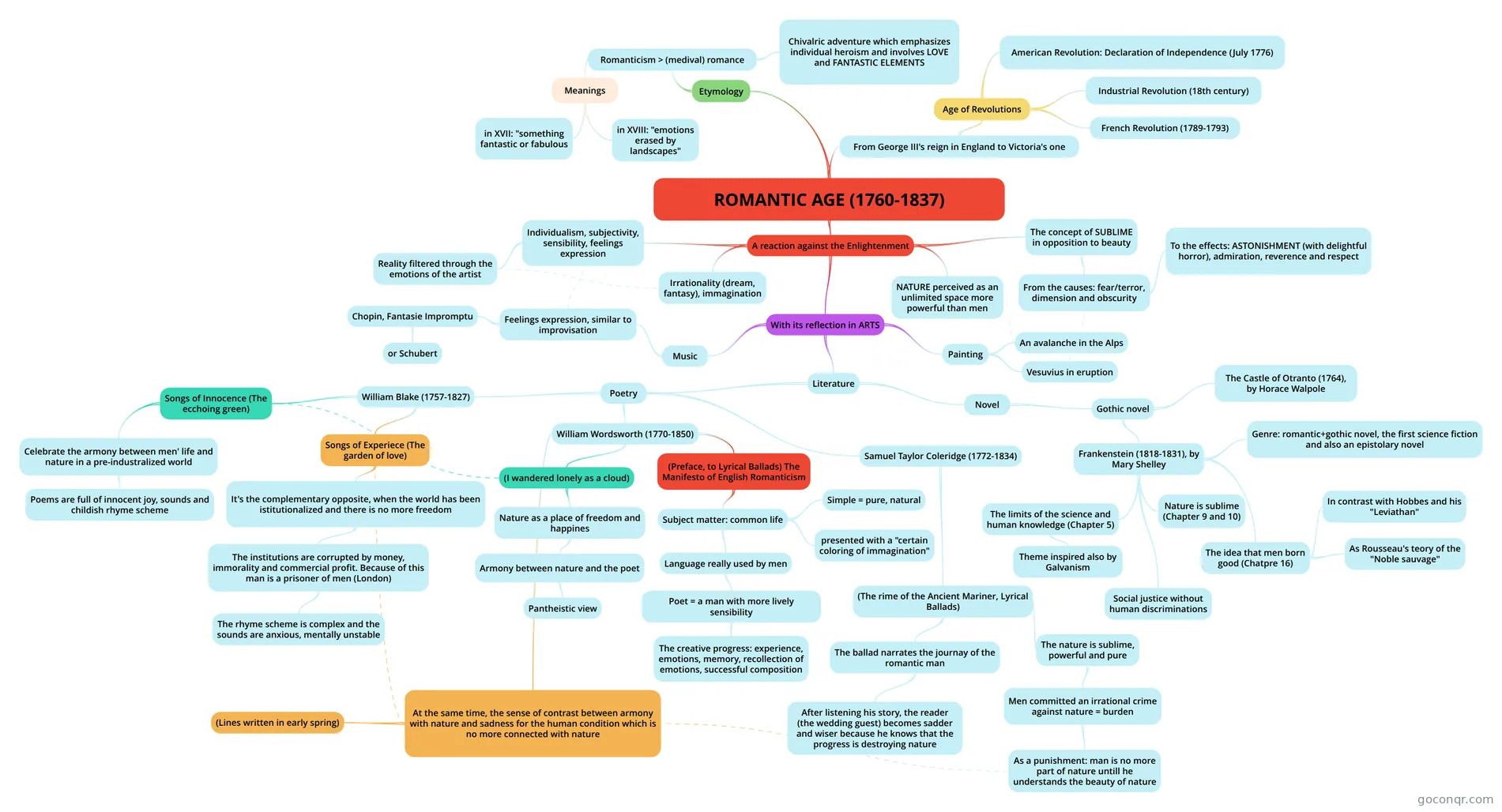
Mind map: Romantic Age and its Characteristics
Conteúdo do mapa
ROMANTIC AGE (1760-1837)
From George III's reign in England to Victoria's one
- Age of Revolutions
- American Revolution: Declaration of Independence (July 1776)
- French Revolution (1789-1793)
- Industrial Revolution (18th century)
- Age of Revolutions
Etymology
- Romanticism > (medival) romance
- Chivalric adventure which emphasizes individual heroism and involves LOVE and FANTASTIC ELEMENTS
- Meanings
- in XVII: "something fantastic or fabulous
- in XVIII: "emotions erased by landscapes"
- Romanticism > (medival) romance
A reaction against the Enlightenment
- Individualism, subjectivity, sensibility, feelings expression
- Reality filtered through the emotions of the artist
- Irrationality (dream, fantasy), immagination
- NATURE perceived as an unlimited space more powerful than men
- The concept of SUBLIME in opposition to beauty
- From the causes: fear/terror, dimension and obscurity
- To the effects: ASTONISHMENT (with delightful horror), admiration, reverence and respect
- From the causes: fear/terror, dimension and obscurity
- With its reflection in ARTS
- Music
- Feelings expression, similar to improvisation
- Chopin, Fantasie Impromptu
- or Schubert
- Chopin, Fantasie Impromptu
- Feelings expression, similar to improvisation
- Literature
- Poetry
- William Blake (1757-1827)
- Songs of Innocence (The ecchoing green)
- Celebrate the armony between men' life and nature in a pre-industralized world
- Poems are full of innocent joy, sounds and childish rhyme scheme
- Celebrate the armony between men' life and nature in a pre-industralized world
- Songs of Experiece (The garden of love)
- It's the complementary opposite, when the world has been istitutionalized and there is no more freedom
- The institutions are corrupted by money, immorality and commercial profit. Because of this man is a prisoner of men (London)
- The rhyme scheme is complex and the sounds are anxious, mentally unstable
- The institutions are corrupted by money, immorality and commercial profit. Because of this man is a prisoner of men (London)
- It's the complementary opposite, when the world has been istitutionalized and there is no more freedom
- Songs of Innocence (The ecchoing green)
- William Wordsworth (1770-1850)
- (I wandered lonely as a cloud)
- Nature as a place of freedom and happines
- Armony between nature and the poet
- Pantheistic view
- Armony between nature and the poet
- Nature as a place of freedom and happines
- (Preface, to Lyrical Ballads) The Manifesto of English Romanticism
- Subject matter: common life
- Simple = pure, natural
- Language really used by men
- Poet = a man with more lively sensibility
- The creative progress: experience, emotions, memory, recollection of emotions, successful composition
- Poet = a man with more lively sensibility
- presented with a "certain coloring of immagination"
- Subject matter: common life
- At the same time, the sense of contrast between armony with nature and sadness for the human condition which is no more connected with nature
- (Lines written in early spring)
- (I wandered lonely as a cloud)
- Samuel Taylor Coleridge (1772-1834)
- (The rime of the Ancient Mariner, Lyrical Ballads)
- The ballad narrates the journay of the romantic man
- After listening his story, the reader (the wedding guest) becomes sadder and wiser because he knows that the progress is destroying nature
- The nature is sublime, powerful and pure
- Men committed an irrational crime against nature = burden
- As a punishment: man is no more part of nature untill he understands the beauty of nature
- Men committed an irrational crime against nature = burden
- The ballad narrates the journay of the romantic man
- (The rime of the Ancient Mariner, Lyrical Ballads)
- William Blake (1757-1827)
- Novel
- Gothic novel
- The Castle of Otranto (1764), by Horace Walpole
- Frankenstein (1818-1831), by Mary Shelley
- Genre: romantic+gothic novel, the first science fiction and also an epistolary novel
- Nature is sublime (Chapter 9 and 10)
- The idea that men born good (Chatpre 16)
- In contrast with Hobbes and his "Leviathan"
- As Rousseau's teory of the "Noble sauvage"
- Social justice without human discriminations
- The limits of the science and human knowledge (Chapter 5)
- Theme inspired also by Galvanism
- Gothic novel
- Poetry
- Painting
- An avalanche in the Alps
- Vesuvius in eruption
- Music
- Individualism, subjectivity, sensibility, feelings expression