
Mapa mental
Work patterns and practices
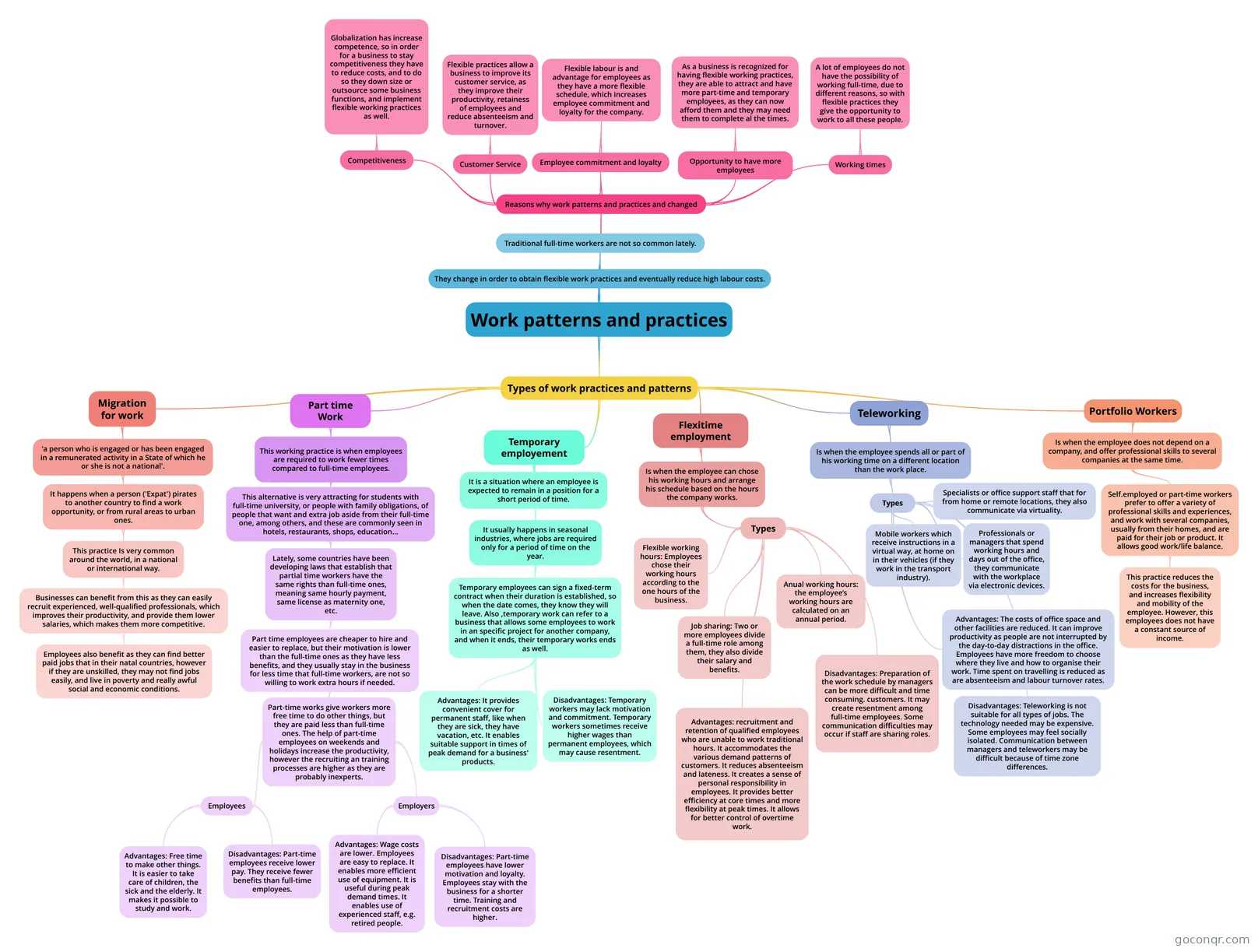
Mind map: Work patterns and practices
Conteúdo do mapa
Work patterns and practices
They change in order to obtain flexible work practices and eventually reduce high labour costs.
- Traditional full-time workers are not so common lately.
Reasons why work patterns and practices and changed
- Competitiveness
- Globalization has increase competence, so in order for a business to stay competitiveness they have to reduce costs, and to do so they down size or outsource some business functions, and implement flexible working practices as well.
- Customer Service
- Flexible practices allow a business to improve its customer service, as they improve their productivity, retainess of employees and reduce absenteeism and turnover.
- Employee commitment and loyalty
- Flexible labour is and advantage for employees as they have a more flexible schedule, which increases employee commitment and loyalty for the company.
- Opportunity to have more employees
- As a business is recognized for having flexible working practices, they are able to attract and have more part-time and temporary employees, as they can now afford them and they may need them to complete al the times.
- Working times
- A lot of employees do not have the possibility of working full-time, due to different reasons, so with flexible practices they give the opportunity to work to all these people.
- Competitiveness
Types of work practices and patterns
- Part time Work
- This working practice is when employees are required to work fewer times compared to full-time employees.
- This alternative is very attracting for students with full-time university, or people with family obligations, of people that want and extra job aside from their full-time one, among others, and these are commonly seen in hotels, restaurants, shops, education...
- Lately, some countries have been developing laws that establish that partial time workers have the same rights than full-time ones, meaning same hourly payment, same license as maternity one, etc.
- Part time employees are cheaper to hire and easier to replace, but their motivation is lower than the full-time ones as they have less benefits, and they usually stay in the business for less time that full-time workers, are not so willing to work extra hours if needed.
- Part-time works give workers more free time to do other things, but they are paid less than full-time ones. The help of part-time employees on weekends and holidays increase the productivity, however the recruiting an training processes are higher as they are probably inexperts.
- Employees
- Advantages: Free time to make other things. It is easier to take care of children, the sick and the elderly. It makes it possible to study and work.
- Disadvantages: Part-time employees receive lower pay. They receive fewer benefits than full-time employees.
- Employers
- Advantages: Wage costs are lower. Employees are easy to replace. It enables more efficient use of equipment. It is useful during peak demand times. It enables use of experienced staff, e.g. retired people.
- Disadvantages: Part-time employees have lower motivation and loyalty. Employees stay with the business for a shorter time. Training and recruitment costs are higher.
- Employees
- Part-time works give workers more free time to do other things, but they are paid less than full-time ones. The help of part-time employees on weekends and holidays increase the productivity, however the recruiting an training processes are higher as they are probably inexperts.
- Part time employees are cheaper to hire and easier to replace, but their motivation is lower than the full-time ones as they have less benefits, and they usually stay in the business for less time that full-time workers, are not so willing to work extra hours if needed.
- Lately, some countries have been developing laws that establish that partial time workers have the same rights than full-time ones, meaning same hourly payment, same license as maternity one, etc.
- This alternative is very attracting for students with full-time university, or people with family obligations, of people that want and extra job aside from their full-time one, among others, and these are commonly seen in hotels, restaurants, shops, education...
- This working practice is when employees are required to work fewer times compared to full-time employees.
- Temporary employement
- It is a situation where an employee is expected to remain in a position for a short period of time.
- It usually happens in seasonal industries, where jobs are required only for a period of time on the year.
- Temporary employees can sign a fixed-term contract when their duration is established, so when the date comes, they know they will leave. Also ,temporary work can refer to a business that allows some employees to work in an specific project for another company, and when it ends, their temporary works ends as well.
- Advantages: It provides convenient cover for permanent staff, like when they are sick, they have vacation, etc. It enables suitable support in times of peak demand for a business' products.
- Disadvantages: Temporary workers may lack motivation and commitment. Temporary workers sometimes receive higher wages than permanent employees, which may cause resentment.
- Temporary employees can sign a fixed-term contract when their duration is established, so when the date comes, they know they will leave. Also ,temporary work can refer to a business that allows some employees to work in an specific project for another company, and when it ends, their temporary works ends as well.
- Flexitime employment
- Is when the employee can chose his working hours and arrange his schedule based on the hours the company works.
- Types
- Flexible working hours: Employees chose their working hours according to the one hours of the business.
- Job sharing: Two or more employees divide a full-time role among them, they also divide their salary and benefits.
- Anual working hours: the employee’s working hours are calculated on an annual period.
- Advantages: recruitment and retention of qualified employees who are unable to work traditional hours. It accommodates the various demand patterns of customers. It reduces absenteeism and lateness. It creates a sense of personal responsibility in employees. It provides better efficiency at core times and more flexibility at peak times. It allows for better control of overtime work.
- Disadvantages: Preparation of the work schedule by managers can be more difficult and time consuming. customers. It may create resentment among full-time employees. Some communication difficulties may occur if staff are sharing roles.
- Types
- Is when the employee can chose his working hours and arrange his schedule based on the hours the company works.
- Teleworking
- Is when the employee spends all or part of his working time on a different location than the work place.
- Types
- Professionals or managers that spend working hours and days out of the office, they communicate with the workplace via electronic devices.
- Mobile workers which receive instructions in a virtual way, at home on in their vehicles (if they work in the transport industry).
- Specialists or office support staff that for from home or remote locations, they also communicate via virtuality.
- Advantages: The costs of office space and other facilities are reduced. It can improve productivity as people are not interrupted by the day-to-day distractions in the office. Employees have more freedom to choose where they live and how to organise their work. Time spent on travelling is reduced as are absenteeism and labour turnover rates.
- Disadvantages: Teleworking is not suitable for all types of jobs. The technology needed may be expensive. Some employees may feel socially isolated. Communication between managers and teleworkers may be difficult because of time zone differences.
- Types
- Is when the employee spends all or part of his working time on a different location than the work place.
- Portfolio Workers
- Is when the employee does not depend on a company, and offer professional skills to several companies at the same time.
- Self.employed or part-time workers prefer to offer a variety of professional skills and experiences, and work with several companies, usually from their homes, and are paid for their job or product. It allows good work/life balance.
- This practice reduces the costs for the business, and increases flexibility and mobility of the employee. However, this employees does not have a constant source of income.
- Self.employed or part-time workers prefer to offer a variety of professional skills and experiences, and work with several companies, usually from their homes, and are paid for their job or product. It allows good work/life balance.
- Is when the employee does not depend on a company, and offer professional skills to several companies at the same time.
- Migration for work
- 'a person who is engaged or has been engaged in a remunerated activity in a State of which he or she is not a national'.
- It happens when a person ('Expat') pirates to another country to find a work opportunity, or from rural areas to urban ones.
- This practice Is very common around the world, in a national or international way.
- Businesses can benefit from this as they can easily recruit experienced, well-qualified professionals, which improves their productivity, and provide them lower salaries, which makes them more competitive.
- Employees also benefit as they can find better paid jobs that in their natal countries, however if they are unskilled, they may not find jobs easily, and live in poverty and really awful social and economic conditions.
- Businesses can benefit from this as they can easily recruit experienced, well-qualified professionals, which improves their productivity, and provide them lower salaries, which makes them more competitive.
- This practice Is very common around the world, in a national or international way.
- It happens when a person ('Expat') pirates to another country to find a work opportunity, or from rural areas to urban ones.
- 'a person who is engaged or has been engaged in a remunerated activity in a State of which he or she is not a national'.
- Part time Work
Informações
- Descrição
- Mapa Mental sobre Work patterns and practices, criado por VALENTINA ECHEVERRI LOZANO-Alumno em 21-09-2020.
- Criado por
- VALENTINA ECHEVERRI LOZANO-Alumno
- Visualizações
- 1
- Avaliação