
Mapa mental
Psoriatic Arthritis
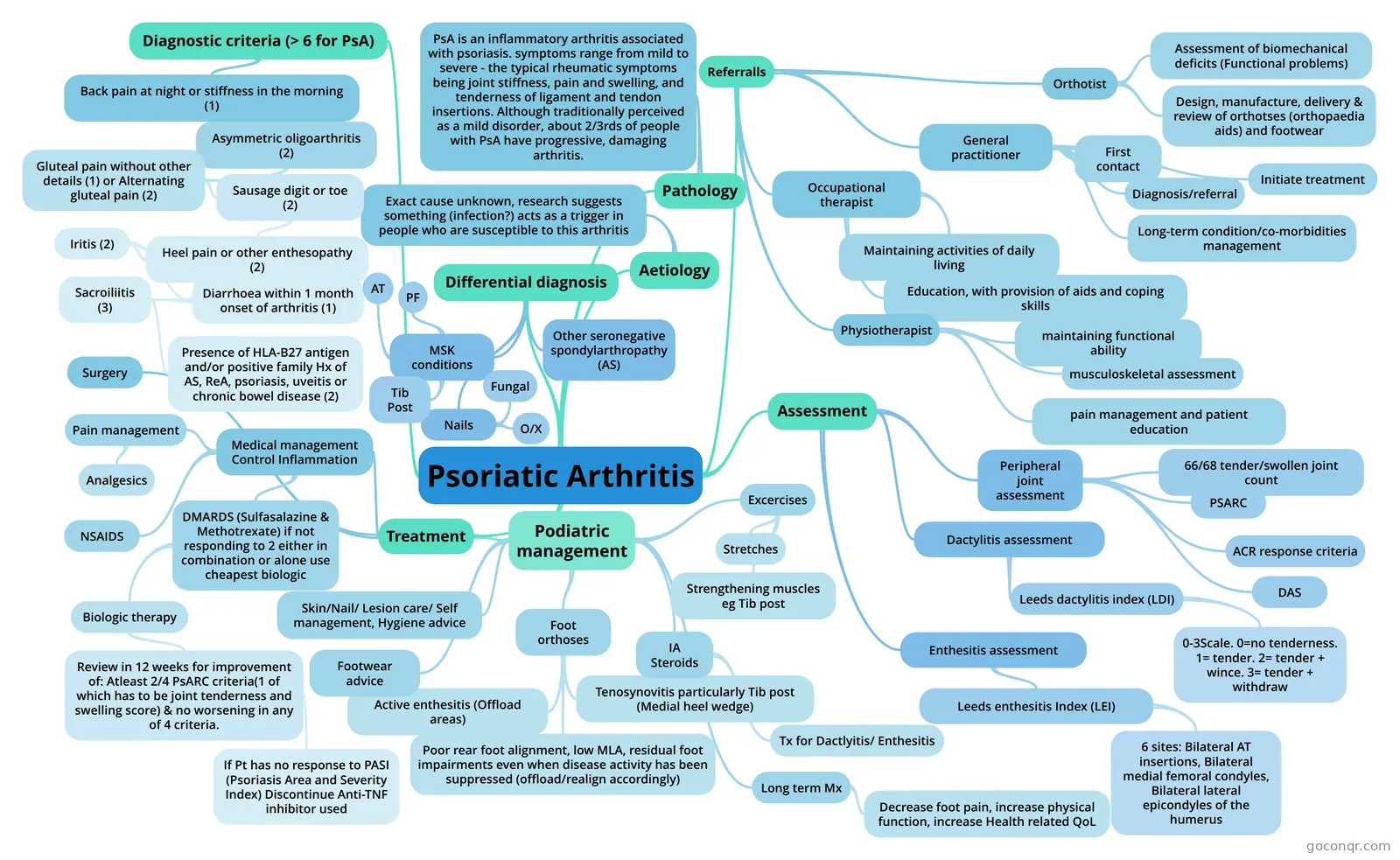
Mind map: Psoriatic arthritis
Conteúdo do mapa
Psoriatic Arthritis
Aetiology
- Exact cause unknown, research suggests something (infection?) acts as a trigger in people who are susceptible to this arthritis
Pathology
- PsA is an inflammatory arthritis associated with psoriasis. symptoms range from mild to severe - the typical rheumatic symptoms being joint stiffness, pain and swelling, and tenderness of ligament and tendon insertions. Although traditionally perceived as a mild disorder, about 2/3rds of people with PsA have progressive, damaging arthritis.
Diagnostic criteria (> 6 for PsA)
- Back pain at night or stiffness in the morning (1)
- Asymmetric oligoarthritis (2)
- Gluteal pain without other details (1) or Alternating gluteal pain (2)
- Sausage digit or toe (2)
- Heel pain or other enthesopathy (2)
- Iritis (2)
- Diarrhoea within 1 month onset of arthritis (1)
- Sacroiliitis (3)
- Presence of HLA-B27 antigen and/or positive family Hx of AS, ReA, psoriasis, uveitis or chronic bowel disease (2)
- Sacroiliitis (3)
- Diarrhoea within 1 month onset of arthritis (1)
- Iritis (2)
- Heel pain or other enthesopathy (2)
- Sausage digit or toe (2)
- Gluteal pain without other details (1) or Alternating gluteal pain (2)
- Asymmetric oligoarthritis (2)
- Back pain at night or stiffness in the morning (1)
Treatment
- Medical management Control Inflammation
- Pain management
- Analgesics
- NSAIDS
- DMARDS (Sulfasalazine & Methotrexate) if not responding to 2 either in combination or alone use cheapest biologic
- Biologic therapy
- Review in 12 weeks for improvement of: Atleast 2/4 PsARC criteria(1 of which has to be joint tenderness and swelling score) & no worsening in any of 4 criteria.
- If Pt has no response to PASI (Psoriasis Area and Severity Index) Discontinue Anti-TNF inhibitor used
- Review in 12 weeks for improvement of: Atleast 2/4 PsARC criteria(1 of which has to be joint tenderness and swelling score) & no worsening in any of 4 criteria.
- Biologic therapy
- Pain management
- Surgery
- Podiatric management
- Foot orthoses
- Active enthesitis (Offload areas)
- Tenosynovitis particularly Tib post (Medial heel wedge)
- Poor rear foot alignment, low MLA, residual foot impairments even when disease activity has been suppressed (offload/realign accordingly)
- Skin/Nail/ Lesion care/ Self management, Hygiene advice
- Footwear advice
- Excercises
- Strengthening muscles eg Tib post
- Stretches
- IA Steroids
- Tx for Dactlyitis/ Enthesitis
- Long term Mx
- Decrease foot pain, increase physical function, increase Health related QoL
- Foot orthoses
- Medical management Control Inflammation
Differential diagnosis
- MSK conditions
- PF
- AT
- Tib Post
- Nails
- Fungal
- O/X
- Other seronegative spondylarthropathy (AS)
- MSK conditions
Referralls
- Orthotist
- Assessment of biomechanical deficits (Functional problems)
- Design, manufacture, delivery & review of orthotses (orthopaedia aids) and footwear
- General practitioner
- First contact
- Diagnosis/referral
- Initiate treatment
- Long-term condition/co-morbidities management
- Occupational therapist
- Maintaining activities of daily living
- Education, with provision of aids and coping skills
- Physiotherapist
- maintaining functional ability
- musculoskeletal assessment
- pain management and patient education
- Orthotist
Assessment
- Peripheral joint assessment
- 66/68 tender/swollen joint count
- DAS
- PSARC
- ACR response criteria
- Enthesitis assessment
- Leeds enthesitis Index (LEI)
- 6 sites: Bilateral AT insertions, Bilateral medial femoral condyles, Bilateral lateral epicondyles of the humerus
- Leeds enthesitis Index (LEI)
- Dactylitis assessment
- Leeds dactylitis index (LDI)
- 0-3Scale. 0=no tenderness. 1= tender. 2= tender + wince. 3= tender + withdraw
- Leeds dactylitis index (LDI)
- Peripheral joint assessment