
Mapa mental
Proteins (2.4)
Conteúdo do mapa
Proteins (2.4)
Functions
- Catalysts-Enzymes: They cut and paste molecules
- Muscle contraction
- Cytoskeletons: help the skeleton of cells keep their form
- Tensile strenghtening: proteines give strength and resistance to our muscles so that if our (example) ankle bends, it does not break
- Blood clotting
- Transport of nutrients and gases
- Cell adhesion: cells stick to each other
- Immunity
- Membrane transport: getting things in and out of the cell
- Hormones: (example) insuline
- Receptors: recieving messages from other parts of the body
- Packing of DNA: DNA curls around the protein
Examples
- Rubisco
- Function: catalyse the reaction that fixes CO2 from the atmosphere
- Insulin
- Function: signal cells to absorb glucose and help reduce glucose concentration in blood
- Immunoglobulin
- Function: fight off bacteria and pathogens
- Rhodopsin
- Function: recept light through the eye
- Collagen
- Function: 1) help prevent cracks and fractures in bones and teeth, 2) form a mesh of fiber in the skin and blood vessel walls that resists tearing, and3) strengthen ligaments and blood vessel walls
- Spider silk
- Function: create the spokes of the spider web and the spider's lifelines. It also makes the silk extensible and resistant to breaking
- Rubisco
Basics of proteins
- The sequence of amino acids is determined by genes. This means that the genes are the cake recipe and the amino acid structure is the cake.
- Amino acids can be combined in any way
- Every individual has a unique proteome: set of proteins expressed in an organism.
- What are proteins?
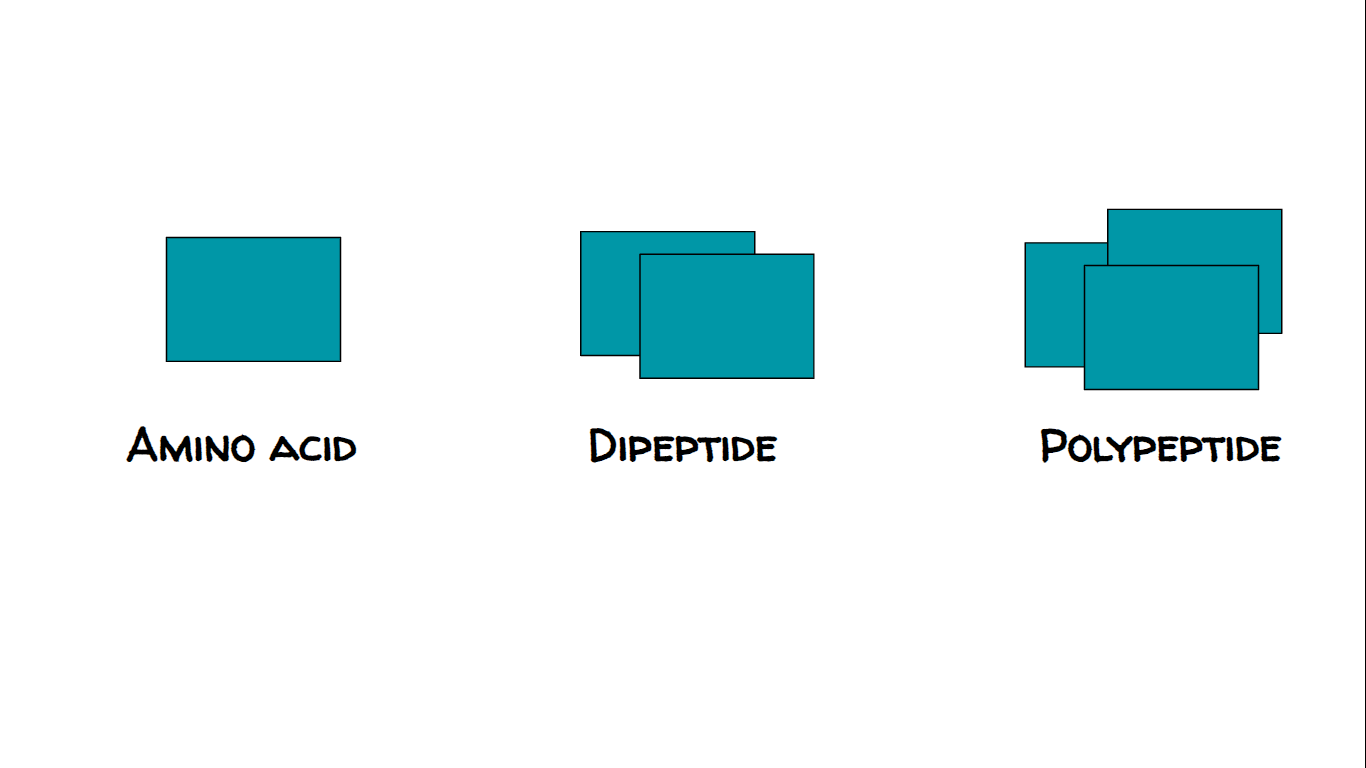
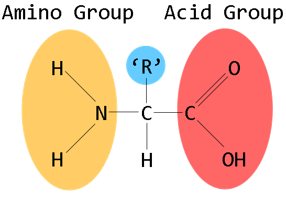
- Proteins are made of amino acids, they are the basic unit
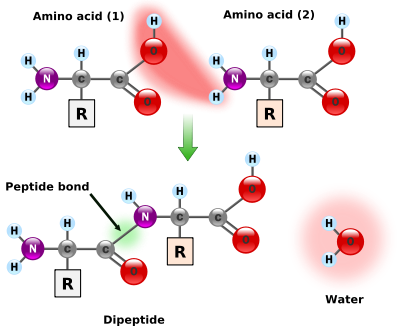
- Amino acids are combined by condensation to form polypeptides
- This process happens in ribosomes
- http://www.thevitaminmag.com/amino-acids-benefits/
- Amino acids are combined by condensation to form polypeptides
- Proteins are made of amino acids, they are the basic unit
- Charges
- It can be either positive, negative or non-charged
- This determines the interaction between amino acids
- Polar (when they are charged) are going to attract the opposite and repel the equal charge (like a magnet)
- Structure
- http://www.thevitaminmag.com/amino-acids-benefits/
- Proteins and water
- Hydrophobic
- This kind of amino acids don't like water and therefore are likely to be found in the inside part of a protein's structure
- Hydrophilic
- This kind of amino acids like water and therefore are likely to be found in the outside part of a protein's structure
- Hydrophobic
- Changes in PH and heat damage proteins
Structure and formation of proteins
- Primary structure: Amino acids are joined by condensation, therefore forming peptide bonds. In this stage, the sequence of amino acids is formed
- Secondary structure: in this stage, the protein starts to take a 3D shape. This means that in the secondary structure, chains of polypeptides are forming 3D structures that are often found as helical shapes.
- Tertiary structure: In this structure is where most of the proteins start to become functional. On this stage, the previously formed helix and pleated sheets are combined to form complex structures.
- Quaternary structure: Only some proteins have this stage. What happens is that two or more polypeptides are folded and assembled like a puzzle
A protein's from and its properties
- When the protein is already 3D and functional it acquires maily 2 shapes
- Rope like (fibrous protein)
- Long and narrow
- Role: structural (strengthening and support)
- Mostly insoluble in water
- Repetitive sequence of amino acids
- Less sensitive to changes in PH and heat
- Examples: Collagen and keratin
- Ball like (globular protein)
- Rounded or spherical
- Role: Functional (catalysts and transport)
- Mostly soluble in water
- Irregular amino acid sequence
- More sensitive to changes in heat and PH
- Examples: Hemoglobin and insulin
- Rope like (fibrous protein)
- When the protein is already 3D and functional it acquires maily 2 shapes
Denaturation
- A structural change in a protein that results in the loss (usually permanent) of its biological properties.
- It is a process that involves the breaking of weak bonds.
- It can be caused by exposition to extreme heat and pH (both, too low and too high)
Imagens e arquivos do mapa
Informações
- Descrição
- Mapa Mental sobre Proteins (2.4), criado por Laura Mejia em 02-01-2021.
- Criado por
- Laura Mejia
- Visualizações
- 18
- Avaliação