
Mapa mental
The Three Approaches Of Arguements
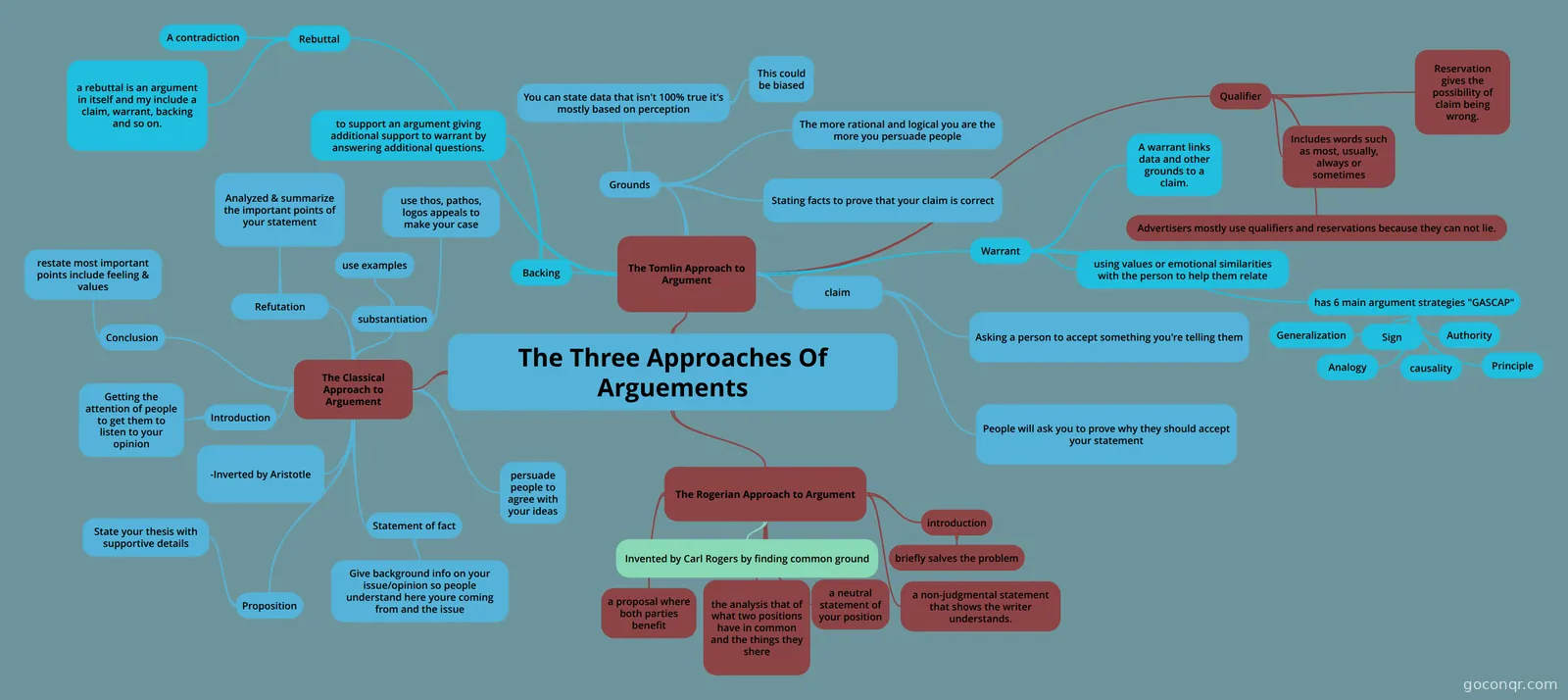
Mind map: The Three Approaches of Arguments
Conteúdo do mapa
The Three Approaches Of Arguements
The Classical Approach to Arguement
- -Inverted by Aristotle
- persuade people to agree with your ideas
- Introduction
- Getting the attention of people to get them to listen to your opinion
- Statement of fact
- Give background info on your issue/opinion so people understand here youre coming from and the issue
- Proposition
- State your thesis with supportive details
- Refutation
- Analyzed & summarize the important points of your statement
- substantiation
- use thos, pathos, logos appeals to make your case
- use examples
- Conclusion
- restate most important points include feeling & values
The Tomlin Approach to Argument
- claim
- Asking a person to accept something you're telling them
- People will ask you to prove why they should accept your statement
- Grounds
- Stating facts to prove that your claim is correct
- You can state data that isn't 100% true it's mostly based on perception
- This could be biased
- The more rational and logical you are the more you persuade people
- Warrant
- using values or emotional similarities with the person to help them relate
- A warrant links data and other grounds to a claim.
- has 6 main argument strategies "GASCAP"
- Generalization
- Analogy
- Sign
- causality
- Authority
- Principle
- Backing
- to support an argument giving additional support to warrant by answering additional questions.
- Qualifier
- Includes words such as most, usually, always or sometimes
- Reservation gives the possibility of claim being wrong.
- Advertisers mostly use qualifiers and reservations because they can not lie.
- Rebuttal
- A contradiction
- a rebuttal is an argument in itself and my include a claim, warrant, backing and so on.
- claim
The Rogerian Approach to Argument
- Invented by Carl Rogers by finding common ground
- introduction
- briefly salves the problem
- a non-judgmental statement that shows the writer understands.
- a neutral statement of your position
- the analysis that of what two positions have in common and the things they shere
- a proposal where both parties benefit
Informações
- Descrição
- three approaches of arguments. details
- Criado por
- rjlucero100
- Visualizações
- 56
- Tags
- Avaliação