
Mapa mental
GCSE Chemistry B - OCR - C1
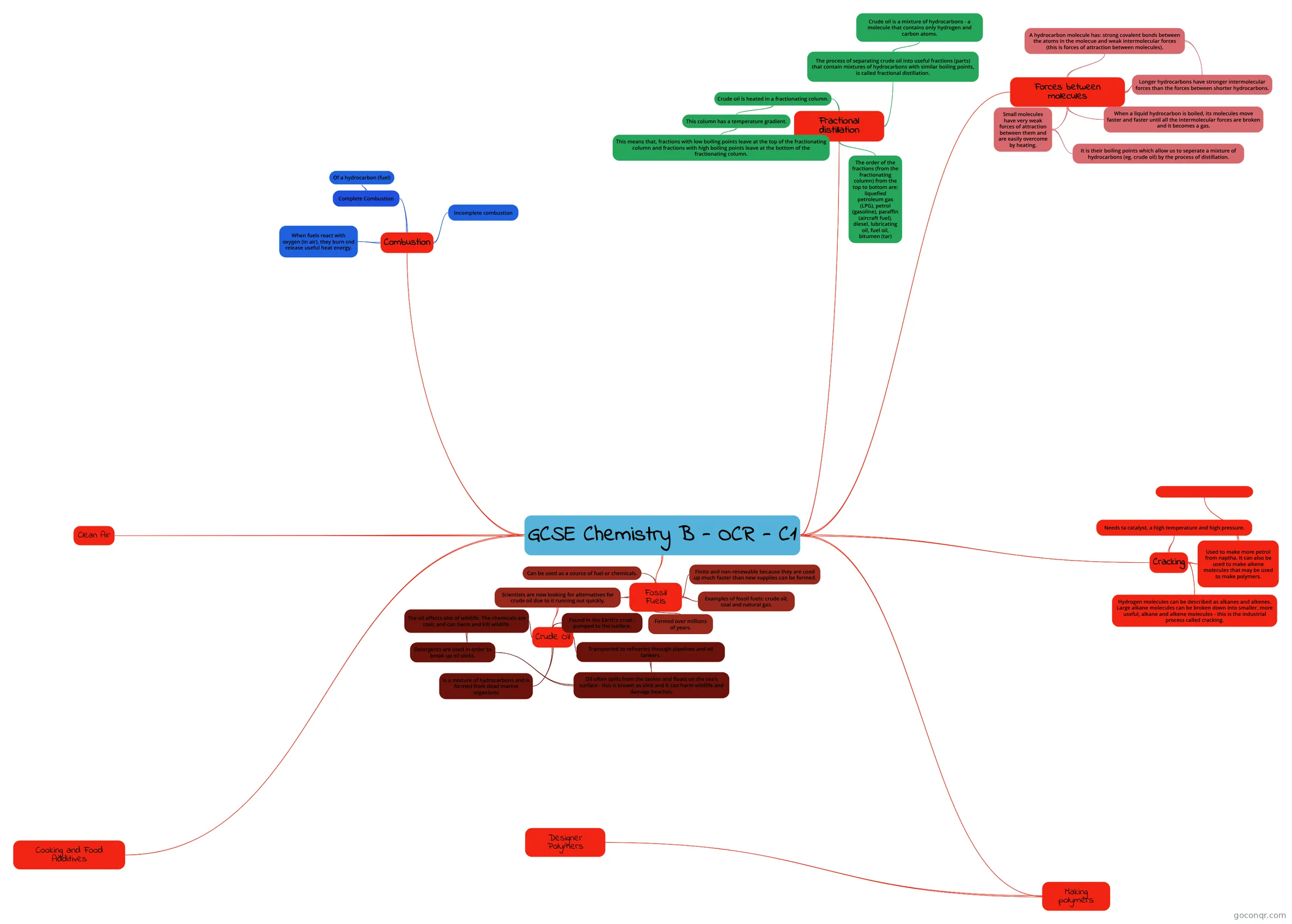
Mind map: GCSE Chemistry B OCR C1
Conteúdo do mapa
GCSE Chemistry B - OCR - C1
Fossil Fuels
- Examples of fossil fuels: crude oil, coal and natural gas.
- Formed over millions of years.
- Finite and non-renewable because they are used up much faster than new supplies can be formed.
- Can be used as a source of fuel or chemicals.
- Scientists are now looking for alternatives for crude oil due to it running out quickly.
- Crude OIl
- Transported to refineries through pipelines and oil tankers.
- Oil often spills from the tanker and floats on the sea's surface - this is known as slick and it can harm wildlife and damage beaches.
- Detergents are used in order to break up oil slicks.
- Oil often spills from the tanker and floats on the sea's surface - this is known as slick and it can harm wildlife and damage beaches.
- The oil affects alot of wildlife. The chemicals are toxic and can harm and kill wildlife.
- Found in the Earth's crust - pumped to the surface.
- Is a mixture of hydrocarbons and is formed from dead marine organisms
- Transported to refineries through pipelines and oil tankers.
- Crude OIl
Fractional distillation
- The process of separating crude oil into useful fractions (parts) that contain mixtures of hydrocarbons with similar boiling points, is called fractional distillation.
- Crude oil is a mixture of hydrocarbons - a molecule that contains only hydrogen and carbon atoms.
- Crude oil is heated in a fractionating column.
- This column has a temperature gradient.
- This means that, fractions with low boiling points leave at the top of the fractionating column and fractions with high boiling points leave at the bottom of the fractionating column.
- This column has a temperature gradient.
- The order of the fractions (from the fractionating column) from the top to bottom are: liquefied petroleum gas (LPG), petrol (gasoline), paraffin (aircraft fuel), diesel, lubricating oil, fuel oil, bitumen (tar)
- The process of separating crude oil into useful fractions (parts) that contain mixtures of hydrocarbons with similar boiling points, is called fractional distillation.
Cracking
- Hydrogen molecules can be described as alkanes and alkenes. Large alkane molecules can be broken down into smaller, more useful, alkane and alkene molecules - this is the industrial process called cracking.
- Needs ta catalyst, a high temperature and high pressure.
- Used to make more petrol from naptha. It can also be used to make alkene molecules that may be used to make polymers.
Forces between molecules
- A hydrocarbon molecule has: strong covalent bonds between the atoms in the molecue and weak intermolecular forces (this is forces of attraction between molecules).
- Longer hydrocarbons have stronger intermolecular forces than the forces between shorter hydrocarbons.
- When a liquid hydrocarbon is boiled, its molecules move faster and faster until all the intermolecular forces are broken and it becomes a gas.
- Small molecules have very weak forces of attraction between them and are easily overcome by heating.
- It is their boiling points which allow us to seperate a mixture of hydrocarbons (eg. crude oil) by the process of distillation.
- A hydrocarbon molecule has: strong covalent bonds between the atoms in the molecue and weak intermolecular forces (this is forces of attraction between molecules).
Combustion
- Incomplete combustion
- Complete Combustion
- Of a hydrocarbon (fuel)
- When fuels react with oxygen (in air), they burn snd release useful heat energy.
Clean Air
Making polymers
- Designer Polymers
Cooking and Food Additives