
Mapa mental
UNIT 5 (Mechanisms)
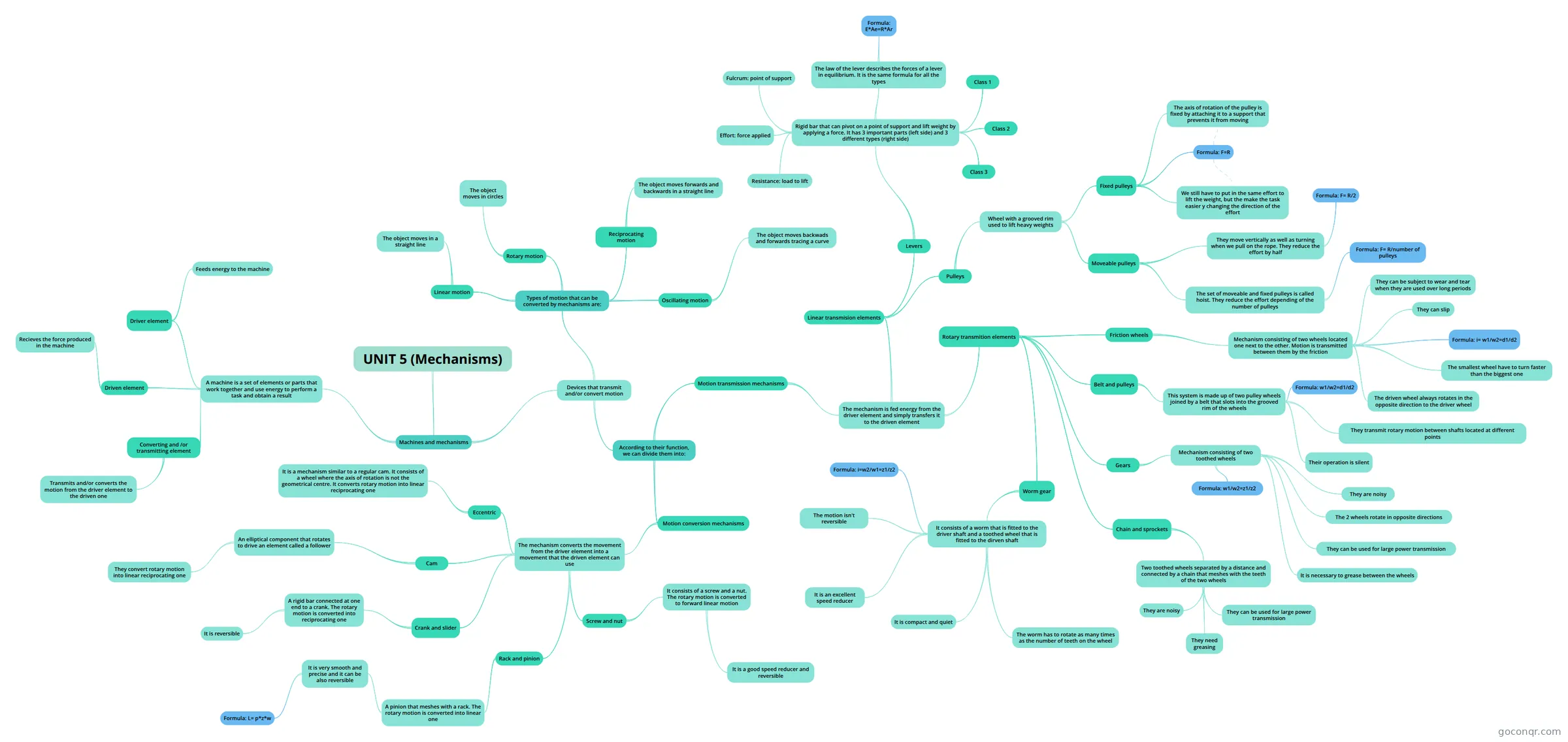
Mind map: Mechanisms
Conteúdo do mapa
UNIT 5 (Mechanisms)
Machines and mechanisms
- A machine is a set of elements or parts that work together and use energy to perform a task and obtain a result
- Driver element
- Feeds energy to the machine
- Driven element
- Recieves the force produced in the machine
- Converting and /or transmitting element
- Transmits and/or converts the motion from the driver element to the driven one
- Driver element
- Devices that transmit and/or convert motion
- Types of motion that can be converted by mechanisms are:
- Linear motion
- The object moves in a straight line
- Rotary motion
- The object moves in circles
- Reciprocating motion
- The object moves forwards and backwards in a straight line
- Oscillating motion
- The object moves backwads and forwards tracing a curve
- Linear motion
- According to their function, we can divide them into:
- Motion transmission mechanisms
- The mechanism is fed energy from the driver element and simply transfers it to the driven element
- Linear transmision elements
- Levers
- Rigid bar that can pivot on a point of support and lift weight by applying a force. It has 3 important parts (left side) and 3 different types (right side)
- Fulcrum: point of support
- Effort: force applied
- Resistance: load to lift
- Class 1
- Class 2
- Class 3
- The law of the lever describes the forces of a lever in equilibrium. It is the same formula for all the types
- Formula: E*Ae=R*Ar
- Rigid bar that can pivot on a point of support and lift weight by applying a force. It has 3 important parts (left side) and 3 different types (right side)
- Pulleys
- Wheel with a grooved rim used to lift heavy weights
- Fixed pulleys
- The axis of rotation of the pulley is fixed by attaching it to a support that prevents it from moving
- We still have to put in the same effort to lift the weight, but the make the task easier y changing the direction of the effort
- Formula: F=R
- Moveable pulleys
- They move vertically as well as turning when we pull on the rope. They reduce the effort by half
- Formula: F= R/2
- The set of moveable and fixed pulleys is called hoist. They reduce the effort depending of the number of pulleys
- Formula: F= R/number of pulleys
- They move vertically as well as turning when we pull on the rope. They reduce the effort by half
- Fixed pulleys
- Wheel with a grooved rim used to lift heavy weights
- Levers
- Rotary transmition elements
- Friction wheels
- Mechanism consisting of two wheels located one next to the other. Motion is transmitted between them by the friction
- They can be subject to wear and tear when they are used over long periods
- They can slip
- The smallest wheel have to turn faster than the biggest one
- The driven wheel always rotates in the opposite direction to the driver wheel
- Formula: i= w1/w2=d1/d2
- Mechanism consisting of two wheels located one next to the other. Motion is transmitted between them by the friction
- Belt and pulleys
- This system is made up of two pulley wheels joined by a belt that slots into the grooved rim of the wheels
- Formula: w1/w2=d1/d2
- They transmit rotary motion between shafts located at different points
- Their operation is silent
- This system is made up of two pulley wheels joined by a belt that slots into the grooved rim of the wheels
- Gears
- Mechanism consisting of two toothed wheels
- Formula: w1/w2=z1/z2
- The 2 wheels rotate in opposite directions
- They can be used for large power transmission
- It is necessary to grease between the wheels
- They are noisy
- Mechanism consisting of two toothed wheels
- Chain and sprockets
- Two toothed wheels separated by a distance and connected by a chain that meshes with the teeth of the two wheels
- They can be used for large power transmission
- They need greasing
- They are noisy
- Two toothed wheels separated by a distance and connected by a chain that meshes with the teeth of the two wheels
- Worm gear
- It consists of a worm that is fitted to the driver shaft and a toothed wheel that is fitted to the dirven shaft
- It is an excellent speed reducer
- It is compact and quiet
- The motion isn't reversible
- Formula: i=w2/w1=z1/z2
- The worm has to rotate as many times as the number of teeth on the wheel
- It consists of a worm that is fitted to the driver shaft and a toothed wheel that is fitted to the dirven shaft
- Friction wheels
- Linear transmision elements
- The mechanism is fed energy from the driver element and simply transfers it to the driven element
- Motion conversion mechanisms
- The mechanism converts the movement from the driver element into a movement that the driven element can use
- Eccentric
- It is a mechanism similar to a regular cam. It consists of a wheel where the axis of rotation is not the geometrical centre. It converts rotary motion into linear reciprocating one
- Rack and pinion
- A pinion that meshes with a rack. The rotary motion is converted into linear one
- It is very smooth and precise and it can be also reversible
- Formula: L= p*z*w
- It is very smooth and precise and it can be also reversible
- A pinion that meshes with a rack. The rotary motion is converted into linear one
- Cam
- An elliptical component that rotates to drive an element called a follower
- They convert rotary motion into linear reciprocating one
- An elliptical component that rotates to drive an element called a follower
- Crank and slider
- A rigid bar connected at one end to a crank. The rotary motion is converted into reciprocating one
- It is reversible
- A rigid bar connected at one end to a crank. The rotary motion is converted into reciprocating one
- Screw and nut
- It consists of a screw and a nut. The rotary motion is converted to forward linear motion
- It is a good speed reducer and reversible
- It consists of a screw and a nut. The rotary motion is converted to forward linear motion
- Eccentric
- The mechanism converts the movement from the driver element into a movement that the driven element can use
- Motion transmission mechanisms
- Types of motion that can be converted by mechanisms are:
- A machine is a set of elements or parts that work together and use energy to perform a task and obtain a result
Informações
- Descrição
- Mapa Mental sobre UNIT 5 (Mechanisms), criado por Salma delacruz Bonilla em 06-03-2022.
- Criado por
- Salma delacruz Bonilla
- Visualizações
- 2
- Avaliação
Mais sobre Classification of Mechanisms