
Mapa mental
TYPES OF LOGISTICS
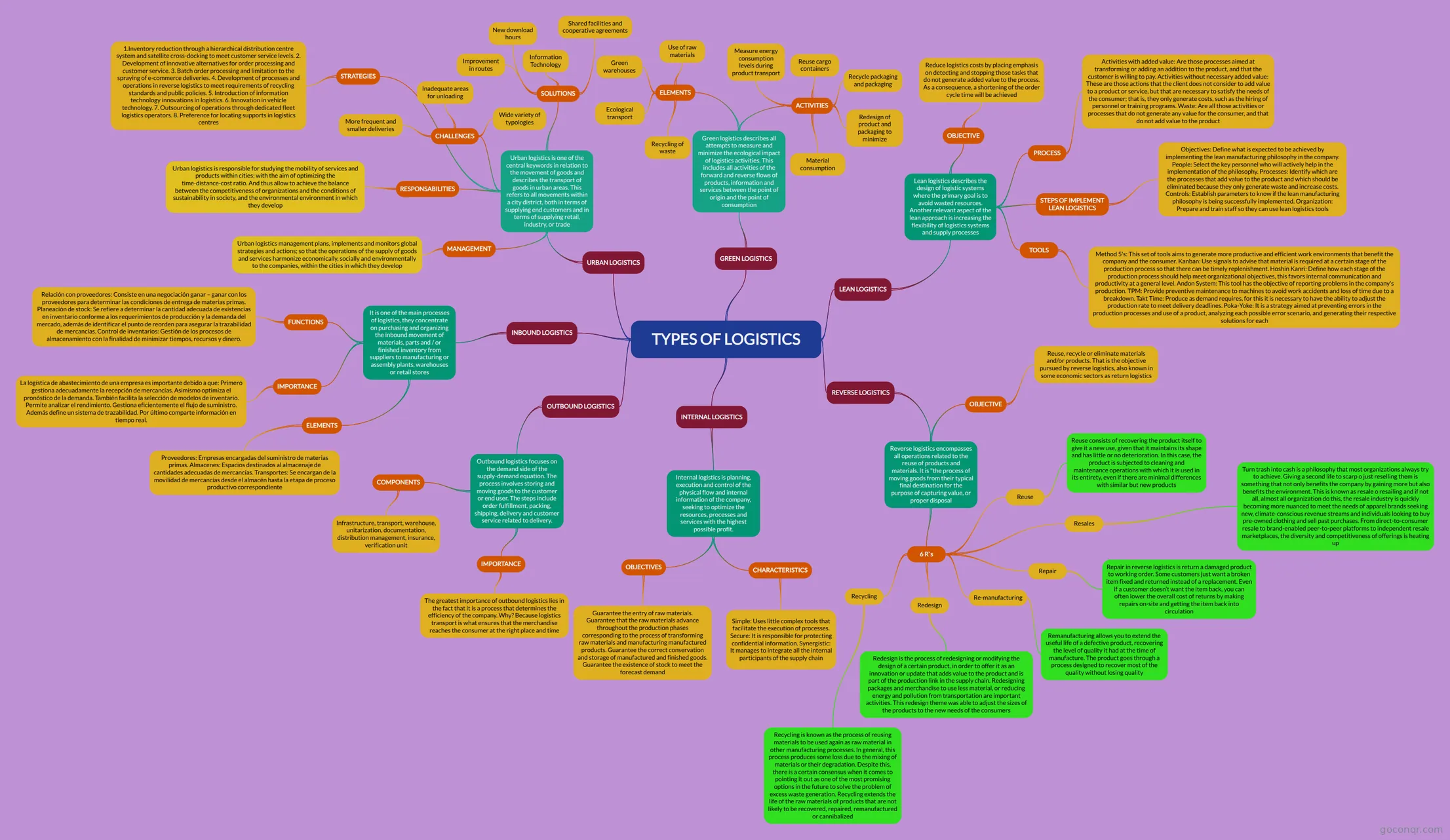
Mind map: types of logistics
Conteúdo do mapa
TYPES OF LOGISTICS
INBOUND LOGISTICS
- It is one of the main processes of logistics, they concentrate on purchasing and organizing the inbound movement of materials, parts and / or finished inventory from suppliers to manufacturing or assembly plants, warehouses or retail stores
- FUNCTIONS
- Relación con proveedores: Consiste en una negociación ganar – ganar con los proveedores para determinar las condiciones de entrega de materias primas. Planeación de stock: Se refiere a determinar la cantidad adecuada de existencias en inventario conforme a los requerimientos de producción y la demanda del mercado, además de identificar el punto de reorden para asegurar la trazabilidad de mercancías. Control de inventarios: Gestión de los procesos de almacenamiento con la finalidad de minimizar tiempos, recursos y dinero.
- IMPORTANCE
- La logística de abastecimiento de una empresa es importante debido a que: Primero gestiona adecuadamente la recepción de mercancías. Asimismo optimiza el pronóstico de la demanda. También facilita la selección de modelos de inventario. Permite analizar el rendimiento. Gestiona eficientemente el flujo de suministro. Además define un sistema de trazabilidad. Por último comparte información en tiempo real.
- ELEMENTS
- Proveedores: Empresas encargadas del suministro de materias primas. Almacenes: Espacios destinados al almacenaje de cantidades adecuadas de mercancías. Transportes: Se encargan de la movilidad de mercancías desde el almacén hasta la etapa de proceso productivo correspondiente
- FUNCTIONS
- It is one of the main processes of logistics, they concentrate on purchasing and organizing the inbound movement of materials, parts and / or finished inventory from suppliers to manufacturing or assembly plants, warehouses or retail stores
OUTBOUND LOGISTICS
- Outbound logistics focuses on the demand side of the supply-demand equation. The process involves storing and moving goods to the customer or end user. The steps include order fulfillment, packing, shipping, delivery and customer service related to delivery.
- COMPONENTS
- Infrastructure, transport, warehouse, unitarization, documentation, distribution management, insurance, verification unit
- IMPORTANCE
- The greatest importance of outbound logistics lies in the fact that it is a process that determines the efficiency of the company. Why? Because logistics transport is what ensures that the merchandise reaches the consumer at the right place and time
- COMPONENTS
- Outbound logistics focuses on the demand side of the supply-demand equation. The process involves storing and moving goods to the customer or end user. The steps include order fulfillment, packing, shipping, delivery and customer service related to delivery.
INTERNAL LOGISTICS
- Internal logistics is planning, execution and control of the physical flow and internal information of the company, seeking to optimize the resources, processes and services with the highest possible profit.
- OBJECTIVES
- Guarantee the entry of raw materials. Guarantee that the raw materials advance throughout the production phases corresponding to the process of transforming raw materials and manufacturing manufactured products. Guarantee the correct conservation and storage of manufactured and finished goods. Guarantee the existence of stock to meet the forecast demand
- CHARACTERISTICS
- Simple: Uses little complex tools that facilitate the execution of processes. Secure: It is responsible for protecting confidential information. Synergistic: It manages to integrate all the internal participants of the supply chain
- OBJECTIVES
- Internal logistics is planning, execution and control of the physical flow and internal information of the company, seeking to optimize the resources, processes and services with the highest possible profit.
REVERSE LOGISTICS
- Reverse logistics encompasses all operations related to the reuse of products and materials. It is "the process of moving goods from their typical final destination for the purpose of capturing value, or proper disposal
- OBJECTIVE
- Reuse, recycle or eliminate materials and/or products. That is the objective pursued by reverse logistics, also known in some economic sectors as return logistics
- 6 R`s
- Reuse
- Reuse consists of recovering the product itself to give it a new use, given that it maintains its shape and has little or no deterioration. In this case, the product is subjected to cleaning and maintenance operations with which it is used in its entirety, even if there are minimal differences with similar but new products
- Resales
- Turn trash into cash is a philosophy that most organizations always try to achieve. Giving a second life to scarp o just reselling them is something that not only benefits the company by gaining more but also benefits the environment. This is known as resale o resailing and if not all, almost all organization do this, the resale industry is quickly becoming more nuanced to meet the needs of apparel brands seeking new, climate-conscious revenue streams and individuals looking to buy pre-owned clothing and sell past purchases. From direct-to-consumer resale to brand-enabled peer-to-peer platforms to independent resale marketplaces, the diversity and competitiveness of offerings is heating up
- Repair
- Repair in reverse logistics is return a damaged product to working order. Some customers just want a broken item fixed and returned instead of a replacement. Even if a customer doesn’t want the item back, you can often lower the overall cost of returns by making repairs on-site and getting the item back into circulation
- Re-manufacturing
- Remanufacturing allows you to extend the useful life of a defective product, recovering the level of quality it had at the time of manufacture. The product goes through a process designed to recover most of the quality without losing quality
- Redesign
- Redesign is the process of redesigning or modifying the design of a certain product, in order to offer it as an innovation or update that adds value to the product and is part of the production link in the supply chain. Redesigning packages and merchandise to use less material, or reducing energy and pollution from transportation are important activities. This redesign theme was able to adjust the sizes of the products to the new needs of the consumers
- Recycling
- Recycling is known as the process of reusing materials to be used again as raw material in other manufacturing processes. In general, this process produces some loss due to the mixing of materials or their degradation. Despite this, there is a certain consensus when it comes to pointing it out as one of the most promising options in the future to solve the problem of excess waste generation. Recycling extends the life of the raw materials of products that are not likely to be recovered, repaired, remanufactured or cannibalized
- Reuse
- OBJECTIVE
- Reverse logistics encompasses all operations related to the reuse of products and materials. It is "the process of moving goods from their typical final destination for the purpose of capturing value, or proper disposal
LEAN LOGISTICS
- Lean logistics describes the design of logistic systems where the primary goal is to avoid wasted resources. Another relevant aspect of the lean approach is increasing the flexibility of logistics systems and supply processes
- OBJECTIVE
- Reduce logistics costs by placing emphasis on detecting and stopping those tasks that do not generate added value to the process. As a consequence, a shortening of the order cycle time will be achieved
- PROCESS
- Activities with added value: Are those processes aimed at transforming or adding an addition to the product, and that the customer is willing to pay. Activities without necessary added value: These are those actions that the client does not consider to add value to a product or service, but that are necessary to satisfy the needs of the consumer; that is, they only generate costs, such as the hiring of personnel or training programs. Waste: Are all those activities or processes that do not generate any value for the consumer, and that do not add value to the product
- STEPS OF IMPLEMENT LEAN LOGISTICS
- Objectives: Define what is expected to be achieved by implementing the lean manufacturing philosophy in the company. People: Select the key personnel who will actively help in the implementation of the philosophy. Processes: Identify which are the processes that add value to the product and which should be eliminated because they only generate waste and increase costs. Controls: Establish parameters to know if the lean manufacturing philosophy is being successfully implemented. Organization: Prepare and train staff so they can use lean logistics tools
- TOOLS
- Method 5's: This set of tools aims to generate more productive and efficient work environments that benefit the company and the consumer. Kanban: Use signals to advise that material is required at a certain stage of the production process so that there can be timely replenishment. Hoshin Kanri: Define how each stage of the production process should help meet organizational objectives, this favors internal communication and productivity at a general level. Andon System: This tool has the objective of reporting problems in the company's production. TPM: Provide preventive maintenance to machines to avoid work accidents and loss of time due to a breakdown. Takt Time: Produce as demand requires, for this it is necessary to have the ability to adjust the production rate to meet delivery deadlines. Poka-Yoke: It is a strategy aimed at preventing errors in the production processes and use of a product, analyzing each possible error scenario, and generating their respective solutions for each
- OBJECTIVE
- Lean logistics describes the design of logistic systems where the primary goal is to avoid wasted resources. Another relevant aspect of the lean approach is increasing the flexibility of logistics systems and supply processes
GREEN LOGISTICS
- Green logistics describes all attempts to measure and minimize the ecological impact of logistics activities. This includes all activities of the forward and reverse flows of products, information and services between the point of origin and the point of consumption
- ELEMENTS
- Recycling of waste
- Ecological transport
- Green warehouses
- Use of raw materials
- ACTIVITIES
- Measure energy consumption levels during product transport
- Reuse cargo containers
- Recycle packaging and packaging
- Redesign of product and packaging to minimize
- Material consumption
- ELEMENTS
- Green logistics describes all attempts to measure and minimize the ecological impact of logistics activities. This includes all activities of the forward and reverse flows of products, information and services between the point of origin and the point of consumption
URBAN LOGISTICS
- Urban logistics is one of the central keywords in relation to the movement of goods and describes the transport of goods in urban areas. This refers to all movements within a city district, both in terms of supplying end customers and in terms of supplying retail, industry, or trade
- RESPONSABILITIES
- Urban logistics is responsible for studying the mobility of services and products within cities; with the aim of optimizing the time-distance-cost ratio. And thus allow to achieve the balance between the competitiveness of organizations and the conditions of sustainability in society, and the environmental environment in which they develop
- MANAGEMENT
- Urban logistics management plans, implements and monitors global strategies and actions; so that the operations of the supply of goods and services harmonize economically, socially and environmentally to the companies, within the cities in which they develop
- CHALLENGES
- More frequent and smaller deliveries
- Inadequate areas for unloading
- Wide variety of typologies
- SOLUTIONS
- Improvement in routes
- New download hours
- Information Technology
- Shared facilities and cooperative agreements
- STRATEGIES
- 1.Inventory reduction through a hierarchical distribution centre system and satellite cross-docking to meet customer service levels. 2. Development of innovative alternatives for order processing and customer service. 3. Batch order processing and limitation to the spraying of e-commerce deliveries. 4. Development of processes and operations in reverse logistics to meet requirements of recycling standards and public policies. 5. Introduction of information technology innovations in logistics. 6. Innovation in vehicle technology. 7. Outsourcing of operations through dedicated fleet logistics operators. 8. Preference for locating supports in logistics centres
- RESPONSABILITIES
- Urban logistics is one of the central keywords in relation to the movement of goods and describes the transport of goods in urban areas. This refers to all movements within a city district, both in terms of supplying end customers and in terms of supplying retail, industry, or trade
Informações
- Descrição
- Mapa Mental sobre TYPES OF LOGISTICS, criado por Nicole Marcelino em 05-07-2022.
- Criado por
- Nicole Marcelino
- Visualizações
- 1
- Avaliação