
Mapa mental
Environmental Chemistry
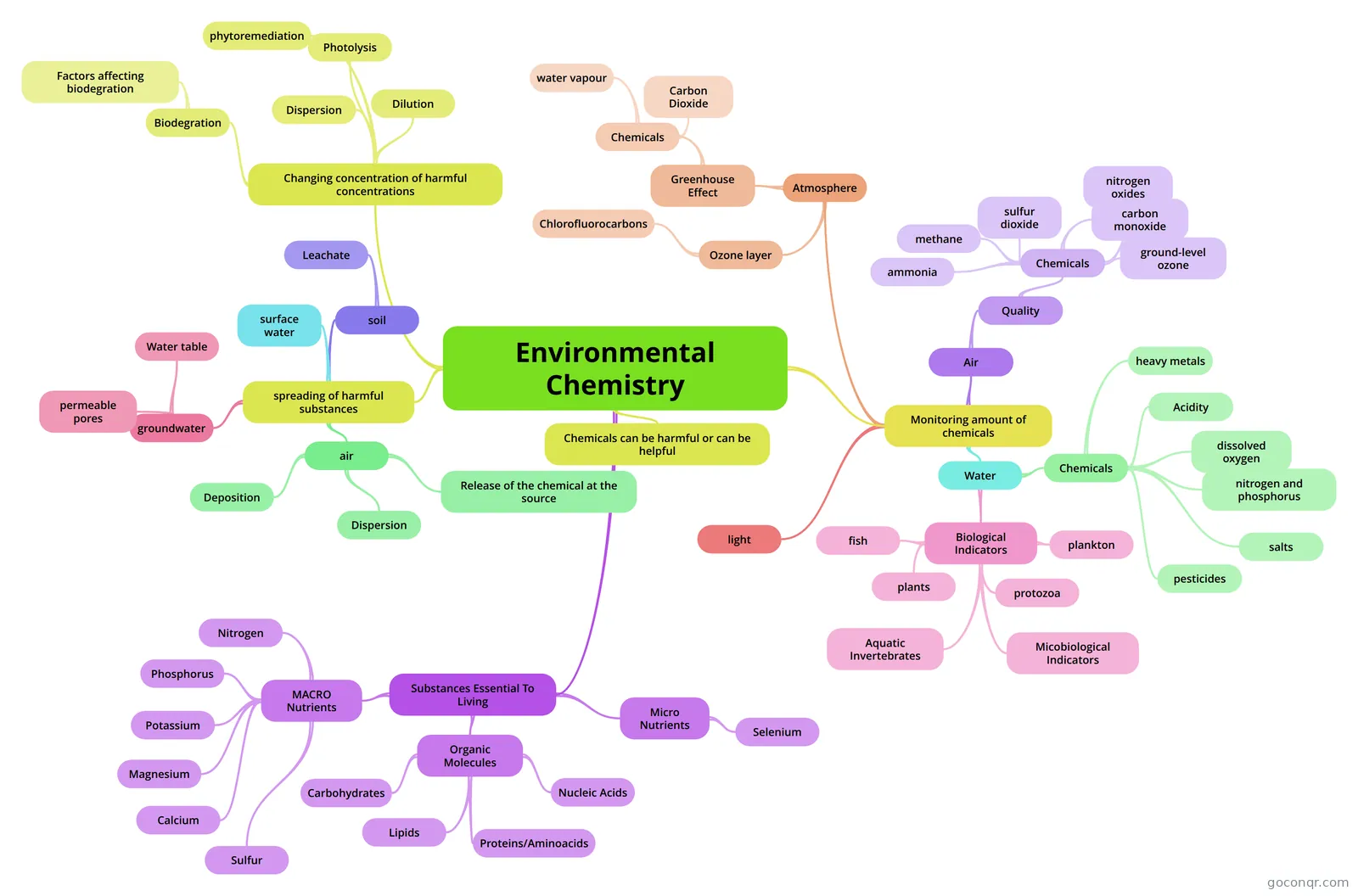
Mind map: Environmental Chemistry
Conteúdo do mapa
Environmental Chemistry
Monitoring amount of chemicals
- Water
- Chemicals
- Acidity
- want it to be close to neutral
- dissolved oxygen
- heavy metals
- biomagnification- levels of a metal increasing as we go up the food chain
- nitrogen and phosphorus
- plant growth
- pesticides
- salts
- For example sodium chloride and magnesium sulfate Acid+ Base= neutralization * forms water and salt low levels of salts are needed
- Acidity
- Biological Indicators
- fish
- plants
- plankton
- protozoa
- Micobiological Indicators
- Examples of harmful bacteria such as Escherichia coli. Bacteria and viruses.
- Aquatic Invertebrates
- Examples are insects, crustaceans, worms, mollusks, water boatman, mosquito larva, water strider, flatworm, dragonfly nymph, leech, caddisfly larva, stonefly nymph, clam, midge larva, mayfly nymph.
- Chemicals
- Air
- Quality
- Chemicals
- sulfur dioxide
- Forms smog and acid rain sulfur dioxide and other oxides of sulfur form when oxygen combines with sulfur Also formed by burning fuels such as coal, oil, and natural gas. It can affect your respiratory system and irritate your eyes.
- nitrogen oxides
- forms smog and acid rain can affect the respiratory system and eyes. Froms mainly from combustion in vehicles, generating plants and some industrial processes.
- carbon monoxide
- It is an odourless and colourless gas and is called the silent killer. the main source from human activities is motor vehicles.
- ground-level ozone
- the main source is fuel combustion in vehicle engines and industry
- methane
- ammonia
- sulfur dioxide
- Chemicals
- Quality
- Atmosphere
- Greenhouse Effect
- Results from the greater concentration of gases trapping even more heat. This increases overall temperatures on Earth, this temperature increase worldwide is called Global Warming. After water vapour, carbon dioxide is the gas that contributes most to the enhanced greenhouse effect. Figure 2.16 on page 230
- Chemicals
- water vapour
- Carbon Dioxide
- Ozone layer
- A layer in Earth's atmosphere that absorbs most of the sun's UV radiation
- Chlorofluorocarbons
- the thinning of the ozone layer is caused by our use of chemicals called chlorofluorocarbons. refrigerators,, aerosol cans. The UV radiation breaks down chlorofluorocarbons and reacts with the ozone layer. Made up of chlorine and fluorine.
- Greenhouse Effect
- light
- Water
Chemicals can be harmful or can be helpful
spreading of harmful substances
- air
- Release of the chemical at the source
- Dispersion
- Dispersion of the chemical in the atmosphere (the chemicals scatter in various directions)
- Deposition
- Deposition of the chemical in soil and water.
- groundwater
- Water table
- how much water is under the surface
- permeable pores
- description of a substance that contains connected pores
- Water table
- surface water
- soil
- Leachate
- Liquid that dissolves and carries substances as it passes through the soil.
- Leachate
- air
Changing concentration of harmful concentrations
- Dispersion
- Dilution
- Biodegration
- breakdown of materials by organisms such as earthworms, bacteria, and fungi; "bio-" refers to living things and "degrade" means to break up
- Factors affecting biodegration
- whether or not the chemical structure of the materials is biodegradable
- phytoremediation
- A technique that can be used to reduce the concentration of harmful chemicals in soil or groundwater.
- Photolysis
- is the breakdown of compounds by sunlight.
Substances Essential To Living
- MACRO Nutrients
- need lots NEED OPTIMAL AMOUNT
- Nitrogen
- -make protein -make chlorophyll -stems and leaves -nucleic acids -grows & repairs tissue
- Phosphorus
- -root and flower growth -cellular respiration -photosynthesis -making DNA, bones, teeth
- Potassium
- -muscle contraction -nerve impulses -stimulates growth -making proteins -fight diseases -making chlorophyll
- Magnesium
- -compulsion of chlorophyll -photosynthesis -making bones & teeth -absorb calcium & potassium
- Calcium
- -muscle and nerve function -cell walls -cell division -bones and teeth blood clotting
- Sulfur
- -produce fruits and grains -make proteins -detoxification
- Micro Nutrients
- need small amounts NEED OPTIMAL AMOUNT
- Selenium
- Need it, but only a little bit.
- Organic Molecules
- Carbohydrates
- NEED -sugar -simple or complex molecules -made of carbon, hydrogen, oxygen
- Lipids
- fat C, H, oO
- Proteins/Aminoacids
- -meat, eggs, dairy
- Nucleic Acids
- DNA, RNA
- Carbohydrates
- MACRO Nutrients
Informações
- Descrição
- Mapa Mental sobre Environmental Chemistry, criado por shaeturnquist em 19-11-2013.
- Criado por
- shaeturnquist
- Visualizações
- 26
- Avaliação
Mais sobre Environmental Chemistry