
Mapa mental
Great Expectations: Writer's Methods and Techniques.
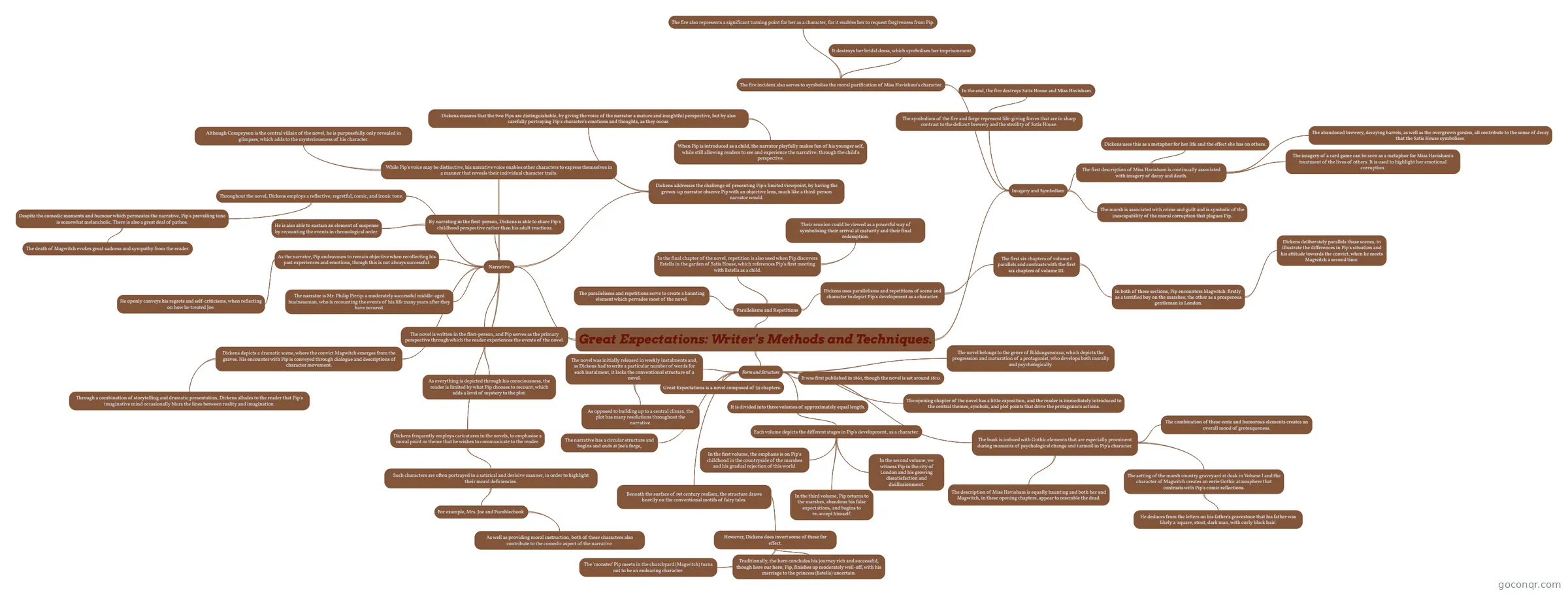
Mind map: Great Expectations writer's methods and techniques
Conteúdo do mapa
Great Expectations: Writer's Methods and Techniques.
Form and Structure
- Great Expectations is a novel composed of 59 chapters.
- It was first published in 1861, though the novel is set around 1810.
- It is divided into three volumes of approximately equal length.
- Each volume depicts the different stages in Pip's development, as a character.
- In the first volume, the emphasis is on Pip's childhood in the countryside of the marshes and his gradual rejection of this world.
- In the second volume, we witness Pip in the city of London and his growing dissatisfaction and disillusionment.
- In the third volume, Pip returns to the marshes, abandons his false expectations, and begins to re-accept himself.
- Each volume depicts the different stages in Pip's development, as a character.
- The novel was initially released in weekly instalments and, as Dickens had to write a particular number of words for each instalment, it lacks the conventional structure of a novel.
- As opposed to building up to a central climax, the plot has many resolutions throughout the narrative.
- The novel belongs to the genre of Bildungsroman, which depicts the progression and maturation of a protagonist, who develops both morally and psychologically.
- Beneath the surface of 19t century realism, the structure draws heavily on the conventional motifs of fairy tales.
- However, Dickens does invert some of these for effect.
- Traditionally, the hero concludes his journey rich and successful, though here our hero, Pip, finishes up moderately well-off, with his marriage to the princess (Estella) uncertain.
- The 'monster' Pip meets in the churchyard (Magwitch) turns out to be an endearing character.
- However, Dickens does invert some of these for effect.
- The narrative has a circular structure and begins and ends at Joe's forge,
- The opening chapter of the novel has a little exposition, and the reader is immediately introduced to the central themes, symbols, and plot points that drive the protagonists actions.
- The book is imbued with Gothic elements that are especially prominent during moments of psychological change and turmoil in Pip's character.
- The setting of the marsh country graveyard at dusk in Volume I and the character of Magwitch creates an eerie Gothic atmosphere that contrasts with Pip's comic reflections.
- He deduces from the letters on his father's gravestone that his father was likely a 'square, stout, dark man, with curly black hair'.
- The description of Miss Havisham is equally haunting and both her and Magwitch, in these opening chapters, appear to resemble the dead.
- The combination of these eerie and humorous elements creates an overall mood of grotesqueness.
- The setting of the marsh country graveyard at dusk in Volume I and the character of Magwitch creates an eerie Gothic atmosphere that contrasts with Pip's comic reflections.
Parallelisms and Repetitions
- Dickens uses parallelisms and repetitions of scene and character to depict Pip's development as a character.
- The first six chapters of volume I parallels and contrasts with the first six chapters of volume III.
- In both of these sections, Pip encounters Magwitch: firstly, as a terrified boy on the marshes; the other as a prosperous gentleman in London.
- Dickens deliberately parallels these scenes, to illustrate the differences in Pip's situation and his attitude towards the convict, when he meets Magwitch a second time.
- In both of these sections, Pip encounters Magwitch: firstly, as a terrified boy on the marshes; the other as a prosperous gentleman in London.
- The first six chapters of volume I parallels and contrasts with the first six chapters of volume III.
- In the final chapter of the novel, repetition is also used when Pip discovers Estella in the garden of Satis House, which references Pip's first meeting with Estella as a child.
- Their reunion could be viewed as a powerful way of symbolising their arrival at maturity and their final redemption.
- The parallelisms and repetitions serve to create a haunting element which pervades most of the novel.
- Dickens uses parallelisms and repetitions of scene and character to depict Pip's development as a character.
Narrative
- The narrator is Mr. Philip Pirrip: a moderately successful middle-aged businessman, who is recounting the events of his life many years after they have occured.
- The novel is written in the first-person, and Pip serves as the primary perspective through which the reader experiences the events of the novel.
- As everything is depicted through his consciousness, the reader is limited by what Pip chooses to recount, which adds a level of mystery to the plot.
- By narrating in the first-person, Dickens is able to share Pip's childhood perspective rather than his adult reactions.
- He is also able to sustain an element of suspense by recounting the events in chronological order.
- Dickens addresses the challenge of presenting Pip's limited viewpoint, by having the grown-up narrator observe Pip with an objective lens, much like a third-person narrator would.
- Dickens ensures that the two Pips are distinguishable, by giving the voice of the narrator a mature and insightful perspective, but by also carefully portraying Pip's character's emotions and thoughts, as they occur.
- When Pip is introduced as a child, the narrator playfully makes fun of his younger self, while still allowing readers to see and experience the narrative, through the child's perspective.
- Dickens ensures that the two Pips are distinguishable, by giving the voice of the narrator a mature and insightful perspective, but by also carefully portraying Pip's character's emotions and thoughts, as they occur.
- As the narrator, Pip endeavours to remain objective when recollecting his past experiences and emotions, though this is not always successful.
- He openly conveys his regrets and self-criticisms, when reflecting on how he treated Joe.
- While Pip's voice may be distinctive, his narrative voice enables other characters to express themselves in a manner that reveals their individual character traits.
- Although Compeyson is the central villain of the novel, he is purposefully only revealed in glimpses, which adds to the mysteriousness of his character.
- Throughout the novel, Dickens employs a reflective, regretful, comic, and ironic tone.
- Despite the comedic moments and humour which permeates the narrative, Pip's prevailing tone is somewhat melancholic. There is also a great deal of pathos.
- The death of Magwitch evokes great sadness and sympathy from the reader.
- Despite the comedic moments and humour which permeates the narrative, Pip's prevailing tone is somewhat melancholic. There is also a great deal of pathos.
- Dickens depicts a dramatic scene, where the convict Magwitch emerges from the graves. His encounter with Pip is conveyed through dialogue and descriptions of character movement.
- Through a combination of storytelling and dramatic presentation, Dickens alludes to the reader that Pip's imaginative mind occasionally blurs the lines between reality and imagination.
- Dickens frequently employs caricatures in the novels, to emphasise a moral point or theme that he wishes to communicate to the reader.
- Such characters are often portrayed in a satirical and derisive manner, in order to highlight their moral deficiencies.
- For example, Mrs. Joe and Pumblechook.
- As well as providing moral instruction, both of these characters also contribute to the comedic aspect of the narrative.
- For example, Mrs. Joe and Pumblechook.
- Such characters are often portrayed in a satirical and derisive manner, in order to highlight their moral deficiencies.
Imagery and Symbolism
- The marsh is associated with crime and guilt and is symbolic of the inescapability of the moral corruption that plagues Pip.
- The first description of Miss Havisham is continually associated with imagery of decay and death.
- Dickens uses this as a metaphor for her life and the effect she has on others.
- The imagery of a card game can be seen as a metaphor for Miss Havisham's treatment of the lives of others. It is used to highlight her emotional corruption.
- The abandoned brewery, decaying barrels, as well as the overgrown garden, all contribute to the sense of decay that the Satis House symbolises.
- The symbolism of the fire and forge represent life-giving forces that are in sharp contrast to the defunct brewery and the sterility of Satis House.
- In the end, the fire destroys Satis House and Miss Havisham.
- The fire incident also serves to symbolise the moral purification of Miss Havisham's character.
- It destroys her bridal dress, which symbolises her imprisonment.
- The fire also represents a significant turning point for her as a character, for it enables her to request forgiveness from Pip.
Informações
- Descrição
- Mapa Mental sobre Great Expectations: Writer's Methods and Techniques., criado por Hannah Hamad em 08-01-2024.
- Criado por
- Hannah Hamad
- Visualizações
- 3
- Avaliação