
Mapa mental
Immunology I
Conteúdo do mapa
Immunology I
the study of the body's defence mechanisms
immune responses
- Specific
- required several days
- daptive
- Cell-mediated
- involve lymphocytes
- Cell-Mediated immunity
- T-lymphocytes
- originally from red bone marrow
- perinatal migration & stop off in thymus gland
- of or relating to the time, usually a number of weeks, immediately before and after birth.
- confers immunological competence on T-cells
- most stored in inactive state
- as small lymphocytes
- perinatal migration & stop off in thymus gland
- less than 10% of cells r selected
- the only with receptors
- bind to specific antigen
- activation
- 1 in 10000 T-cells may respond
- become activated/sensitized cells
- 1. increase size
- 2. divides mitotically
- 3. form clone of cells
- 4. produce variety of specialised cells (T-cell subsets)
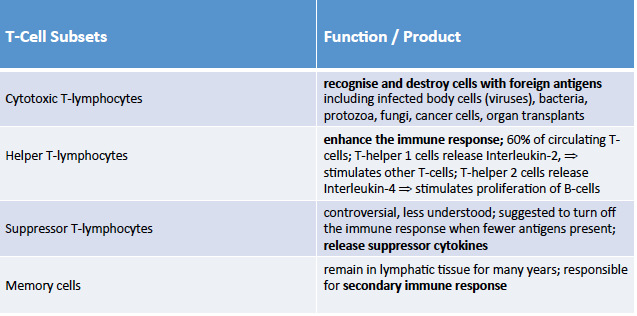
- Cytotoxic T-cells
- combine with surface antigens releasing Cytokines
- e.g. perforine-1
- membrane pores
- i.e destroy infected cells
- membrane pores
- e.g. perforine-1
- combine with surface antigens releasing Cytokines
- Helper T-cells
- release interleukins --> infection site
- attract macrophages
- make other lymphocytes competent to help
- release interleukins --> infection site
- memory cells
- cause rapid second response
- the first response take from 3-14 days
- bearing receptors to the antigen
- pathogens destroyed before it can get established
- e.g. Measles & chickenpox
- cold/influenza viruses change their surface antigens
- pathogens destroyed before it can get established
- cause rapid second response
- suppressor T-cells
- 5. T-cells leave lymph nodes to infection site
- Cytotoxic T-cells
- 4. produce variety of specialised cells (T-cell subsets)
- 3. form clone of cells
- 2. divides mitotically
- 1. increase size
- become activated/sensitized cells
- helper T-cells secret cytokines
- help activate T-cells
- 1 in 10000 T-cells may respond
- originally from red bone marrow
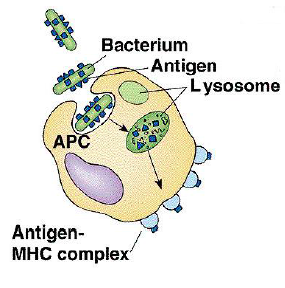
- antigen-presenting cells (APCs)
- dendritic cells
- engulf foreign antigen
- macrophages
- phagocytoses pathogen
- break down surface antigens
- e.g antigen-MHC complex
- phagocytoses pathogen
- competent lymphocytes;
- T-lymphocytes
- Antibody-Mediated immunity
- Cell-Mediated immunity
- non-specific
- innate
- types
- 1. physical barrier
- the skin
- sweat and sebum
- destroy some bacteria
- defensins
- mucin
- lysosome
- destroy some bacteria
- sweat and sebum
- the stomach
- acid secretions
- destroy microorganisms
- acid secretions
- the lungs
- sticky mucous
- lining in Bronchi andbronchioles
- sticky mucous
- the skin
- 2. Cytokines (soluble molecules)
- the special proteins that are secreted collectively when pathogens enter tissues
- interferons
- inhibit viral macromolecule production
- stimulate other immune responses
- release in viral infections
- Interleukins
- secreted by macrophages and lymphocytes
- regulate interaction between various parts of the immune system
- Functions with Tumor Necrosis Factor TNF in mediating inflammation
- some of them stimulate NK cell activation
- Natural Killer Cells (NK)
- large granular lymphocytes from the bone marrow
- 15% of the circulating lymphocytes
- release cytokines e.g perforine
- cause pores in PM of target cells
- PM= Plasma Membrane
- Granzymes then activate a cascade of reactions
- cause apoptosis
- cause pores in PM of target cells
- Natural Killer Cells (NK)
- 3. inflammation
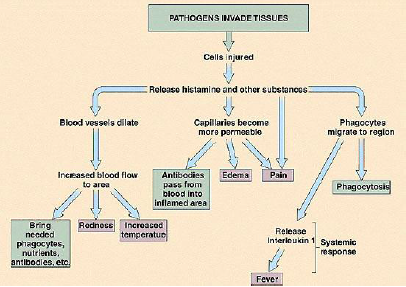
- cells release histamine & serotonine
- dilate blood vessels in the infected area
- increase capillary wall permeability
- cause Oedema
- brings monocytes + neutrophils+ plasma protein gamma globulins (antibodies)
- releasing endogenous pyrogens
- interleukin-1
- prostaglandins
- reset body's thermostat in the hypothalamus to higher (T)
- produce fever or pyrexia
- effects directly bacterial metabolism
- produce fever or pyrexia
- releasing endogenous pyrogens
- increase capillary wall permeability
- dilate blood vessels in the infected area
- cells release histamine & serotonine
- phagocytosis
- major function of inflammation
- they're leucocytes
- Monocytes
- 1. leave the circulation
- 2. transform into macrophages
- phagocytose 〰100 bacteria before dying!
- 2. transform into macrophages
- 1. leave the circulation
- Neutrophils
- phagocytose 〰 20 bacteria before dying
- dead neutrophils formed pus
- smaller
- phagocytose 〰 20 bacteria before dying
- Monocytes
- some bacteria resist it
- e.g. tuberculosis bacilli
- distributed widley
- particularly in the gut wall & lungs
- release interleukin-1
- as inflammatory process
- 1. physical barrier
- prevent the spread of infection
- until specific come into play
- Specific
Imagens e arquivos do mapa

Informações
- Descrição
- this mind map covers the concepts of self and non-self antigens. it also illustrates the specific and non-specific immune responses and much more ...
- Criado por
- fatema Al-Sabahi
- Visualizações
- 139
- Tags
- Avaliação