
Mapa mental
B5a - Skeletons
Conteúdo do mapa
B5a - Skeletons
Types of skeletons
- Internal
- Features: Grows with the rest of the body, flexible as there are lots of joints, organs are protected
- Examples of organisms: humans, tigers, penguins, crocodiles
- Advantages: provides internal framework for the body, flexible due to joints
- Disadvantages: takes a long time to regrow broken bones
- External
- Features: contains a material called chitin.
- Examples of organisms: arachnids, myria pods
- Advantages: Can be regrown quickly compared to internal bones
- Disadvantages: need to shed their exoskeletons when they grow
- Internal skeletonshave many advanatges over external skeletons: It provides an internal framework for the body, grows with the rest of the body, is flexible due to the many joints and it allows easy attachment of muscles
- Endo over Exo
- Internal
Bones and cartilage
- Cartilage and bone are living tissues containing living cells, this means they can be infected by bacteria and viruses. However they are able to grow and repair themselves.
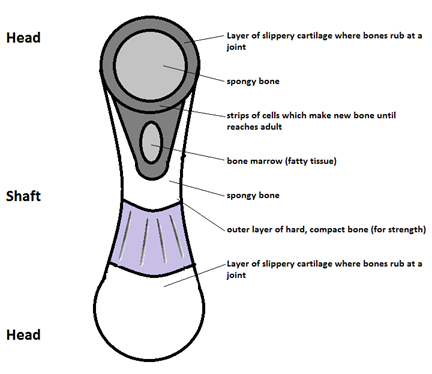
- A long bone contains of a long shaft containing bone marrow with blood vessels. At each end there is a head covered with cartilage. Long bones are hollow, so they are stronger and lighter than solid bones.
- At birth the human skeleton is made of cartilage. Ossification is the proccess of slowly replacing the cartilage by bone. If some cartilage remains between the head and shaft - the bone is still growing.
- In an accident it can be dangerous to move a person with a suspected bone fracture. Broken vertebrae in the backbone can damage the spinal cord, resulting in paralysis or death.
- Fractures
- Even though bones are very strong they can easily be broken by a sharp knock. The bones of elderly people can lack calcium and phosphorus which often results in osteoporosis making them prone to fracture.
- There are threee types of fracture: simple (straight break), compound (comes out of skin) and greenstick (bone not completely broken).
Joints and Joint Replacement
- A joint is where two or more bones meet and muscles act together to cause movement
- Antagonistic pairs - muscles working together, as one contracts another relaxes.
- The forearm is raised and lowered by antagonistic muscles - the biceps and triceps. To raise the biceps contract&triceps relax and vice versa.
- This is an example of a lever, with the elbow acting as a pivot.
- The forearm is raised and lowered by antagonistic muscles - the biceps and triceps. To raise the biceps contract&triceps relax and vice versa.
- Coral and liquid bones can be used as joint replacements however artifical substances are at risk of not being accpeted by the immune system.
- Advantages - it allows patients to live more independantly, improves their quality of life, accidental injuries and amputations can be avoided and there is no worry about rejection.
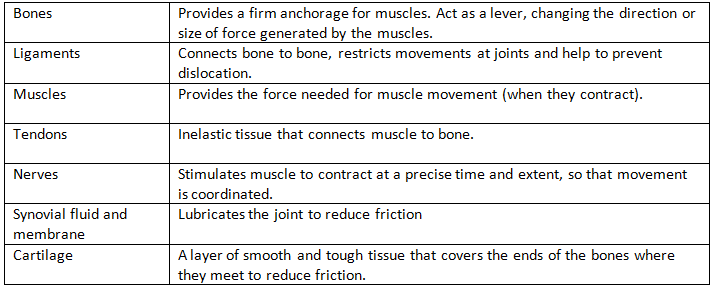
- Synovial joints, such as ball and socket joints and hinge joints, contain synovial fluid, a synovial membrane, ligaments and cartilage.
- Each part of the synovial joint has a special function: the synovial fluis acts as a cushion against shock and a lubricant for easy movement. A synovial membrane holds in the fluid. The cartilage protects protexts the bone head. The ligaments hold the bones in place.
- A ball and socket joint has a wider range of movement than a hinge joint ( these can only go up-and-down)
Imagens e arquivos do mapa
Informações
- Descrição
- mindmap of all topics in B5 a - OCR gateway b
- Criado por
- annie garratt
- Visualizações
- 52
- Tags
- Avaliação