
Mapa mental
Supply chain
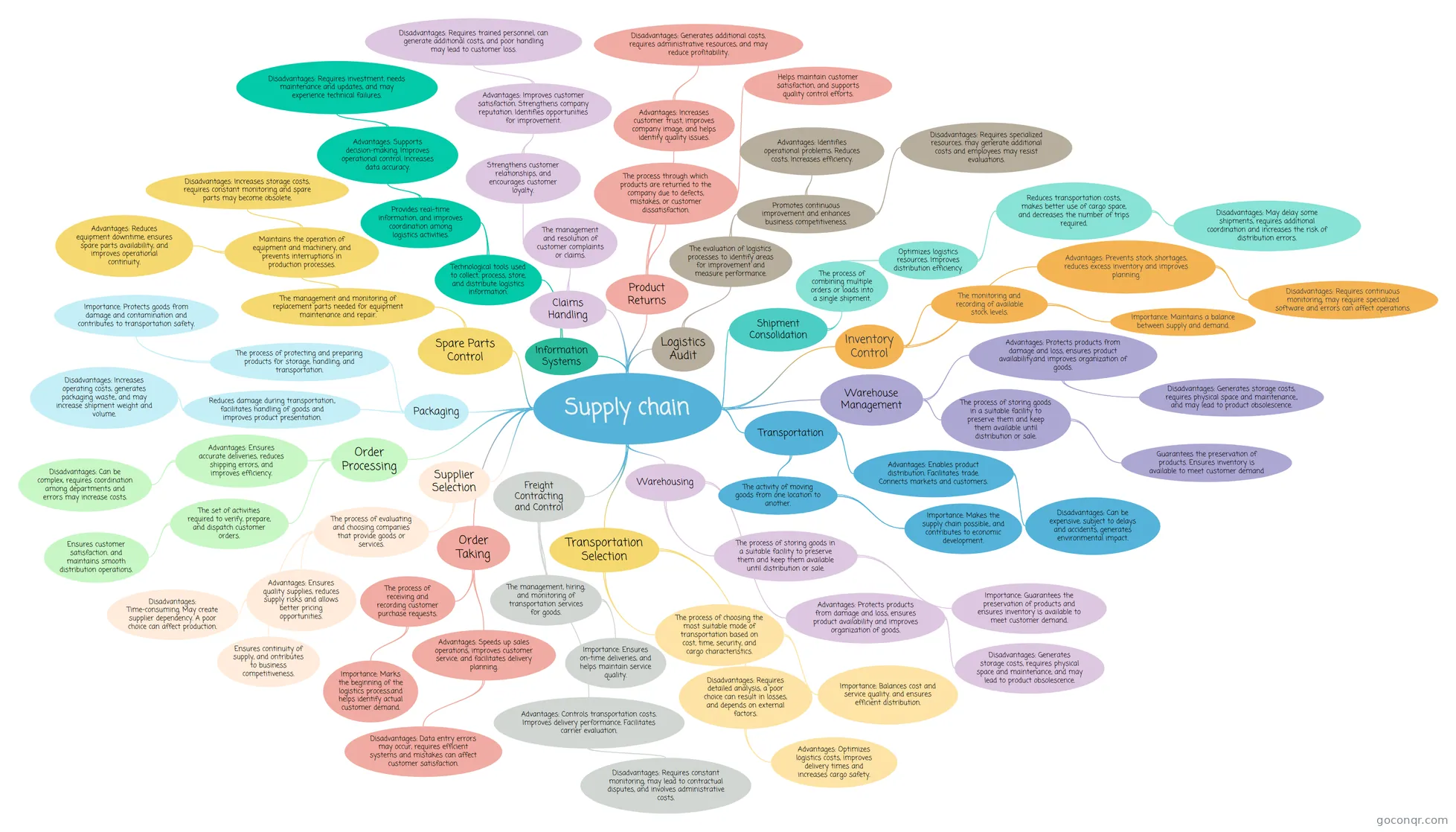
Mind map: Supply chain
Conteúdo do mapa
Supply chain
Warehousing
- Advantages: Protects products from damage and loss, ensures product availability and improves organization of goods.
- Disadvantages: Generates storage costs, requires physical space and maintenance, and may lead to product obsolescence.
- The process of storing goods in a suitable facility to preserve them and keep them available until distribution or sale.
- Importance: Guarantees the preservation of products and ensures inventory is available to meet customer demand.
- Advantages: Protects products from damage and loss, ensures product availability and improves organization of goods.
Warehouse Management
- The process of storing goods in a suitable facility to preserve them and keep them available until distribution or sale.
- Guarantees the preservation of products. Ensures inventory is available to meet customer demand
- Advantages: Protects products from damage and loss, ensures product availability.and improves organization of goods.
- Disadvantages: Generates storage costs, requires physical space and maintenance., and may lead to product obsolescence.
- The process of storing goods in a suitable facility to preserve them and keep them available until distribution or sale.
Packaging
- The process of protecting and preparing products for storage, handling, and transportation.
- Importance: Protects goods from damage and contamination and contributes to transportation safety.
- Reduces damage during transportation., facilitates handling of goods and improves product presentation.
- Disadvantages: Increases operating costs, generates packaging waste., and may increase shipment weight and volume.
- The process of protecting and preparing products for storage, handling, and transportation.
Transportation
- The activity of moving goods from one location to another.
- Importance: Makes the supply chain possible., and contributes to economic development.
- Advantages: Enables product distribution. Facilitates trade. Connects markets and customers.
- Disadvantages: Can be expensive, subject to delays and accidents, generates environmental impact.
- The activity of moving goods from one location to another.
Order Processing
- The set of activities required to verify, prepare, and dispatch customer orders.
- Ensures customer satisfaction. and maintains smooth distribution operations.
- Advantages: Ensures accurate deliveries, reduces shipping errors, and improves efficiency.
- Disadvantages: Can be complex, requires coordination among departments and errors may increase costs.
- The set of activities required to verify, prepare, and dispatch customer orders.
Order Taking
- The process of receiving and recording customer purchase requests.
- Importance: Marks the beginning of the logistics process.and helps identify actual customer demand.
- Advantages: Speeds up sales operations, improves customer service. and facilitates delivery planning.
- Disadvantages: Data entry errors may occur, requires efficient systems and mistakes can affect customer satisfaction.
- The process of receiving and recording customer purchase requests.
Freight Contracting and Control
- The management, hiring, and monitoring of transportation services for goods.
- Importance: Ensures on-time deliveries, and helps maintain service quality.
- Advantages: Controls transportation costs. Improves delivery performance. Facilitates carrier evaluation.
- Disadvantages: Requires constant monitoring, may lead to contractual disputes, and involves administrative costs.
- The management, hiring, and monitoring of transportation services for goods.
Shipment Consolidation
- The process of combining multiple orders or loads into a single shipment.
- Optimizes logistics resources. Improves distribution efficiency.
- Reduces transportation costs, makes better use of cargo space, and decreases the number of trips required.
- Disadvantages: May delay some shipments, requires additional coordination and increases the risk of distribution errors.
- Reduces transportation costs, makes better use of cargo space, and decreases the number of trips required.
- Optimizes logistics resources. Improves distribution efficiency.
- The process of combining multiple orders or loads into a single shipment.
Product Returns
- The process through which products are returned to the company due to defects, mistakes, or customer dissatisfaction.
- Helps maintain customer satisfaction, and supports quality control efforts.
- Advantages: Increases customer trust, improves company image, and helps identify quality issues.
- Disadvantages: Generates additional costs, requires administrative resources, and may reduce profitability.
- The process through which products are returned to the company due to defects, mistakes, or customer dissatisfaction.
Transportation Selection
- The process of choosing the most suitable mode of transportation based on cost, time, security, and cargo characteristics.
- Importance: Balances cost and service quality. and ensures efficient distribution.
- Disadvantages: Requires detailed analysis, a poor choice can result in losses, and depends on external factors.
- Advantages: Optimizes logistics costs, improves delivery times and increases cargo safety.
- The process of choosing the most suitable mode of transportation based on cost, time, security, and cargo characteristics.
Claims Handling
- The management and resolution of customer complaints or claims.
- Strengthens customer relationships, and encourages customer loyalty.
- Advantages: Improves customer satisfaction. Strengthens company reputation. Identifies opportunities for improvement.
- Disadvantages: Requires trained personnel, can generate additional costs, and poor handling may lead to customer loss.
- Advantages: Improves customer satisfaction. Strengthens company reputation. Identifies opportunities for improvement.
- Strengthens customer relationships, and encourages customer loyalty.
- The management and resolution of customer complaints or claims.
Inventory Control
- The monitoring and recording of available stock levels.
- Importance: Maintains a balance between supply and demand.
- Advantages: Prevents stock shortages, reduces excess inventory and improves planning.
- Disadvantages: Requires continuous monitoring, may require specialized software and errors can affect operations.
- The monitoring and recording of available stock levels.
Logistics Audit
- The evaluation of logistics processes to identify areas for improvement and measure performance.
- Promotes continuous improvement and enhances business competitiveness.
- Advantages: Identifies operational problems. Reduces costs. Increases efficiency.
- Disadvantages: Requires specialized resources. may generate additional costs and employees may resist evaluations.
- Promotes continuous improvement and enhances business competitiveness.
- The evaluation of logistics processes to identify areas for improvement and measure performance.
Information Systems
- Technological tools used to collect, process, store, and distribute logistics information.
- Provides real-time information, and improves coordination among logistics activities.
- Advantages: Supports decision-making. Improves operational control. Increases data accuracy.
- Disadvantages: Requires investment, needs maintenance and updates, and may experience technical failures.
- Advantages: Supports decision-making. Improves operational control. Increases data accuracy.
- Provides real-time information, and improves coordination among logistics activities.
- Technological tools used to collect, process, store, and distribute logistics information.
Supplier Selection
- The process of evaluating and choosing companies that provide goods or services.
- Ensures continuity of supply, and ontributes to business competitiveness.
- Advantages: Ensures quality supplies, reduces supply risks and allows better pricing opportunities.
- Disadvantages: Time-consuming. May create supplier dependency. A poor choice can affect production.
- The process of evaluating and choosing companies that provide goods or services.
Spare Parts Control
- The management and monitoring of replacement parts needed for equipment maintenance and repair.
- Maintains the operation of equipment and machinery, and prevents interruptions in production processes.
- Advantages: Reduces equipment downtime, ensures spare parts availability, and improves operational continuity.
- Disadvantages: Increases storage costs, requires constant monitoring and spare parts may become obsolete.
- Maintains the operation of equipment and machinery, and prevents interruptions in production processes.
- The management and monitoring of replacement parts needed for equipment maintenance and repair.
Informações
- Descrição
- Mapa Mental sobre Supply chain, criado por GUADALUPE JESUSITA GARCIA SILVA em 19-06-2026.
- Criado por
- GUADALUPE JESUSITA GARCIA SILVA
- Visualizações
- 1
- Histórico
-
- Criado por GUADALUPE JESUSITA GARCIA SILVA · 19 jun 2026
- Copiado por GUADALUPE JESUSITA GARCIA SILVA · 19 jun 2026
- Avaliação