
Mapa mental
Thermal Physics
Conteúdo do mapa
Thermal Physics
Solids, Liquids and Gasses
- Energy change = mass x specific heat capacity x change in temperature
- Specific Heat Capacity - Energy needed to raise 1 kg of a substance by 1K
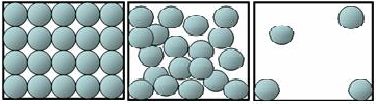
- Solids - Fixed positions, strong attraction between molecules
- Liquid - constantly moving, attraction between molecules
- Gas - constant random motion, no attraction
- Specific Latent Heat of fusion of vaporisation is the thermal energy required to change the state of 1kg of a substance
- Energy change = SLH x mass
- Energy change = mass x specific heat capacity x change in temperature
Ideal Gasses
- Boyle's Law: pV=constant
- Charles' Law: V/T=constant
- Pressure Law: p/T = constant
- - Large number of molecules in rapid random motion - Collision between molecules are elastic - Gravitational force is negligible - no intermolecular forces except during collisions - total volumes of molecules is negligible compared to the volume of the container -
- pV=nRT n-number of moles, R-molar gas constant
- R = 8.31 J mol^-1 K^-1
- pV=NkT N-number of molecules, k-Boltzmann's constant
- k = R/Avagadro's constant = 1.38x10 JK^-1
- Avagadro's constant = 6.02x10^23 mol^1
- For one molecule of gas
- k = R/Avagadro's constant = 1.38x10 JK^-1
Pressure of Ideal Gasses
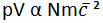
- Pressure is the combined force of all the molecules colliding with the walls of the container at any given time
- The force a particle exerts in proportion to it's change of momentum (2 x mass x velocity) when it rebound of a wall
- c bar squared is the square of the mean speed of a particle
- Real gasses are closest to ideal gasses when the pressure is low but the temperature is high
- Pressure is the combined force of all the molecules colliding with the walls of the container at any given time
Internal Energy andTemperature
- Change of state is a change in Internal energy, but not temperature because molecules gain potential energy, not kinetic
- Thermal energy is always transferred from higher temperature regions to lower ones
- The higher the temperature - both the average and maximum speeds increase, and the speed distribution in the gas also increases
- When particles collide, sometimes they can either gain or lose speed (and energy), this doesn't alter the total energy in the system
- Internal Energy is the sum of the kinetic and potential energy of particles in the system
- E=(3/2)kT
- Average kinetic energy is proportional to Boltzmann's constant x absolute temperature
K = C + 273
Imagens e arquivos do mapa
Informações
- Descrição
- Summary of A2 Thermal Physics
- Criado por
- SarahBarrett
- Visualizações
- 435
- Tags
- Avaliação