
Mapa mental
INTRODUCTION TO ANIMAL DIVERSITY
Conteúdo do mapa
INTRODUCTION TO ANIMAL DIVERSITY
STRUCTURE AND SPECIALIZATION
- Nervous tissue and muscle tissue
- Multicellular
- Heterotroph (ingest food)
- Cells lack cell wall
- Bodies held together (collagen)
REPRODUCTION AND DEVELOPMENT
- Have one larval stage
- Hox genes
- Regulate development body form
- Produce wide diversity of animal morphology
- Zygote undergoes rapid development called as clevage
- Reproduce sexually
- Diploid stage dominate life cycle
- Larva
- Sexually immature
- Distinct from adult
HISTORY OF LIFE SPAN
- 2. PALEOZOIC ERA
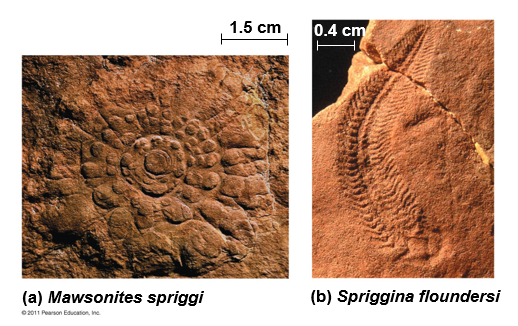
- Cambrian explosion
- Cause by
- Prey-predator relationship
- Rise in level of atmospheric oxygen
- Hox genes evolution
- Earliest fossil animal
- Cause by
- 542-251 million years ago
- Cambrian explosion
- 3. MESOZOIC ERA
- First mammals emerged
- Dinosaurs were dominant terrestrial vertebrates
- 252-65.5 million years ago
- Coral reefs emerged
- Important marine ecological niches
- 4. CENOZOIC ERA
- Mass extinction (land and aquatic)
- Insect diversified
- Modern mammals orders
- 65.5 million years ago - present
- Global climate cooled
- 1. NEOPROTEROZOIC ERA
- 1 billion - 542 million years ago
- 2. PALEOZOIC ERA
BODY PLAN
- To categories animals
- SYMMETRY
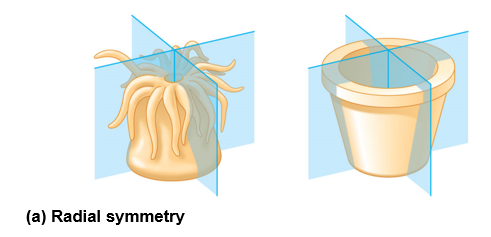
- Radial
- Often sessile or planktonic (drifting or weakly swimming)
- No front and back, or left and right
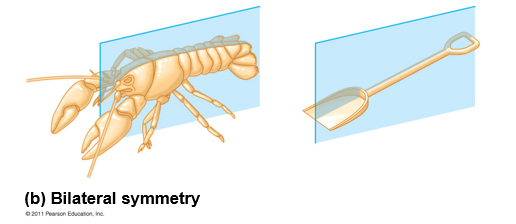
- Bilateral
- Two sided symmetry
- Characteristic
- Cephalization, the development of a head
- A dorsal (top) side and a ventral (bottom) side
- Anterior (head) and posterior (tail) end
- A right and left side
- Move actively and have a central nervous system
- Radial
- TISSUE
- Diploblastic animals
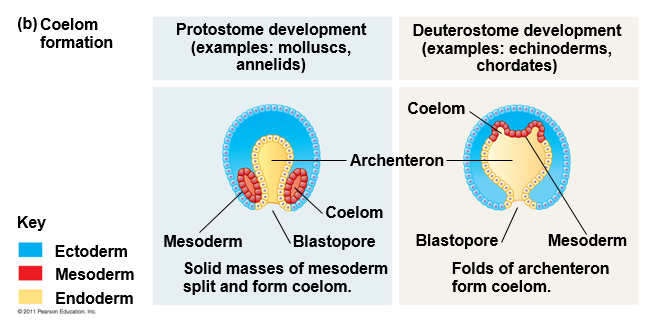
- Ectoderm
- Germ layer covering the embryo’s surface
- Endoderm
- Innermost germ layer and lines the developing digestive tube, called the archenteron
- Ectoderm
- Triploblastic animals
- + Mesoderm
- Three germ layers
- Include all bilaterians
- Diploblastic animals
- CAVITIES
- Coelomates
- Acolomates
- Pseudocoelomates
- A grade is a group whose members share key biological features
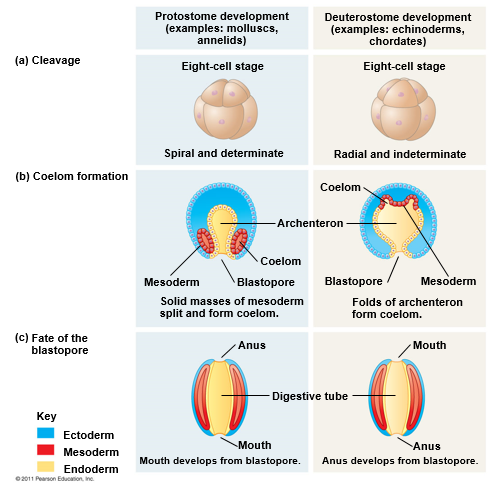
CLEAVAGE
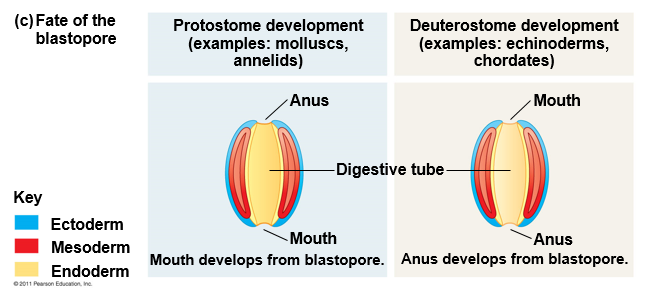
- Deuterostrome
- Cleavage is radial and indeterminate
- Protostrome
- Cleavage is spiral and determinate
- Deuterostrome
Imagens e arquivos do mapa
Informações
- Descrição
- Mapa Mental sobre INTRODUCTION TO ANIMAL DIVERSITY, criado por farisnazmie em 22-03-2016.
- Criado por
- farisnazmie
- Visualizações
- 33
- Avaliação