
Mapa mental
12.2 Chemical Reactions of the Alkanes
Conteúdo do mapa
12.2 Chemical Reactions of the Alkanes
Reactivity of the Alkanes
- Fairly Unreactive
- C-C and C-H sigma bonds are strong
- C-C bonds are non-polar
- the electronegativity of C and H is so similar that the C-H bond can be considered non-polar
- Fairly Unreactive
Complete Combustion of Alkanes
- Plentiful supply of O2
- Water
- Carbon Dioxide
- Exothermic
- This reaction is exothermic as it gives out more heat than it takes in
- Hexane (in petrol) = C6H14 (l) + 9.5O2 (g) --> 6CO2 (g) + 7H2O (l)
- Propane = C3H8 (g) + 5O2 (g) --> 3CO2 (g) + 4H2O (l)
- Ethane = C2H6 (g) + 3.5O2 (g) --> 2CO2 (g) + 3H2O (l)
- Methane (as natural gas) = CH4 (g) + 2O2 (g) --> CO2 (g) + 2H2O (l)
- Examples//
Incomplete Combustion of Alkanes
- Limited supply of O2
- Carbon Monoxide (CO)
- Colourless
- odourless
- Highly toxic
- Carbon could also be formed!
- solid
- Water
- E.g// The incomplete combustion of Heptane
- C7H16 (l) + 7.5O2 (g) --> 7CO (g) + 8H2O
Reactions of Alkanes with Halogens
- UV radiation provides initial energy for reaction to take place
- E.g// Methane + Bromine
- CH4 (g) + Br2 (l) --> CH3Br (g) + HBr (g)
- Forms bromomethane
- CH4 (g) + Br2 (l) --> CH3Br (g) + HBr (g)
- Substitution reaction
- Hydrogen atom int he alkane has been substituted by a halogen atom
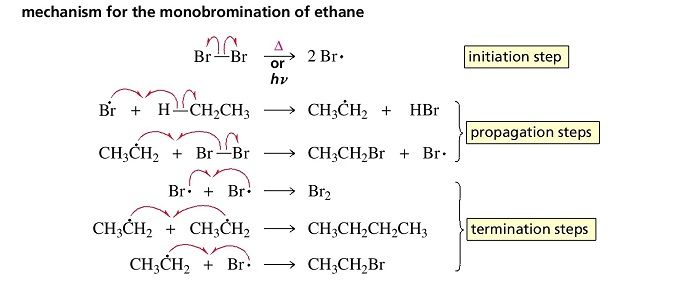
- Mechanism for bromination of Alkanes
- Free Radical Substitution
- Step 1: INITIATION
- Covalent bond in a bromine molecule is broken by HOMOLYCTIC FISSION
- Each bromine atom takes one electron from the pair in the covalent bond
- This forms two highly reactive bromine radicals
- Br-Br --> Br' + Br'
- This forms two highly reactive bromine radicals
- Each bromine atom takes one electron from the pair in the covalent bond
- Covalent bond in a bromine molecule is broken by HOMOLYCTIC FISSION
- Step 2: PROPAGATION
- These 2 propagation steps can keep reacting over and over in a chain reaction. Similar to that reaction with ozone.
- Propagation step 1: CH4 + Br' --> CH3' + HBr
- Propagation step 2: CH3' + Br2 --> CH3Br + Br'
- Each methyl radical reacts with another bromine molecule, forming bromomethane (CH3Br) and a new bromine radical (Br')
- Bromine radical reacts with a C-H bond in the methane to form a methyl radical (CH3') and a molecule fo hydrogen brominde
- Propagation step 2: CH3' + Br2 --> CH3Br + Br'
- Step 3: TERMINATION
- There can be a number of different termination reactions between two radicals
- Two radicals collide, forming a molecule with all electrons paired
- Br' + Br' --> Br2
- CH3' + CH3' --> C2H6
- CH3' + Br' --> CH3Br
- Step 1: INITIATION
- Free Radical Substitution
Limitations of radical substitution in organic synthesis
- Bromomethane CH3Br was formed from radical substitution. Another bromine radical can collide with a bromomethane molecule, substituting it further. This can carry on in a kind of chain reaction.
- Results in a mixture of compounds, E.g/ CH3Br --> CH2Br2 --> CHBr3 --> CBr4
- Substitution at different points in the carbon chain
- methane = only one monobromo compound possible as one carbon
- Ethane = only on monosubstituted product C2H2Br possible
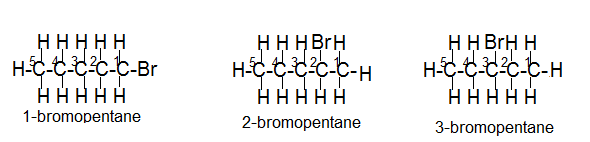
- However pentane could have three monosubstituted isomers
- 1-bromopentane
- 2-bromopentane
- 3-bromopentane
- Bromomethane CH3Br was formed from radical substitution. Another bromine radical can collide with a bromomethane molecule, substituting it further. This can carry on in a kind of chain reaction.
Imagens e arquivos do mapa
Informações
- Descrição
- AS - Level Chemistry (12 - Alkanes) Mapa Mental sobre 12.2 Chemical Reactions of the Alkanes, criado por Bee Brittain em 22-03-2016.
- Criado por
- Bee Brittain
- Visualizações
- 466
- Tags
- Avaliação