
Mapa mental
Heart Failure
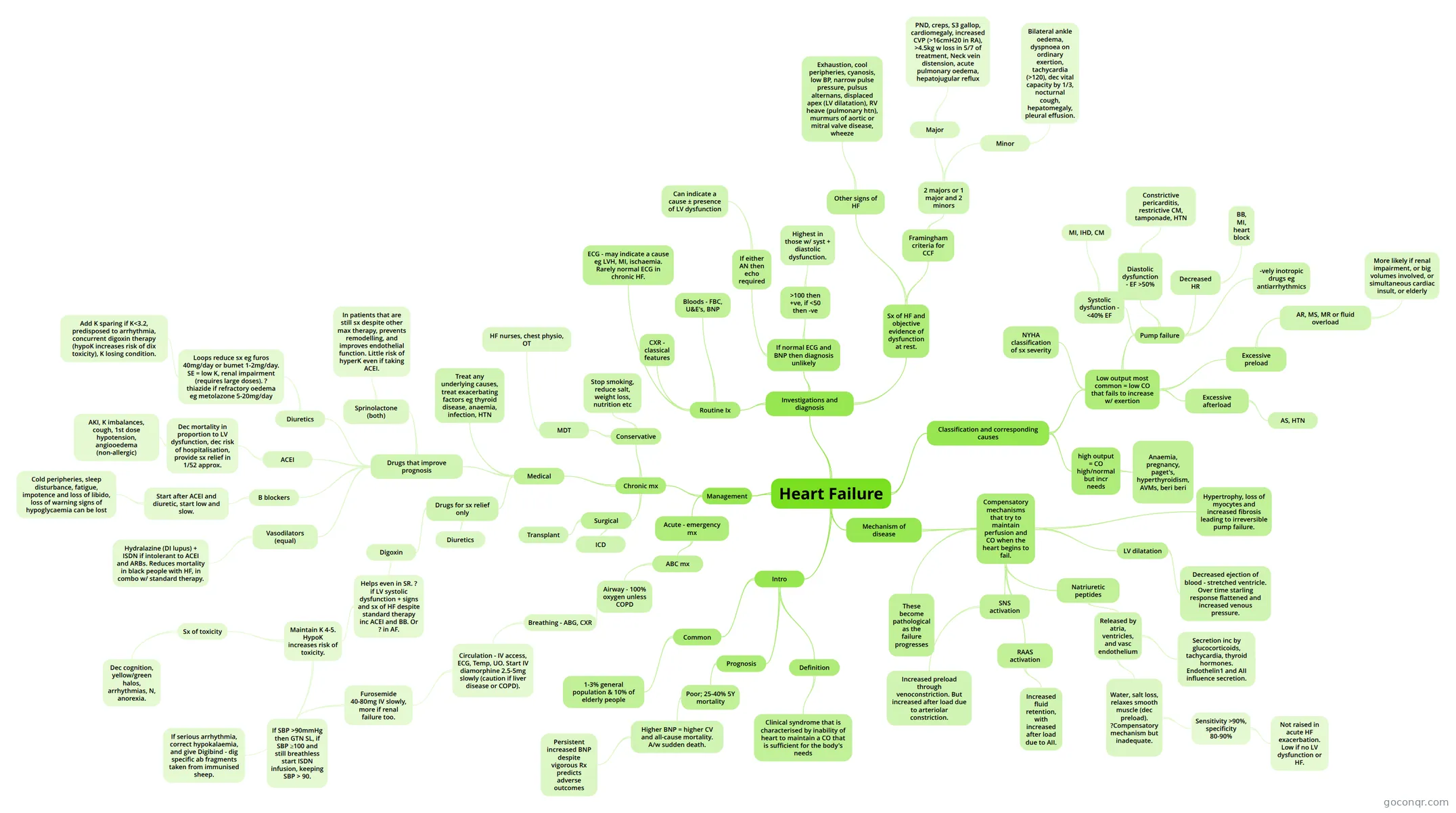
Mind map: Heart failure
Conteúdo do mapa
Heart Failure
Intro
- Common
- 1-3% general population & 10% of elderly people
- Prognosis
- Poor; 25-40% 5Y mortality
- Higher BNP = higher CV and all-cause mortality. A/w sudden death.
- Persistent increased BNP despite vigorous Rx predicts adverse outcomes
- Higher BNP = higher CV and all-cause mortality. A/w sudden death.
- Poor; 25-40% 5Y mortality
- Definition
- Clinical syndrome that is characterised by inability of heart to maintain a CO that is sufficient for the body's needs
- Common
Classification and corresponding causes
- Low output most common = low CO that fails to increase w/ exertion
- Pump failure
- Systolic dysfunction - <40% EF
- MI, IHD, CM
- Diastolic dysfunction - EF >50%
- Constrictive pericarditis, restrictive CM, tamponade, HTN
- Decreased HR
- BB, MI, heart block
- -vely inotropic drugs eg antiarrhythmics
- Systolic dysfunction - <40% EF
- Excessive preload
- AR, MS, MR or fluid overload
- More likely if renal impairment, or big volumes involved, or simultaneous cardiac insult, or elderly
- AR, MS, MR or fluid overload
- Excessive afterload
- AS, HTN
- NYHA classification of sx severity
- Pump failure
- high output = CO high/normal but incr needs
- Anaemia, pregnancy, paget's, hyperthyroidism, AVMs, beri beri
- Low output most common = low CO that fails to increase w/ exertion
Investigations and diagnosis
- If normal ECG and BNP then diagnosis unlikely
- If either AN then echo required
- Can indicate a cause ± presence of LV dysfunction
- >100 then +ve, if <50 then -ve
- Highest in those w/ syst + diastolic dysfunction.
- If either AN then echo required
- Sx of HF and objective evidence of dysfunction at rest.
- Framingham criteria for CCF
- 2 majors or 1 major and 2 minors
- Major
- PND, creps, S3 gallop, cardiomegaly, increased CVP (>16cmH20 in RA), >4.5kg w loss in 5/7 of treatment, Neck vein distension, acute pulmonary oedema, hepatojugular reflux
- Minor
- Bilateral ankle oedema, dyspnoea on ordinary exertion, tachycardia (>120), dec vital capacity by 1/3, nocturnal cough, hepatomegaly, pleural effusion.
- Major
- 2 majors or 1 major and 2 minors
- Other signs of HF
- Exhaustion, cool peripheries, cyanosis, low BP, narrow pulse pressure, pulsus alternans, displaced apex (LV dilatation), RV heave (pulmonary htn), murmurs of aortic or mitral valve disease, wheeze
- Framingham criteria for CCF
- Routine Ix
- Bloods - FBC, U&E's, BNP
- CXR - classical features
- ECG - may indicate a cause eg LVH, MI, ischaemia. Rarely normal ECG in chronic HF.
- If normal ECG and BNP then diagnosis unlikely
Management
- Acute - emergency mx
- ABC mx
- Airway - 100% oxygen unless COPD
- Breathing - ABG, CXR
- Circulation - IV access, ECG, Temp, UO. Start IV diamorphine 2.5-5mg slowly (caution if liver disease or COPD).
- Furosemide 40-80mg IV slowly, more if renal failure too.
- If SBP >90mmHg then GTN SL, if SBP ≥100 and still breathless start ISDN infusion, keeping SBP > 90.
- Furosemide 40-80mg IV slowly, more if renal failure too.
- Circulation - IV access, ECG, Temp, UO. Start IV diamorphine 2.5-5mg slowly (caution if liver disease or COPD).
- Breathing - ABG, CXR
- Airway - 100% oxygen unless COPD
- ABC mx
- Chronic mx
- Conservative
- Stop smoking, reduce salt, weight loss, nutrition etc
- MDT
- HF nurses, chest physio, OT
- Medical
- Treat any underlying causes, treat exacerbating factors eg thyroid disease, anaemia, infection, HTN
- Drugs that improve prognosis
- Diuretics
- Loops reduce sx eg furos 40mg/day or bumet 1-2mg/day. SE = low K, renal impairment (requires large doses). ? thiazide if refractory oedema eg metolazone 5-20mg/day
- Add K sparing if K<3.2, predisposed to arrhythmia, concurrent digoxin therapy (hypoK increases risk of dix toxicity), K losing condition.
- Loops reduce sx eg furos 40mg/day or bumet 1-2mg/day. SE = low K, renal impairment (requires large doses). ? thiazide if refractory oedema eg metolazone 5-20mg/day
- ACEI
- Dec mortality in proportion to LV dysfunction, dec risk of hospitalisation, provide sx relief in 1/52 approx.
- AKI, K imbalances, cough, 1st dose hypotension, angiooedema (non-allergic)
- Dec mortality in proportion to LV dysfunction, dec risk of hospitalisation, provide sx relief in 1/52 approx.
- B blockers
- Start after ACEI and diuretic, start low and slow.
- Cold peripheries, sleep disturbance, fatigue, impotence and loss of libido, loss of warning signs of hypoglycaemia can be lost
- Start after ACEI and diuretic, start low and slow.
- Sprinolactone (both)
- In patients that are still sx despite other max therapy, prevents remodelling, and improves endothelial function. Little risk of hyperK even if taking ACEI.
- Vasodilators (equal)
- Hydralazine (DI lupus) + ISDN if intolerant to ACEI and ARBs. Reduces mortality in black people with HF, in combo w/ standard therapy.
- Diuretics
- Drugs for sx relief only
- Digoxin
- Helps even in SR. ? if LV systolic dysfunction + signs and sx of HF despite standard therapy inc ACEI and BB. Or ? in AF.
- Maintain K 4-5. HypoK increases risk of toxicity.
- Sx of toxicity
- Dec cognition, yellow/green halos, arrhythmias, N, anorexia.
- If serious arrhythmia, correct hypokalaemia, and give Digibind - dig specific ab fragments taken from immunised sheep.
- Sx of toxicity
- Maintain K 4-5. HypoK increases risk of toxicity.
- Helps even in SR. ? if LV systolic dysfunction + signs and sx of HF despite standard therapy inc ACEI and BB. Or ? in AF.
- Diuretics
- Digoxin
- Surgical
- ICD
- Transplant
- Conservative
- Acute - emergency mx
Mechanism of disease
- Compensatory mechanisms that try to maintain perfusion and CO when the heart begins to fail.
- These become pathological as the failure progresses
- SNS activation
- Increased preload through venoconstriction. But increased after load due to arteriolar constriction.
- RAAS activation
- Increased fluid retention, with increased after load due to AII.
- Natriuretic peptides
- Released by atria, ventricles, and vasc endothelium
- Water, salt loss, relaxes smooth muscle (dec preload). ?Compensatory mechanism but inadequate.
- Sensitivity >90%, specificity 80-90%
- Not raised in acute HF exacerbation. Low if no LV dysfunction or HF.
- Sensitivity >90%, specificity 80-90%
- Secretion inc by glucocorticoids, tachycardia, thyroid hormones. Endothelin1 and AII influence secretion.
- Water, salt loss, relaxes smooth muscle (dec preload). ?Compensatory mechanism but inadequate.
- Released by atria, ventricles, and vasc endothelium
- LV dilatation
- Decreased ejection of blood - stretched ventricle. Over time starling response flattened and increased venous pressure.
- Hypertrophy, loss of myocytes and increased fibrosis leading to irreversible pump failure.
- Compensatory mechanisms that try to maintain perfusion and CO when the heart begins to fail.
Informações
- Descrição
- Mapa Mental sobre Heart Failure, criado por kavi em 29-01-2014.
- Criado por
- kavi
- Visualizações
- 40
- Avaliação