
Mapa mental
6.2 Electronegativity and Polarity
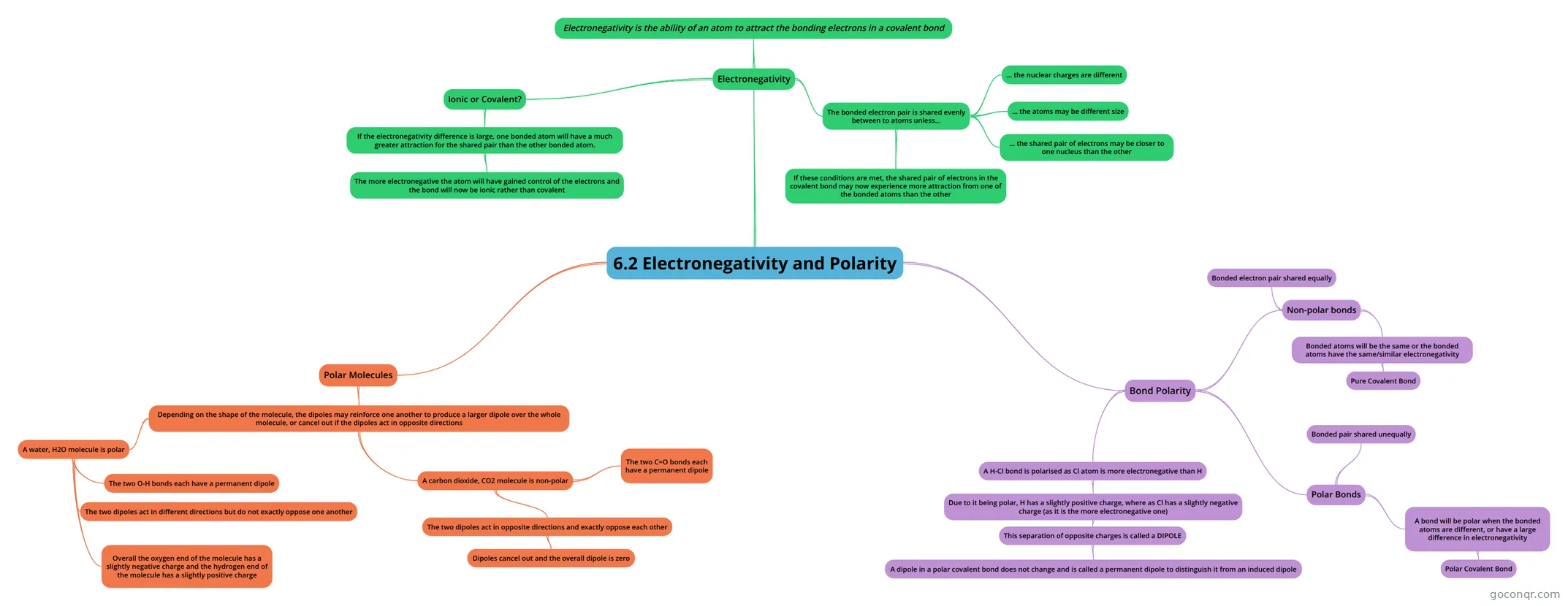
Mind map: Electronegativity and polarity
Conteúdo do mapa
6.2 Electronegativity and Polarity
Electronegativity
- Electronegativity is the ability of an atom to attract the bonding electrons in a covalent bond
- The bonded electron pair is shared evenly between to atoms unless...
- ... the nuclear charges are different
- ... the atoms may be different size
- ... the shared pair of electrons may be closer to one nucleus than the other
- If these conditions are met, the shared pair of electrons in the covalent bond may now experience more attraction from one of the bonded atoms than the other
- Ionic or Covalent?
- If the electronegativity difference is large, one bonded atom will have a much greater attraction for the shared pair than the other bonded atom.
- The more electronegative the atom will have gained control of the electrons and the bond will now be ionic rather than covalent
- If the electronegativity difference is large, one bonded atom will have a much greater attraction for the shared pair than the other bonded atom.
Bond Polarity
- Non-polar bonds
- Bonded electron pair shared equally
- Bonded atoms will be the same or the bonded atoms have the same/similar electronegativity
- Pure Covalent Bond
- Polar Bonds
- Bonded pair shared unequally
- A bond will be polar when the bonded atoms are different, or have a large difference in electronegativity
- Polar Covalent Bond
- A H-Cl bond is polarised as Cl atom is more electronegative than H
- Due to it being polar, H has a slightly positive charge, where as Cl has a slightly negative charge (as it is the more electronegative one)
- This separation of opposite charges is called a DIPOLE
- A dipole in a polar covalent bond does not change and is called a permanent dipole to distinguish it from an induced dipole
- induced dipoles will be on my 6.3 Intermolecular Forces mind map
- A dipole in a polar covalent bond does not change and is called a permanent dipole to distinguish it from an induced dipole
- This separation of opposite charges is called a DIPOLE
- Due to it being polar, H has a slightly positive charge, where as Cl has a slightly negative charge (as it is the more electronegative one)
- Non-polar bonds
Polar Molecules
- Depending on the shape of the molecule, the dipoles may reinforce one another to produce a larger dipole over the whole molecule, or cancel out if the dipoles act in opposite directions
- A water, H2O molecule is polar
- The two O-H bonds each have a permanent dipole
- The two dipoles act in different directions but do not exactly oppose one another
- Overall the oxygen end of the molecule has a slightly negative charge and the hydrogen end of the molecule has a slightly positive charge
- A carbon dioxide, CO2 molecule is non-polar
- The two C=O bonds each have a permanent dipole
- The two dipoles act in opposite directions and exactly oppose each other
- Dipoles cancel out and the overall dipole is zero
- A water, H2O molecule is polar
- Depending on the shape of the molecule, the dipoles may reinforce one another to produce a larger dipole over the whole molecule, or cancel out if the dipoles act in opposite directions
Informações
- Descrição
- AS - Level Chemistry (6 - Shapes of Molecules and Intermolecular Forces) Mapa Mental sobre 6.2 Electronegativity and Polarity, criado por Bee Brittain em 15-04-2016.
- Criado por
- Bee Brittain
- Visualizações
- 371
- Tags
- Avaliação