
Mapa mental
Causes of Rebellions
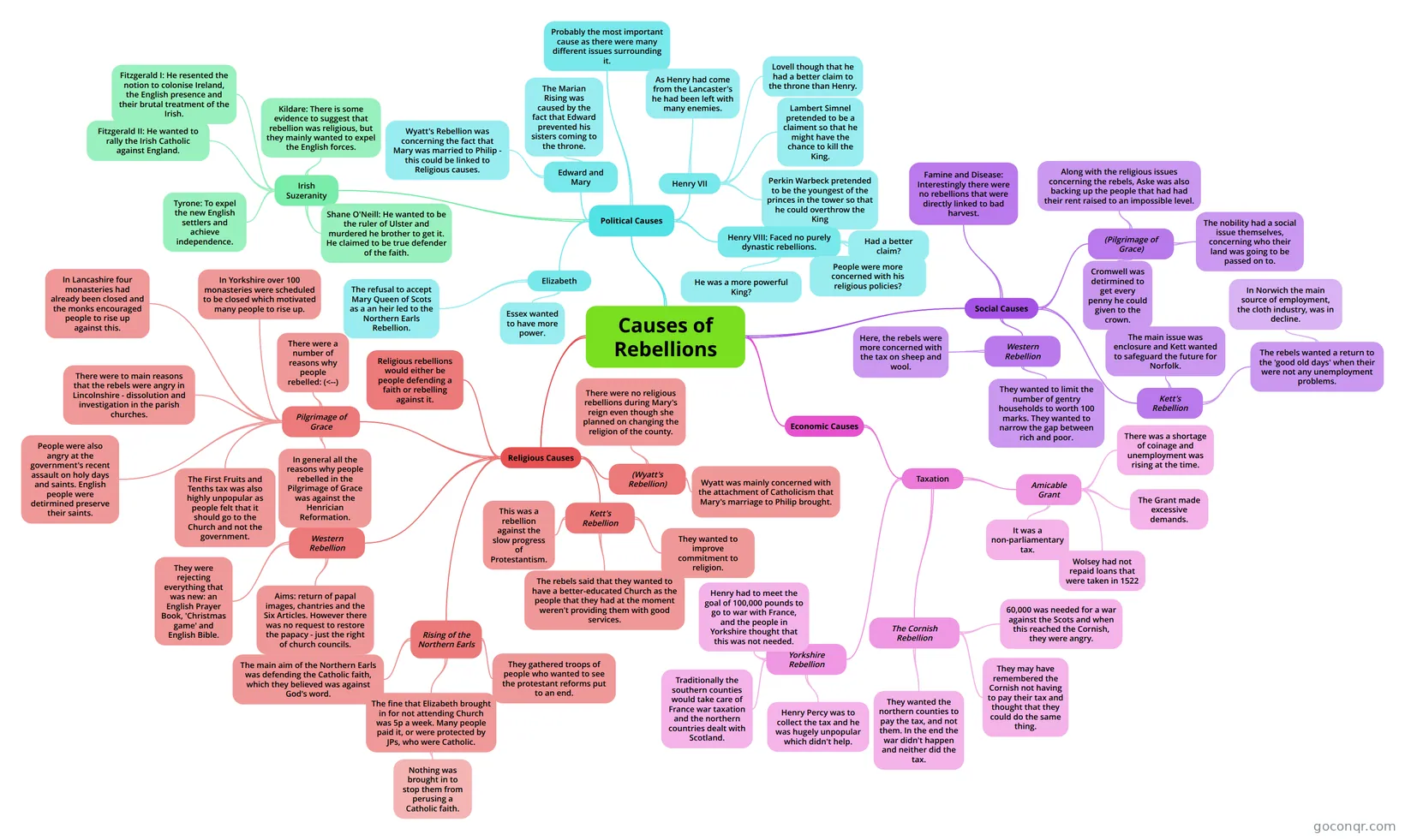
Mind map: Causes of rebellions Tudor England
Conteúdo do mapa
Causes of Rebellions
Social Causes
- Famine and Disease: Interestingly there were no rebellions that were directly linked to bad harvest.
- (Pilgrimage of Grace)
- Along with the religious issues concerning the rebels, Aske was also backing up the people that had had their rent raised to an impossible level.
- The nobility had a social issue themselves, concerning who their land was going to be passed on to.
- Cromwell was detirmined to get every penny he could given to the crown.
- Kett's Rebellion
- The rebels wanted a return to the 'good old days' when their were not any unemployment problems.
- In Norwich the main source of employment, the cloth industry, was in decline.
- The main issue was enclosure and Kett wanted to safeguard the future for Norfolk.
- The rebels wanted a return to the 'good old days' when their were not any unemployment problems.
- Western Rebellion
- Here, the rebels were more concerned with the tax on sheep and wool.
- They wanted to limit the number of gentry households to worth 100 marks. They wanted to narrow the gap between rich and poor.
Political Causes
- Probably the most important cause as there were many different issues surrounding it.
- Henry VII
- As Henry had come from the Lancaster's he had been left with many enemies.
- Lovell though that he had a better claim to the throne than Henry.
- Lambert Simnel pretended to be a claiment so that he might have the chance to kill the King.
- Perkin Warbeck pretended to be the youngest of the princes in the tower so that he could overthrow the King
- Henry VIII: Faced no purely dynastic rebellions.
- He was a more powerful King?
- Had a better claim?
- People were more concerned with his religious policies?
- Edward and Mary
- The Marian Rising was caused by the fact that Edward prevented his sisters coming to the throne.
- Wyatt's Rebellion was concerning the fact that Mary was married to Philip - this could be linked to Religious causes.
- Elizabeth
- The refusal to accept Mary Queen of Scots as a an heir led to the Northern Earls Rebellion.
- Essex wanted to have more power.
- Irish Suzeranity
- Kildare: There is some evidence to suggest that rebellion was religious, but they mainly wanted to expel the English forces.
- Shane O'Neill: He wanted to be the ruler of Ulster and murdered he brother to get it. He claimed to be true defender of the faith.
- Fitzgerald I: He resented the notion to colonise Ireland, the English presence and their brutal treatment of the Irish.
- Fitzgerald II: He wanted to rally the Irish Catholic against England.
- Tyrone: To expel the new English settlers and achieve independence.
Religious Causes
- Religious rebellions would either be people defending a faith or rebelling against it.
- Pilgrimage of Grace
- There were to main reasons that the rebels were angry in Lincolnshire - dissolution and investigation in the parish churches.
- In Yorkshire over 100 monasteries were scheduled to be closed which motivated many people to rise up.
- In Lancashire four monasteries had already been closed and the monks encouraged people to rise up against this.
- People were also angry at the government's recent assault on holy days and saints. English people were detirmined preserve their saints.
- The First Fruits and Tenths tax was also highly unpopular as people felt that it should go to the Church and not the government.
- There were a number of reasons why people rebelled: (<--)
- In general all the reasons why people rebelled in the Pilgrimage of Grace was against the Henrician Reformation.
- Western Rebellion
- They were rejecting everything that was new: an English Prayer Book, 'Christmas game' and English Bible.
- Aims: return of papal images, chantries and the Six Articles. However there was no request to restore the papacy - just the right of church councils.
- Kett's Rebellion
- This was a rebellion against the slow progress of Protestantism.
- The rebels said that they wanted to have a better-educated Church as the people that they had at the moment weren't providing them with good services.
- They wanted to improve commitment to religion.
- (Wyatt's Rebellion)
- There were no religious rebellions during Mary's reign even though she planned on changing the religion of the county.
- Wyatt was mainly concerned with the attachment of Catholicism that Mary's marriage to Philip brought.
- Rising of the Northern Earls
- The main aim of the Northern Earls was defending the Catholic faith, which they believed was against God's word.
- The fine that Elizabeth brought in for not attending Church was 5p a week. Many people paid it, or were protected by JPs, who were Catholic.
- Nothing was brought in to stop them from perusing a Catholic faith.
- They gathered troops of people who wanted to see the protestant reforms put to an end.
Economic Causes
- Taxation
- Yorkshire Rebellion
- Henry had to meet the goal of 100,000 pounds to go to war with France, and the people in Yorkshire thought that this was not needed.
- Traditionally the southern counties would take care of France war taxation and the northern countries dealt with Scotland.
- Henry Percy was to collect the tax and he was hugely unpopular which didn't help.
- The Cornish Rebellion
- 60,000 was needed for a war against the Scots and when this reached the Cornish, they were angry.
- They may have remembered the Cornish not having to pay their tax and thought that they could do the same thing.
- They wanted the northern counties to pay the tax, and not them. In the end the war didn't happen and neither did the tax.
- Amicable Grant
- It was a non-parliamentary tax.
- Wolsey had not repaid loans that were taken in 1522
- The Grant made excessive demands.
- There was a shortage of coinage and unemployment was rising at the time.
- Yorkshire Rebellion
- Taxation
Informações
- Descrição
- Mapa Mental sobre Causes of Rebellions, criado por eleanor.gregory em 21-04-2013.
- Criado por
- eleanor.gregory
- Visualizações
- 441
- Avaliação