
Mapa mental
Phenology
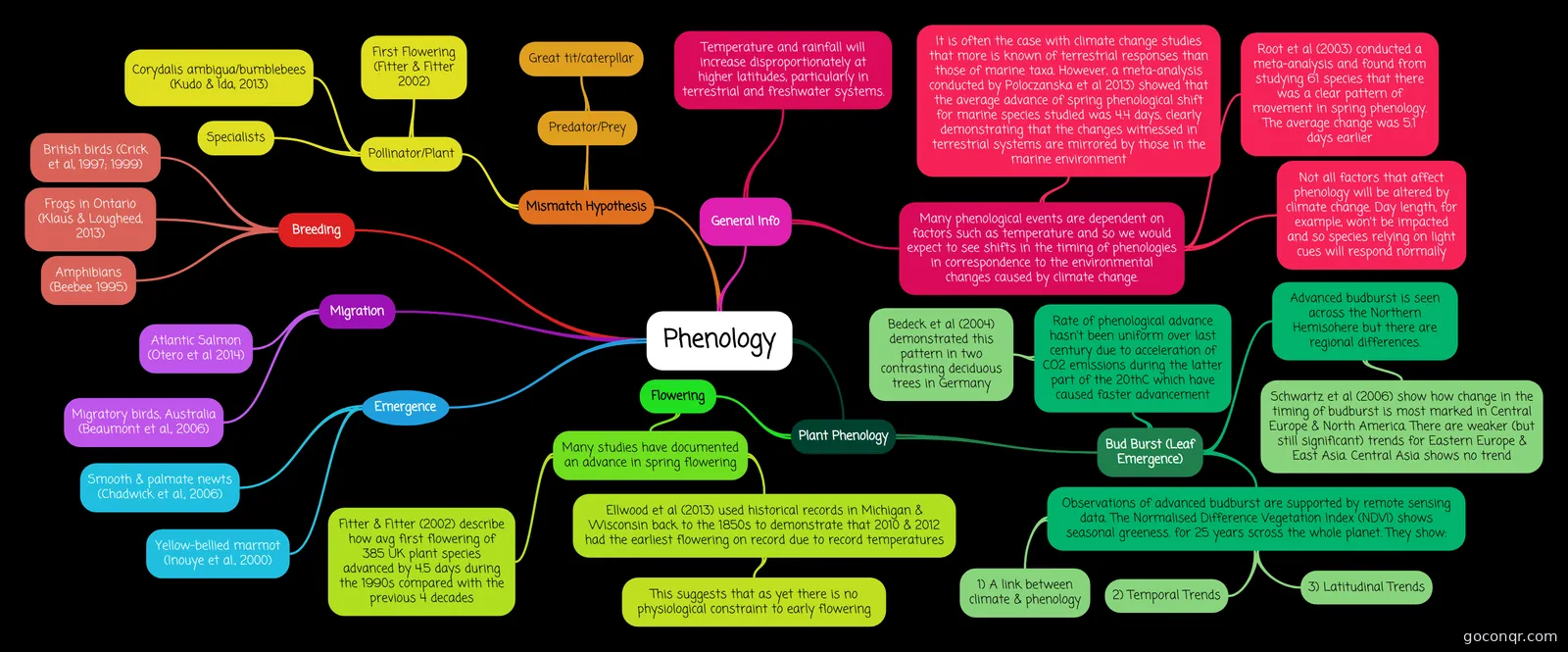
Mind map: Phenology
Conteúdo do mapa
Phenology
General Info
- Temperature and rainfall will increase disproportionately at higher latitudes, particularly in terrestrial and freshwater systems.
- Many phenological events are dependent on factors such as temperature and so we would expect to see shifts in the timing of phenologies in correspondence to the environmental changes caused by climate change.
- Root et al (2003) conducted a meta-analysis and found from studying 61 species that there was a clear pattern of movement in spring phenology. The average change was 5.1 days earlier
- Not all factors that affect phenology will be altered by climate change. Day length, for example, won't be impacted and so species relying on light cues will respond normally
- It is often the case with climate change studies that more is known of terrestrial responses than those of marine taxa. However, a meta-analysis conducted by Poloczanska et al 2013) showed that the average advance of spring phenological shift for marine species studied was 4.4 days, clearly demonstrating that the changes witnessed in terrestrial systems are mirrored by those in the marine environment
Emergence
- Yellow-bellied marmot (Inouye et al., 2000)
- Compared the time of first sighting with temperatures in the Colorado Mountains. Over a 23 year period the marmots emerged 38 days earlier in response to warming springs. However, this is a problem as the rise in temperature has increased the amount of snowfall and thus delayed the time of plants growing in spring. Therefore, the gap between emergence and being able to feed has lengthened and increased energetic costs for the marmots. This could have further consequences e.g. reproduction.
- Smooth & palmate newts (Chadwick et al., 2006)
- Looked at spring emergence of both species of newt. There was a significant advance for both species in emergence of 2-5 days/yr with palmate newts emerging earlier than smooth newts in warmer years. This differential response could have positive consequences in that there will be less temporal overlap between the species and so less competition. Alternatively, (and arguably more likely) the difference, for at least the short term, won't be enough to reduce competition but instead will put the palmate newt at an advantage because the young will already be that little bit more developed at every point of the life-cycle. This is assuming that much of their respective niches overlap however.
- Yellow-bellied marmot (Inouye et al., 2000)
Migration
- Migratory birds, Australia (Beaumont et al., 2006)
- Looked at arrival and departure dates for species from a wide range of taxa. They found clear shifts in timing of migration for a number of the species. There were differences however, between short-distance and long-distance migratory species. The former tended to arrive early and depart later, while the latter tended to arrive earlier but also depart earlier, shifting the timing of their stay rather than the duration. This is likely due to the bigger loss they stand to risk if they time their departure incorrectly.
- Atlantic Salmon (Otero et al 2014)
- Young Atlantic salmon migrate downstream to the ocean to feed and grow. This migration (which occurs annually) is a vital stage in the life history of the species. Otero et al analysed variations in the dates of downstream smolt migration in 67 rivers throughout the North Atlantic during the last 5 decades. The average initiation of the smolt seaward migration has occurred 2.5 days earlier per decade in throughout the region. This shift matches changes in air, river, and ocean temperatures which suggests that the species is responding in accordance with climate change.
- Migratory birds, Australia (Beaumont et al., 2006)
Breeding
- British birds (Crick et al, 1997; 1999)
- British Trust for Ornithology (BTO) have breeding phenology data for about 120 bird species dating back to 1939. They found that 20 species over a 25 yr period laid eggs significantly earlier than previous years & 51 also showed a trend towards earlier breeding. There was no relationship between taxonomy or ecology of species and their phenology.
- A subsequent study showed that laying date was related to temperature or rainfall in 31 of 36 species studied. 37% of species showed long-term trends in advanced egg laying that could be accounted for by climate change.
- Amphibians (Beebee 1995)
- Frogs in Ontario (Klaus & Lougheed, 2013)
- They looked at the breeding phenology of 8 anuran species in eastern Ontario over a period of 40 years in relation to a number of climate variables. They found that two species advanced their calling activity significantly over the 40 year period, one of which emerged significantly earlier, in correlation with increased temperatures. They reasoned that since calling activity was initiated earlier in these two species it would not be unlikely that they should also be breeding earlier.
- British birds (Crick et al, 1997; 1999)
Mismatch Hypothesis
- Durrant et al (2007) " seeks to explain recruitment variation in a population by means of the relationship between its phenology... and that of a species at the immediate lower level". It's not just the species experiencing the shift in phenology that may suffer deleterious consequences, but also the other species that are trophically connected to it. These relationships must be investigated under climate change if we are to understand impacts at the community and even ecosystem level.
- Predator/Prey
- Predators often sync reproduction with high prey abundance. Therefore, shifts in prey phenology have to be matched by predators.
- Great tit/caterpllar
- A number of studies have investigated the relationship between great tits and caterpillars in the Netherlands. It's been found that the timing of egg-laying has become increasingly asynchronous with peak abundance of caterpillars, on which chicks are fed (Visser et al 1998). Caterpillar abundance has shifted with budburst and climate change but reproduction of great tits has not shifted to coincide. Predictive models therefore (Visser et al 2006) suggest that though tits will advance breeding, they will fail to catch up with caterpillar phenology.
- Oddly, great tits in Britain have been shown to be able to match their phenology to a shifting climate (Charmantier et al 2008) which poses the question: what is different about these two populations that one can adapt and one seems less able?
- Pollinator/Plant
- The importance of successful pollination to both the natural and human worlds cannot be overstated, and since nearly 90% of angiosperms are pollinated by animals (Ollerton et al 2011) maintaining synchrony between plants and pollinators is vital.
- First Flowering (Fitter & Fitter 2002)
- During the 1990s average first flowering of 385 British plant species advanced by 4.5 days compared with the previous 4 decades.
- Specialists
- Mismatch is thought to be a particularly significant problem for specialist pollinator species or plants that are only pollinated by a restricted number of species. For example, red clover is only pollinated by long-tongue bumblebees and there is only really 1 species left. If phenological mismatch occurs between them then it would be problematic for both pollinator and plant. The plant would not be able to reproduce and the pollinator would lose a significant food resource (in some cases the only food resource).
- Corydalis ambigua/bumblebees (Kudo & Ida, 2013)
- Kudo and Ida looked at the phenologies of Corydalis ambigua and its pollinators, bumblebees and subsequent seed-set success over 10-14 years. They found that when spring came earlier, flowering tended to occur first with first appearance of the bees lagging behind. This led to decreased seed production due to lower pollination. This suggests that this phenological mismatch is a major limiting factor in reproductive success for this species and possibly spring ephemerals in general.
Plant Phenology
- Many aspects of plant development are closely linked to climate. Therefore, elevated temperatures & increased rainfall will likely cause shifts in growing seasons, affecting the timing of natural events. Plant phenology is expected to be one of the most responsive & easily studied traits in relation to climate change.
- Bud Burst (Leaf Emergence)
- Advanced budburst is seen across the Northern Hemisohere but there are regional differences.
- Schwartz et al (2006) show how change in the timing of budburst is most marked in Central Europe & North America. There are weaker (but still significant) trends for Eastern Europe & East Asia. Central Asia shows no trend
- Rate of phenological advance hasn't been uniform over last century due to acceleration of CO2 emissions during the latter part of the 20thC which have caused faster advancement
- Bedeck et al (2004) demonstrated this pattern in two contrasting deciduous trees in Germany
- Observations of advanced budburst are supported by remote sensing data. The Normalised Difference Vegetation Index (NDVI) shows seasonal greeness. for 25 years scross the whole planet. They show:
- 1) A link between climate & phenology
- Satellite data from 1992 (Bedeck et al 2004) illustrate how the rate of greening in deciduous forests is linked to climate in Western Europe. The growing season starts earlier in oceanic Portugal, but later in cold, continental Poland. Later emergence at altitude is also clear. This confirms that emergence is temperature driven
- 2) Temporal Trends
- Recent rapid increases in temperature are mirrored by advanced greening. Slaybeck et al (2003) looked at NDVI in the Northern Hemisphere from 1982 to 1999 & showed that the rate of change in NDVI was greater in the 90s than the 80s. This confirms ground observations that the rate of change has increased
- 3) Latitudinal Trends
- Slaybeck et al (2003) also compared NDVI across latitudinal ranges. Significant trends between NDVI & year weaken & disappear as latitude decreases. Spring is getting ever earlier in high latitudes of the N. Hemisphere where observed phenological changes are greatest
- 1) A link between climate & phenology
- Advanced budburst is seen across the Northern Hemisohere but there are regional differences.
- Flowering
- Another well studied aspect of plant phenology is flowering
- Many studies have documented an advance in spring flowering
- Fitter & Fitter (2002) describe how avg first flowering of 385 UK plant species advanced by 4.5 days during the 1990s compared with the previous 4 decades
- Ellwood et al (2013) used historical records in Michigan & Wisconsin back to the 1850s to demonstrate that 2010 & 2012 had the earliest flowering on record due to record temperatures
- This suggests that as yet there is no physiological constraint to early flowering
Informações
- Descrição
- BSc Degree Conservation Biology (Global Change) Mapa Mental sobre Phenology, criado por Madison Burt em 20-05-2016.
- Criado por
- Madison Burt
- Visualizações
- 1
- Avaliação