
Mapa mental
Topic 2 - Accounting Analysis
Conteúdo do mapa
Topic 2 - Accounting Analysis
Accounting Analysis
- Purpose
- Evaluate the degree to which a firm's accounting captures its underlying business reality and to undo any accounting distortions.
- Why
- Financial Reporting information is noisy and biased (even in the presence of accounting regulation and external auditing
- It s an important precondition for effective financial analysis, as the quality of the inferences drawn depend on the quality of underlying accounting information
- The Briloff Effect
- Prelude to analysis
- Understand the business
- Understand the accounting policies
- Understand the business areas where accounting quality is most doubtful
- Understand the situations in which management are particularly tempted to 'manager earnings' (manipulation)
- Process
- Evaluating Earnings Quality
- Identify and Assess Key Accounting Policies
- Assess Accounting Flexibility
- Evaluate Accounting/Reporting Strategy
- Evaluate the Quality of Disclosure
- Identify and Assess Potential Red flags
- Adjusting Financial Statements
- Undo Accounting Distortions to better serve your analysis
- Evaluating Earnings Quality
- Purpose
Income Statement Analysis
- The income statement provides information about the profitability of a firm for a period of time
- Earnings Management
- The choice of discretionary accruals and accounting policies within GAAP so as to achieve specified objectives
- as opposed to Earnings Manipulation
- Types
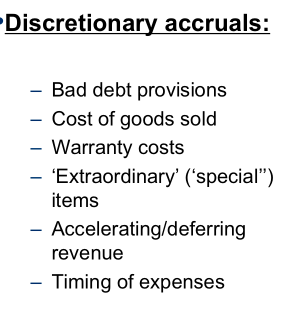
- Discretionary accruals
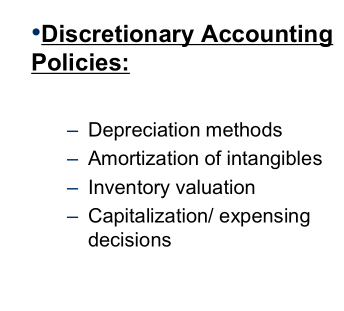
- Discretionary Accounting Policies
- Motives
- Capital Market (Shar prices, IPOs, takeovers)
- Debt covenants
- Political motives
- Executive compensation
- Capital Market: Share prices, IPOs, Takeovers
- Debt covenants
- Political Motives
- Executive compensation
- Empirical Evidence
- The Kay Review 2012
- Graham et al. (2005)
- Revenue Recognition
- Defined
- Key Issue - Timing of revenue recognition
- Adjusting Journal Entries
- Dr decreases, CR increases
- Dr Revenues Cr Unearned revenues (Take out of recorded revenues and 'reclassify' as unearned, when they have been recorded too early, more conservative accounting)
- Revenue with deferred payment
- Recognition at time of job: Dr: A/R Cr: Revenue Dr: Expense (e.g. Line costs) Cr:Liability when receive payment: Dr: Liability Cr: Expense Results in lower expenses and higher earnings. Ensure that this hasn't been prematurely done as opportunism.
- Dr: A/R Cr: Rev Dr: Bad debt expense Cr: Allowance for bad debts
- Capitalisation
- Dr: Asset to be capitalised Cr: Operating Costs Dr: Depr'n Cr: Asset to be capitalised
- Reversing premature realisation
- Dr: Rev Cr: A/R Dr: Inventory Cr: COGS Dr: Deffered Tax Liability Cr: Tax expense
- Unearned Revenue
- Dr: Revenue Cr: Unearned Revenue (Reduce sales, and increase amount of unearned revenue)
- Dr decreases, CR increases
Imagens e arquivos do mapa
Informações
- Descrição
- University Financial Accounting Theory Mapa Mental sobre Topic 2 - Accounting Analysis, criado por Sarah van der Post em 29-05-2016.
- Criado por
- Sarah van der Post
- Visualizações
- 0
- Avaliação