
Mapa mental
Physics: Forces and Equilibrium
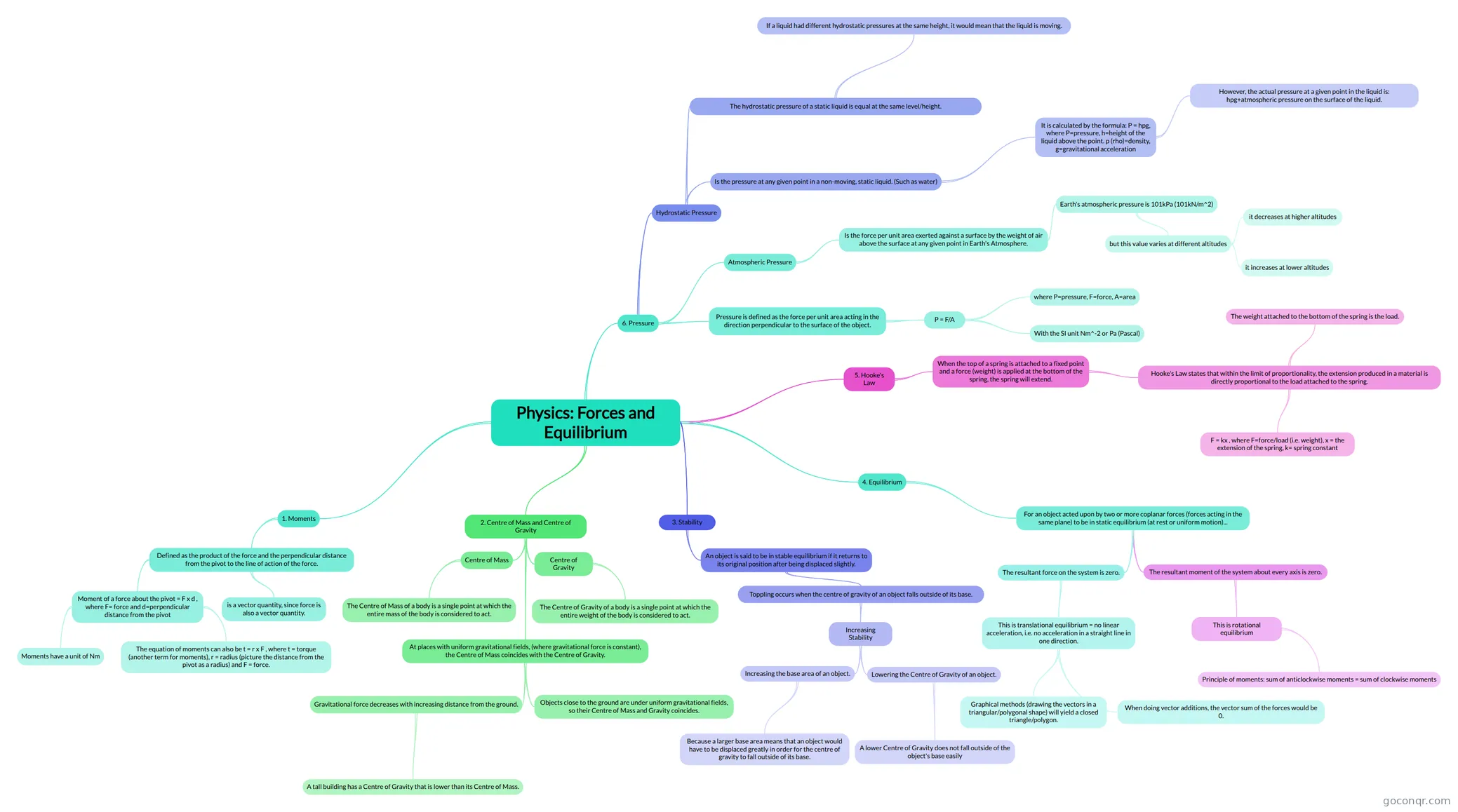
Mind map: Physics forces and equilibrium
Conteúdo do mapa
Physics: Forces and Equilibrium
1. Moments
- Defined as the product of the force and the perpendicular distance from the pivot to the line of action of the force.
- Moment of a force about the pivot = F x d , where F= force and d=perpendicular distance from the pivot
- Moments have a unit of Nm
- The equation of moments can also be t = r x F , where t = torque (another term for moments), r = radius (picture the distance from the pivot as a radius) and F = force.
- is a vector quantity, since force is also a vector quantity.
- Moment of a force about the pivot = F x d , where F= force and d=perpendicular distance from the pivot
- Defined as the product of the force and the perpendicular distance from the pivot to the line of action of the force.
2. Centre of Mass and Centre of Gravity
- Centre of Mass
- The Centre of Mass of a body is a single point at which the entire mass of the body is considered to act.
- Centre of Gravity
- The Centre of Gravity of a body is a single point at which the entire weight of the body is considered to act.
- At places with uniform gravitational fields, (where gravitational force is constant), the Centre of Mass coincides with the Centre of Gravity.
- Objects close to the ground are under uniform gravitational fields, so their Centre of Mass and Gravity coincides.
- Gravitational force decreases with increasing distance from the ground.
- A tall building has a Centre of Gravity that is lower than its Centre of Mass.
- Centre of Mass
3. Stability
- An object is said to be in stable equilibrium if it returns to its original position after being displaced slightly.
- Toppling occurs when the centre of gravity of an object falls outside of its base.
- Increasing Stability
- Increasing the base area of an object.
- Because a larger base area means that an object would have to be displaced greatly in order for the centre of gravity to fall outside of its base.
- Lowering the Centre of Gravity of an object.
- A lower Centre of Gravity does not fall outside of the object's base easily
- Increasing the base area of an object.
- Increasing Stability
- Toppling occurs when the centre of gravity of an object falls outside of its base.
- An object is said to be in stable equilibrium if it returns to its original position after being displaced slightly.
4. Equilibrium
- For an object acted upon by two or more coplanar forces (forces acting in the same plane) to be in static equilibrium (at rest or uniform motion)...
- The resultant force on the system is zero.
- This is translational equilibrium = no linear acceleration, i.e. no acceleration in a straight line in one direction.
- When doing vector additions, the vector sum of the forces would be 0.
- Graphical methods (drawing the vectors in a triangular/polygonal shape) will yield a closed triangle/polygon.
- This is translational equilibrium = no linear acceleration, i.e. no acceleration in a straight line in one direction.
- The resultant moment of the system about every axis is zero.
- This is rotational equilibrium
- Principle of moments: sum of anticlockwise moments = sum of clockwise moments
- This is rotational equilibrium
- The resultant force on the system is zero.
- For an object acted upon by two or more coplanar forces (forces acting in the same plane) to be in static equilibrium (at rest or uniform motion)...
5. Hooke's Law
- When the top of a spring is attached to a fixed point and a force (weight) is applied at the bottom of the spring, the spring will extend.
- Hooke's Law states that within the limit of proportionality, the extension produced in a material is directly proportional to the load attached to the spring.
- F = kx , where F=force/load (i.e. weight), x = the extension of the spring, k= spring constant
- The weight attached to the bottom of the spring is the load.
- Hooke's Law states that within the limit of proportionality, the extension produced in a material is directly proportional to the load attached to the spring.
- When the top of a spring is attached to a fixed point and a force (weight) is applied at the bottom of the spring, the spring will extend.
6. Pressure
- Pressure is defined as the force per unit area acting in the direction perpendicular to the surface of the object.
- P = F/A
- With the SI unit Nm^-2 or Pa (Pascal)
- where P=pressure, F=force, A=area
- P = F/A
- Atmospheric Pressure
- Is the force per unit area exerted against a surface by the weight of air above the surface at any given point in Earth's Atmosphere.
- Earth's atmospheric pressure is 101kPa (101kN/m^2)
- but this value varies at different altitudes
- it decreases at higher altitudes
- it increases at lower altitudes
- but this value varies at different altitudes
- Earth's atmospheric pressure is 101kPa (101kN/m^2)
- Is the force per unit area exerted against a surface by the weight of air above the surface at any given point in Earth's Atmosphere.
- Hydrostatic Pressure
- Is the pressure at any given point in a non-moving, static liquid. (Such as water)
- It is calculated by the formula: P = hpg, where P=pressure, h=height of the liquid above the point. p (rho)=density, g=gravitational acceleration
- However, the actual pressure at a given point in the liquid is: hpg+atmospheric pressure on the surface of the liquid.
- It is calculated by the formula: P = hpg, where P=pressure, h=height of the liquid above the point. p (rho)=density, g=gravitational acceleration
- The hydrostatic pressure of a static liquid is equal at the same level/height.
- If a liquid had different hydrostatic pressures at the same height, it would mean that the liquid is moving.
- Is the pressure at any given point in a non-moving, static liquid. (Such as water)
- Pressure is defined as the force per unit area acting in the direction perpendicular to the surface of the object.
Informações
- Descrição
- This mind map includes a lot of concepts such as moments, CG, Center of mass, stability, Hooke's Law, objects in equilibrium and pressure (Atmospheric & Hydrostatic Pressure).
- Criado por
- Meldy Miyashita
- Visualizações
- 456
- Tags
- Avaliação