
Mapa mental
Cautionary Obligations
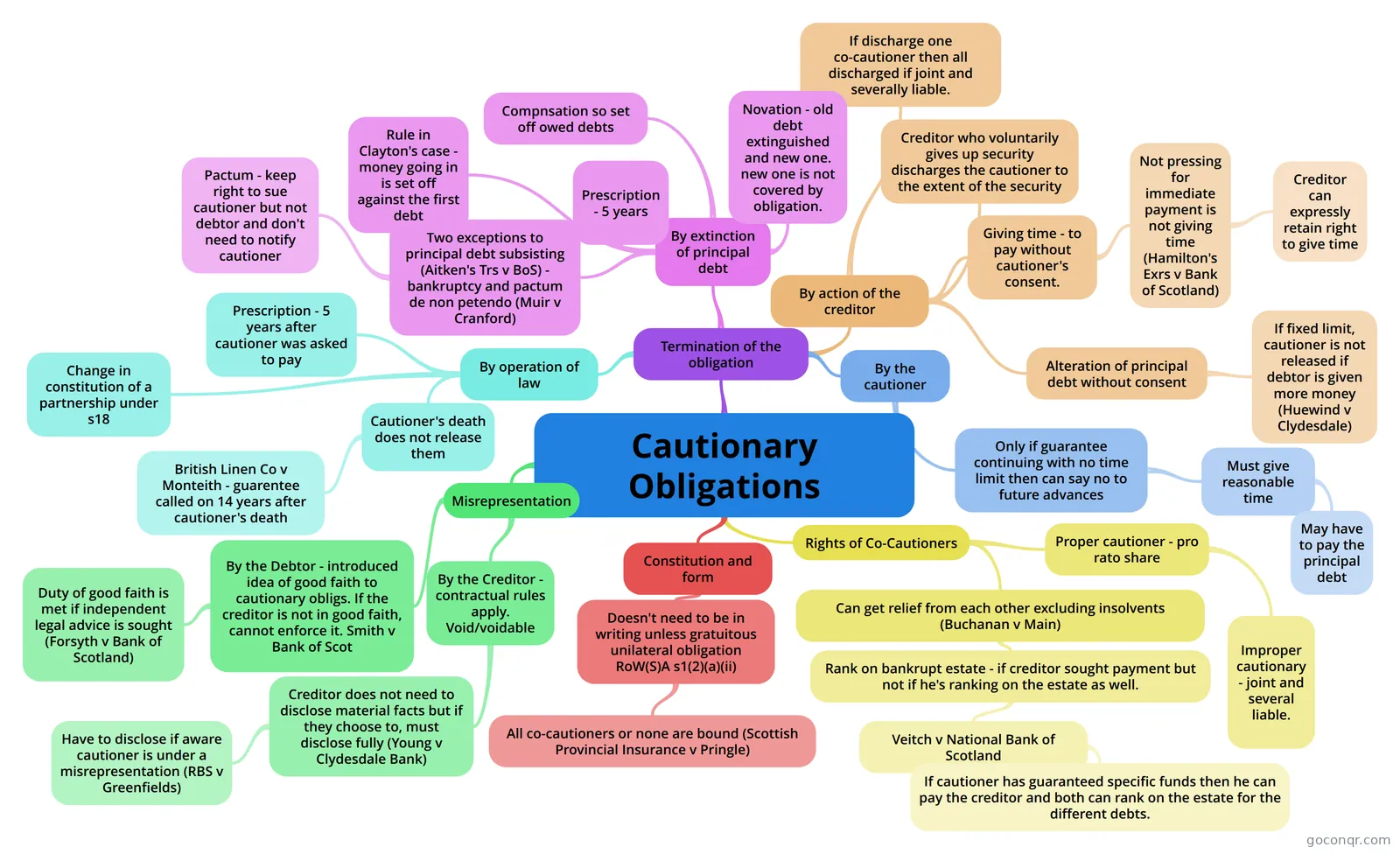
Mind map: Cautionary obligations
Conteúdo do mapa
Cautionary Obligations
Constitution and form
- Doesn't need to be in writing unless gratuitous unilateral obligation RoW(S)A s1(2)(a)(ii)
- All co-cautioners or none are bound (Scottish Provincial Insurance v Pringle)
- Doesn't need to be in writing unless gratuitous unilateral obligation RoW(S)A s1(2)(a)(ii)
Misrepresentation
- By the Creditor - contractual rules apply. Void/voidable
- Creditor does not need to disclose material facts but if they choose to, must disclose fully (Young v Clydesdale Bank)
- Have to disclose if aware cautioner is under a misrepresentation (RBS v Greenfields)
- Creditor does not need to disclose material facts but if they choose to, must disclose fully (Young v Clydesdale Bank)
- By the Debtor - introduced idea of good faith to cautionary obligs. If the creditor is not in good faith, cannot enforce it. Smith v Bank of Scot
- Duty of good faith is met if independent legal advice is sought (Forsyth v Bank of Scotland)
- By the Creditor - contractual rules apply. Void/voidable
Rights of Co-Cautioners
- Can get relief from each other excluding insolvents (Buchanan v Main)
- Rank on bankrupt estate - if creditor sought payment but not if he's ranking on the estate as well.
- Veitch v National Bank of Scotland
- If cautioner has guaranteed specific funds then he can pay the creditor and both can rank on the estate for the different debts.
- Veitch v National Bank of Scotland
- Rank on bankrupt estate - if creditor sought payment but not if he's ranking on the estate as well.
- Proper cautioner - pro rato share
- Improper cautionary - joint and several liable.
- Can get relief from each other excluding insolvents (Buchanan v Main)
Termination of the obligation
- By the cautioner
- Only if guarantee continuing with no time limit then can say no to future advances
- Must give reasonable time
- May have to pay the principal debt
- Must give reasonable time
- Only if guarantee continuing with no time limit then can say no to future advances
- By operation of law
- Cautioner's death does not release them
- British Linen Co v Monteith - guarentee called on 14 years after cautioner's death
- Change in constitution of a partnership under s18
- Prescription - 5 years after cautioner was asked to pay
- Cautioner's death does not release them
- By action of the creditor
- Giving time - to pay without cautioner's consent.
- Not pressing for immediate payment is not giving time (Hamilton's Exrs v Bank of Scotland)
- Creditor can expressly retain right to give time
- Not pressing for immediate payment is not giving time (Hamilton's Exrs v Bank of Scotland)
- Alteration of principal debt without consent
- If fixed limit, cautioner is not released if debtor is given more money (Huewind v Clydesdale)
- If discharge one co-cautioner then all discharged if joint and severally liable.
- Creditor who voluntarily gives up security discharges the cautioner to the extent of the security
- Giving time - to pay without cautioner's consent.
- By extinction of principal debt
- Two exceptions to principal debt subsisting (Aitken's Trs v BoS) - bankruptcy and pactum de non petendo (Muir v Cranford)
- Pactum - keep right to sue cautioner but not debtor and don't need to notify cautioner
- Rule in Clayton's case - money going in is set off against the first debt
- Compnsation so set off owed debts
- Novation - old debt extinguished and new one. new one is not covered by obligation.
- Prescription - 5 years
- Two exceptions to principal debt subsisting (Aitken's Trs v BoS) - bankruptcy and pactum de non petendo (Muir v Cranford)
- By the cautioner
Informações
- Descrição
- Second Year Law Mapa Mental sobre Cautionary Obligations, criado por katy_mcbride12 em 27-04-2013.
- Criado por
- katy_mcbride12
- Visualizações
- 974
- Tags
- Avaliação