
Mapa mental
Eire's Neutrality
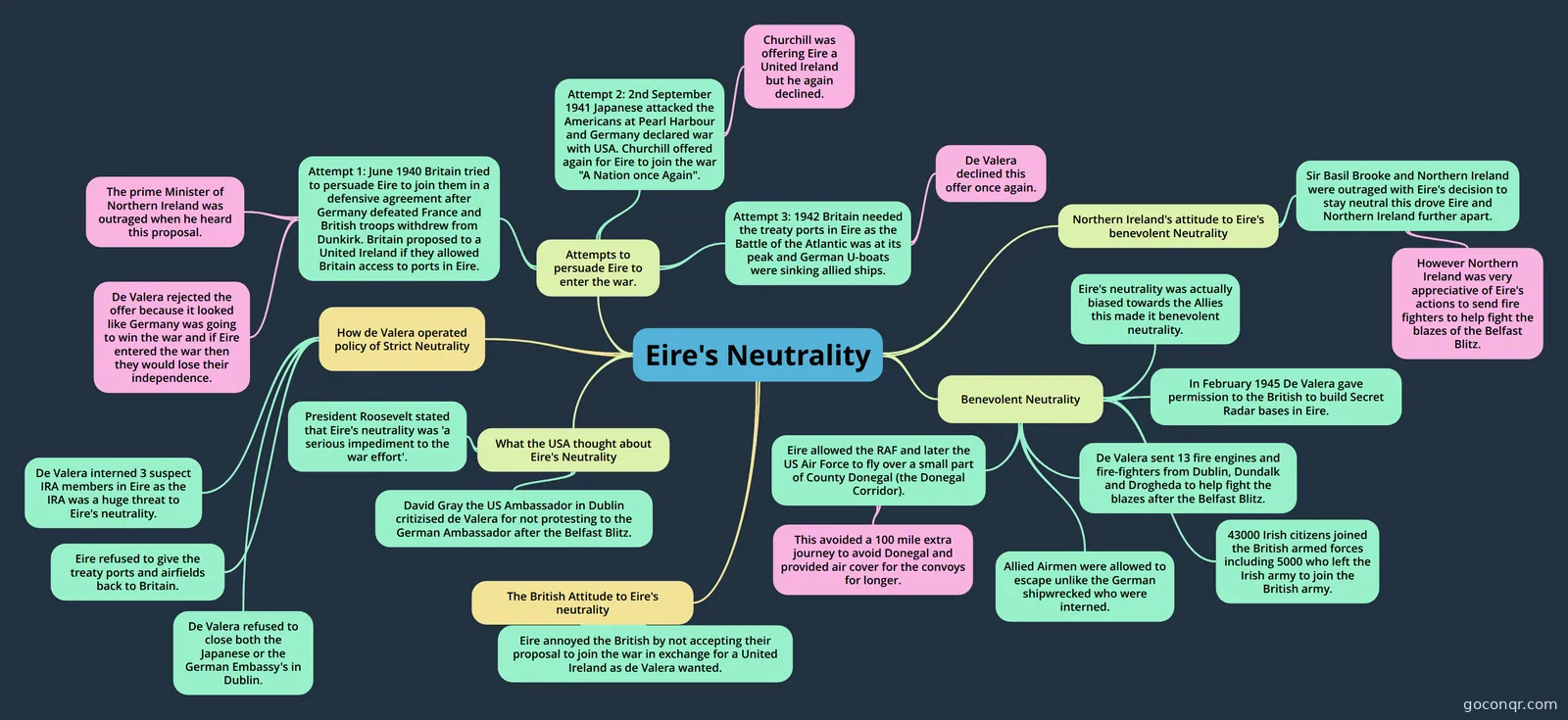
Mind map: Eire's neutrality
Conteúdo do mapa
Eire's Neutrality
Attempts to persuade Eire to enter the war.
- Attempt 1: June 1940 Britain tried to persuade Eire to join them in a defensive agreement after Germany defeated France and British troops withdrew from Dunkirk. Britain proposed to a United Ireland if they allowed Britain access to ports in Eire.
- De Valera rejected the offer because it looked like Germany was going to win the war and if Eire entered the war then they would lose their independence.
- The prime Minister of Northern Ireland was outraged when he heard this proposal.
- Attempt 2: 2nd September 1941 Japanese attacked the Americans at Pearl Harbour and Germany declared war with USA. Churchill offered again for Eire to join the war "A Nation once Again".
- Churchill was offering Eire a United Ireland but he again declined.
- Attempt 3: 1942 Britain needed the treaty ports in Eire as the Battle of the Atlantic was at its peak and German U-boats were sinking allied ships.
- De Valera declined this offer once again.
- Attempt 1: June 1940 Britain tried to persuade Eire to join them in a defensive agreement after Germany defeated France and British troops withdrew from Dunkirk. Britain proposed to a United Ireland if they allowed Britain access to ports in Eire.
Benevolent Neutrality
- Eire's neutrality was actually biased towards the Allies this made it benevolent neutrality.
- Eire allowed the RAF and later the US Air Force to fly over a small part of County Donegal (the Donegal Corridor).
- This avoided a 100 mile extra journey to avoid Donegal and provided air cover for the convoys for longer.
- De Valera sent 13 fire engines and fire-fighters from Dublin, Dundalk and Drogheda to help fight the blazes after the Belfast Blitz.
- Allied Airmen were allowed to escape unlike the German shipwrecked who were interned.
- In February 1945 De Valera gave permission to the British to build Secret Radar bases in Eire.
- 43000 Irish citizens joined the British armed forces including 5000 who left the Irish army to join the British army.
What the USA thought about Eire's Neutrality
- President Roosevelt stated that Eire's neutrality was 'a serious impediment to the war effort'.
- David Gray the US Ambassador in Dublin critizised de Valera for not protesting to the German Ambassador after the Belfast Blitz.
Northern Ireland's attitude to Eire's benevolent Neutrality
- Sir Basil Brooke and Northern Ireland were outraged with Eire's decision to stay neutral this drove Eire and Northern Ireland further apart.
- However Northern Ireland was very appreciative of Eire's actions to send fire fighters to help fight the blazes of the Belfast Blitz.
- Sir Basil Brooke and Northern Ireland were outraged with Eire's decision to stay neutral this drove Eire and Northern Ireland further apart.
The British Attitude to Eire's neutrality
- Eire annoyed the British by not accepting their proposal to join the war in exchange for a United Ireland as de Valera wanted.
How de Valera operated policy of Strict Neutrality
- De Valera interned 3 suspect IRA members in Eire as the IRA was a huge threat to Eire's neutrality.
- Eire refused to give the treaty ports and airfields back to Britain.
- De Valera refused to close both the Japanese or the German Embassy's in Dublin.
Informações
- Descrição
- Mapa Mental sobre Eire's Neutrality, criado por Cara Moore em 08-09-2016.
- Criado por
- Cara Moore
- Visualizações
- 19
- Avaliação