Mapa mental
Particles
Conteúdo do mapa
Particles
Hadrons
- have sub-structure (non-fundamental)
- Made up of QUARKS
- Triplets
- Baryons
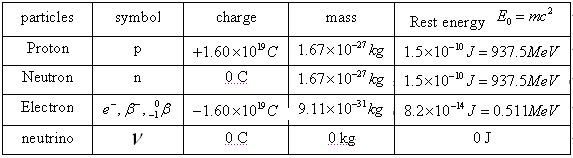
- Protons
- 2 Up Q
- 1 Down Q
- Only stable baryon
- All baryons decay to protons
- Neutrons
- decay into protons
- Antibaryons not found in ordinary matter
- Baryon no. in particle interactions never changes
- Protons
- Baryons
- Quark Antiquark Pair
- Mesons
- Unstable
- BN = 0
- Pions
- lightest
- discovered in cosmic rays
- Produced in high energy particle collisions
- Kaons
- Heavier
- More unstable than pions
- Interact with baryons via strong interaction (force)
- Mesons
- 3 Types
- UP
- C +2/3
- BN +1/3
- DOWN
- C -1/3
- B +1/3
- STRANGE
- C -1/3
- BN +1/3
- Strangeness -1
- UP
- Triplets
- Made up of QUARKS
- Feel the strong nuclear force
- have sub-structure (non-fundamental)
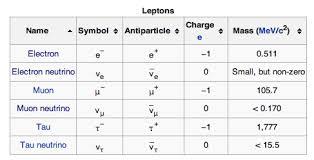
Leptons
- Fundamental particles
- Lepton number 1
- 1 number for each type
- Six Types + associated antiparticles
- Muon
- Muon neutrino
- Electron neutrino
- Electron
- Tau neutrino
- Tau
- Don't feel SN force
Bosons
- exchange particles
- carry forces between particles
- exchange particles
Atomic structure
- Atomic number
- Total no. of protons in the nucleus
- Nucleon (mass) number
- Total no. of protons and neutrons
- Isotopes
- Same no. protons
- Different no. of neutrons
- Greater no. neutrons = less stable nucleus
- Atomic number
Stability of nuclei
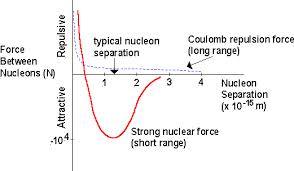
- electrostattic forces
- Replusion of protons
- Range indefinite
- Gravitational forces
- weak
- Strong nuclear (attractive) force
- v.short range: few femtometers
- Works equally on all nucleons
- At v.small separation SN force is replusive
- Decays
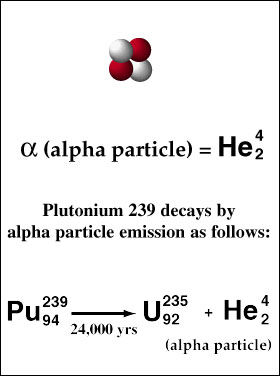
- Alpha
- v. big nuclei
- nuclei to big for SN force to keep stable
- When alpha particle emmitted
- PN decreases by 2
- Mass no. decreases by 4
- v. big nuclei
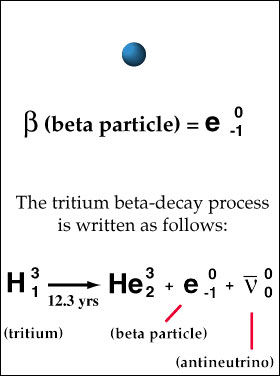
- Beta minus
- Neutron rich nuclei
- Electron + antineutrino emitted from nucleus
- PN increases by 1
- Mass no. stays the same
- Antineutrino carries away
- energy
- momentum
- Alpha
- electrostattic forces
Particles + antiparticles
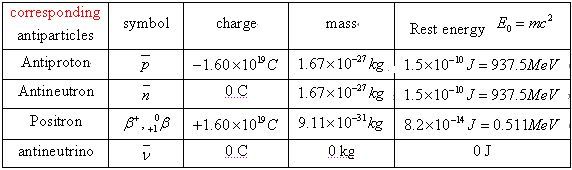
- Antiparticles have
- Same mass
- Opposite charge
- Pair production
- 2 protons collide at high speed
- High energy
- Converted into more particles
- antiparticles + particles formed
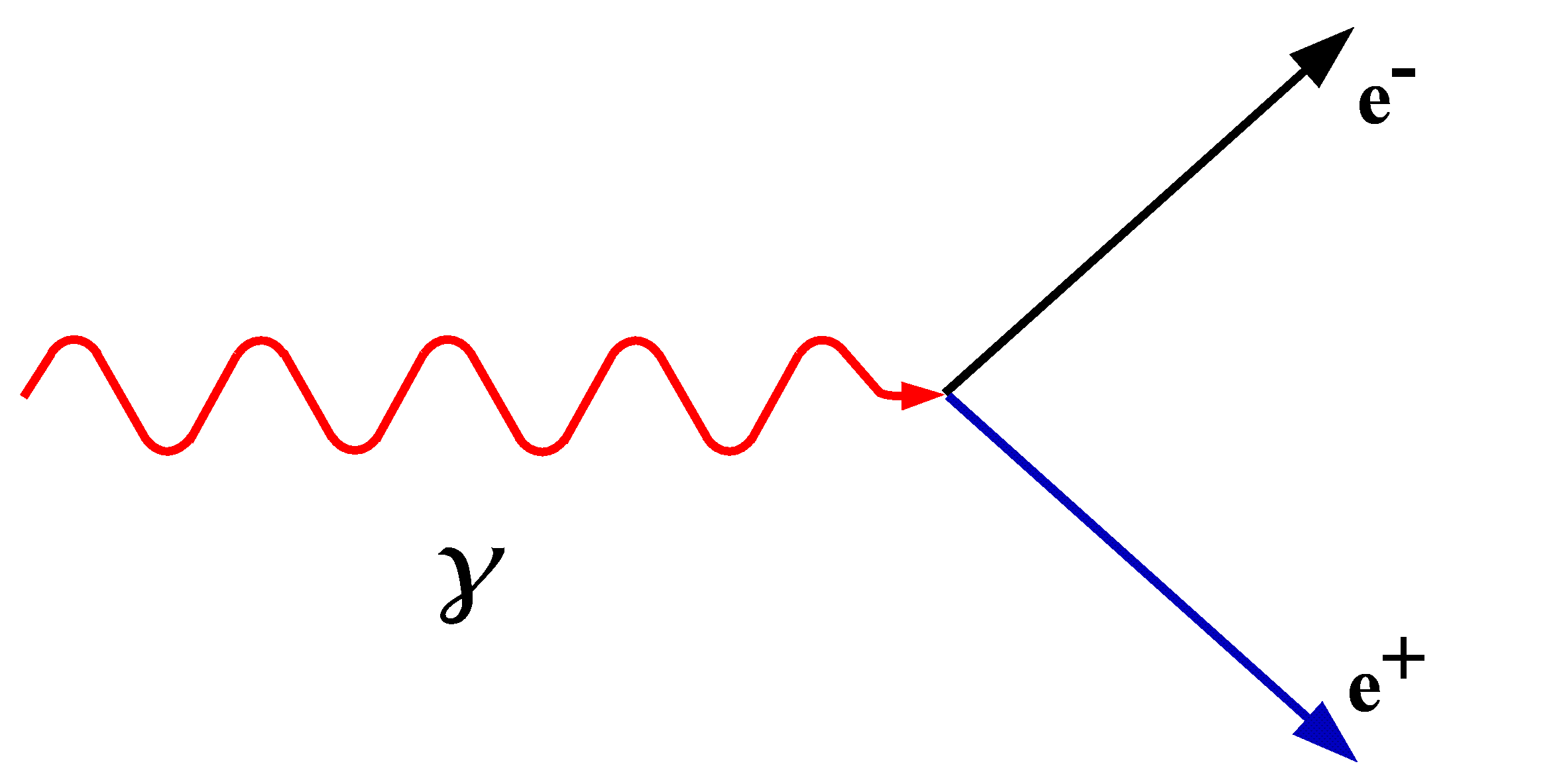
- produced from single photon
- usually electron positron pairs produced
- low mass
- curve due to magnetic field
- opposite directions : opposite charges
- Annihilation
- Particle meets antiparticle
- Total mass converted into enegy
- Antiparticles have