
Mapa mental
Trait Approach to Personality
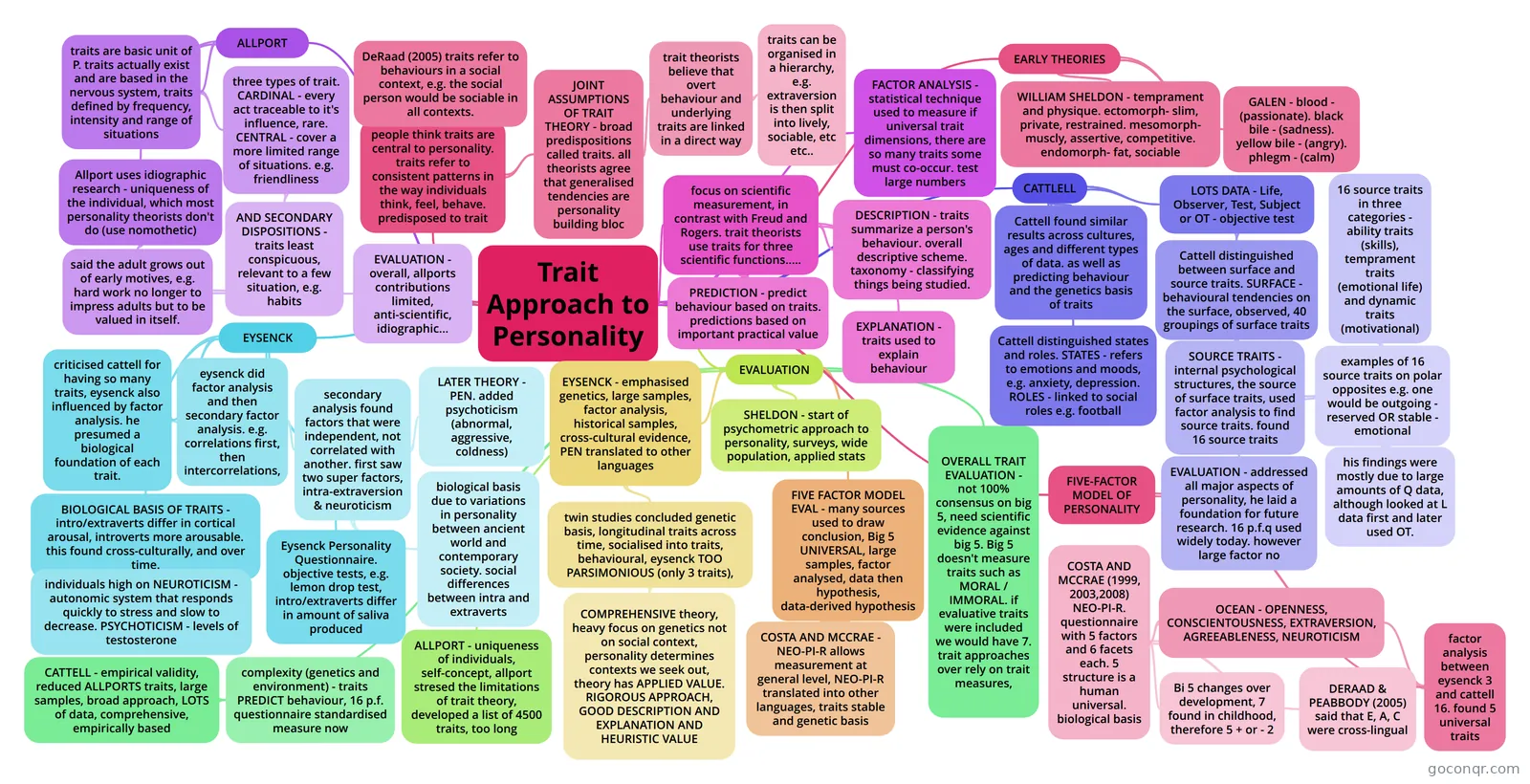
Mind map: trait approach to personality
Conteúdo do mapa
Trait Approach to Personality
focus on scientific measurement, in contrast with Freud and Rogers. trait theorists use traits for three scientific functions.....
- DESCRIPTION - traits summarize a person's behaviour. overall descriptive scheme. taxonomy - classifying things being studied.
- PREDICTION - predict behaviour based on traits. predictions based on important practical value
- EXPLANATION - traits used to explain behaviour
people think traits are central to personality. traits refer to consistent patterns in the way individuals think, feel, behave. predisposed to trait
- DeRaad (2005) traits refer to behaviours in a social context, e.g. the social person would be sociable in all contexts.
- JOINT ASSUMPTIONS OF TRAIT THEORY - broad predispositions called traits. all theorists agree that generalised tendencies are personality building bloc
- trait theorists believe that overt behaviour and underlying traits are linked in a direct way
- traits can be organised in a hierarchy, e.g. extraversion is then split into lively, sociable, etc etc..
- trait theorists believe that overt behaviour and underlying traits are linked in a direct way
ALLPORT
- traits are basic unit of P. traits actually exist and are based in the nervous system, traits defined by frequency, intensity and range of situations
- three types of trait. CARDINAL - every act traceable to it's influence, rare. CENTRAL - cover a more limited range of situations. e.g. friendliness
- AND SECONDARY DISPOSITIONS - traits least conspicuous, relevant to a few situation, e.g. habits
- three types of trait. CARDINAL - every act traceable to it's influence, rare. CENTRAL - cover a more limited range of situations. e.g. friendliness
- Allport uses idiographic research - uniqueness of the individual, which most personality theorists don't do (use nomothetic)
- said the adult grows out of early motives, e.g. hard work no longer to impress adults but to be valued in itself.
- EVALUATION - overall, allports contributions limited, anti-scientific, idiographic...
- said the adult grows out of early motives, e.g. hard work no longer to impress adults but to be valued in itself.
- traits are basic unit of P. traits actually exist and are based in the nervous system, traits defined by frequency, intensity and range of situations
FACTOR ANALYSIS - statistical technique used to measure if universal trait dimensions, there are so many traits some must co-occur. test large numbers
CATTLELL
- LOTS DATA - Life, Observer, Test, Subject or OT - objective test
- Cattell distinguished between surface and source traits. SURFACE - behavioural tendencies on the surface, observed, 40 groupings of surface traits
- SOURCE TRAITS - internal psychological structures, the source of surface traits, used factor analysis to find source traits. found 16 source traits
- 16 source traits in three categories - ability traits (skills), temprament traits (emotional life) and dynamic traits (motivational)
- examples of 16 source traits on polar opposites e.g. one would be outgoing - reserved OR stable - emotional
- his findings were mostly due to large amounts of Q data, although looked at L data first and later used OT.
- examples of 16 source traits on polar opposites e.g. one would be outgoing - reserved OR stable - emotional
- 16 source traits in three categories - ability traits (skills), temprament traits (emotional life) and dynamic traits (motivational)
- EVALUATION - addressed all major aspects of personality, he laid a foundation for future research. 16 p.f.q used widely today. however large factor no
- SOURCE TRAITS - internal psychological structures, the source of surface traits, used factor analysis to find source traits. found 16 source traits
- Cattell distinguished between surface and source traits. SURFACE - behavioural tendencies on the surface, observed, 40 groupings of surface traits
- Cattell found similar results across cultures, ages and different types of data. as well as predicting behaviour and the genetics basis of traits
- Cattell distinguished states and roles. STATES - refers to emotions and moods, e.g. anxiety, depression. ROLES - linked to social roles e.g. football
- LOTS DATA - Life, Observer, Test, Subject or OT - objective test
EYSENCK
- criticised cattell for having so many traits, eysenck also influenced by factor analysis. he presumed a biological foundation of each trait.
- eysenck did factor analysis and then secondary factor analysis. e.g. correlations first, then intercorrelations,
- secondary analysis found factors that were independent, not correlated with another. first saw two super factors, intra-extraversion & neuroticism
- LATER THEORY - PEN. added psychoticism (abnormal, aggressive, coldness)
- biological basis due to variations in personality between ancient world and contemporary society. social differences between intra and extraverts
- secondary analysis found factors that were independent, not correlated with another. first saw two super factors, intra-extraversion & neuroticism
- eysenck did factor analysis and then secondary factor analysis. e.g. correlations first, then intercorrelations,
- Eysenck Personality Questionnaire. objective tests, e.g. lemon drop test, intro/extraverts differ in amount of saliva produced
- BIOLOGICAL BASIS OF TRAITS - intro/extraverts differ in cortical arousal, introverts more arousable. this found cross-culturally, and over time.
- individuals high on NEUROTICISM - autonomic system that responds quickly to stress and slow to decrease. PSYCHOTICISM - levels of testosterone
- criticised cattell for having so many traits, eysenck also influenced by factor analysis. he presumed a biological foundation of each trait.
EARLY THEORIES
- WILLIAM SHELDON - temprament and physique. ectomorph- slim, private, restrained. mesomorph- muscly, assertive, competitive. endomorph- fat, sociable
- GALEN - blood - (passionate). black bile - (sadness). yellow bile - (angry). phlegm - (calm)
FIVE-FACTOR MODEL OF PERSONALITY
- factor analysis between eysenck 3 and cattell 16. found 5 universal traits
- OCEAN - OPENNESS, CONSCIENTOUSNESS, EXTRAVERSION, AGREEABLENESS, NEUROTICISM
- COSTA AND MCCRAE (1999, 2003,2008) NEO-PI-R. questionnaire with 5 factors and 6 facets each. 5 structure is a human universal. biological basis
- DERAAD & PEABBODY (2005) said that E, A, C were cross-lingual
- Bi 5 changes over development, 7 found in childhood, therefore 5 + or - 2
- COSTA AND MCCRAE (1999, 2003,2008) NEO-PI-R. questionnaire with 5 factors and 6 facets each. 5 structure is a human universal. biological basis
- OCEAN - OPENNESS, CONSCIENTOUSNESS, EXTRAVERSION, AGREEABLENESS, NEUROTICISM
- factor analysis between eysenck 3 and cattell 16. found 5 universal traits
EVALUATION
- SHELDON - start of psychometric approach to personality, surveys, wide population, applied stats
- ALLPORT - uniqueness of individuals, self-concept, allport stresed the limitations of trait theory, developed a list of 4500 traits, too long
- CATTELL - empirical validity, reduced ALLPORTS traits, large samples, broad approach, LOTS of data, comprehensive, empirically based
- complexity (genetics and environment) - traits PREDICT behaviour, 16 p.f. questionnaire standardised measure now
- EYSENCK - emphasised genetics, large samples, factor analysis, historical samples, cross-cultural evidence, PEN translated to other languages
- twin studies concluded genetic basis, longitudinal traits across time, socialised into traits, behavioural, eysenck TOO PARSIMONIOUS (only 3 traits),
- COMPREHENSIVE theory, heavy focus on genetics not on social context, personality determines contexts we seek out, theory has APPLIED VALUE. RIGOROUS APPROACH, GOOD DESCRIPTION AND EXPLANATION AND HEURISTIC VALUE
- twin studies concluded genetic basis, longitudinal traits across time, socialised into traits, behavioural, eysenck TOO PARSIMONIOUS (only 3 traits),
- FIVE FACTOR MODEL EVAL - many sources used to draw conclusion, Big 5 UNIVERSAL, large samples, factor analysed, data then hypothesis, data-derived hypothesis
- COSTA AND MCCRAE - NEO-PI-R allows measurement at general level, NEO-PI-R translated into other languages, traits stable and genetic basis
- OVERALL TRAIT EVALUATION - not 100% consensus on big 5, need scientific evidence against big 5. Big 5 doesn't measure traits such as MORAL / IMMORAL. if evaluative traits were included we would have 7. trait approaches over rely on trait measures,
Informações
- Descrição
- Personality - NOT NEEDED Mapa Mental sobre Trait Approach to Personality, criado por becky.waine em 02-05-2013.
- Criado por
- becky.waine
- Visualizações
- 370
- Tags
- Avaliação