
Mapa mental
Heat Transfer and Sankey Diagrams
Conteúdo do mapa
Heat Transfer and Sankey Diagrams
Conduction
- How heat is transferred in solids
- Metals are good conductors; non-metals and gases aren't
- In metals, the electrons can leave their atoms and leave ions behind. The ions vibrate more because the thermal energy excites them, so they give off more kinetic energy. This kinetic energy is carried by the electrons, colliding with other particles as it travels. The vibrations spread throughout the metal and thus the heat has been transferred.
- Insulators are substances that stop heat from passing through. Air is a good example of this.
Convection
- How heat is transferred in fluids (i.e: liquids and gases)
- Travel in convection currents
- STEP 1: Particles are heated, so they expand. The gaps between the particles expand so the particles become less dense and rise up.
- STEP 2: These heated particles take the place of the colder particles above, so the colder particles, which are more dense, sink below to the heat source.
- STEP 3: The warmer particles above cool down and sink again, with the previously colder particles now warmed up again. The cycle continues and makes a convection current.
- STEP 2: These heated particles take the place of the colder particles above, so the colder particles, which are more dense, sink below to the heat source.
Radiation
- How heat is transferred without particles and instead through waves
- Thermal energy is transferred by radiation through infrared waves. The hotter something is, the more infrared radiation it emits.
- Radiation can even pass through the vacuum of space, which is why vacuum flasks are useful. The vacuums in vacuum flasks have no particles, which prevents heat from leaving it via conduction or convection. The silvery surface on it however also prevent heat loss via radiation.
- Black, matt surfaces are good absorbers and emitters of radiation.; shiny, silvery surfaces are not (because they are good reflectors)
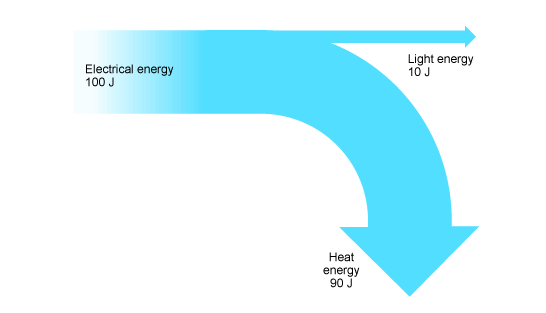
Sankey Diagrams
- Efficiency
- Useful Energy Out / Total Energy In
- Width of arrows = how many joules
- The width of the leaving arrows must add up to the total square length.
- Efficiency
Imagens e arquivos do mapa
Informações
- Descrição
- A summary of methods of heat transfer and how to use Sankey diagrams.
- Criado por
- Quinn Quillfeather
- Visualizações
- 88
- Tags
- Avaliação