
Mapa mental
Biology Unit 4.1.2- Nerves
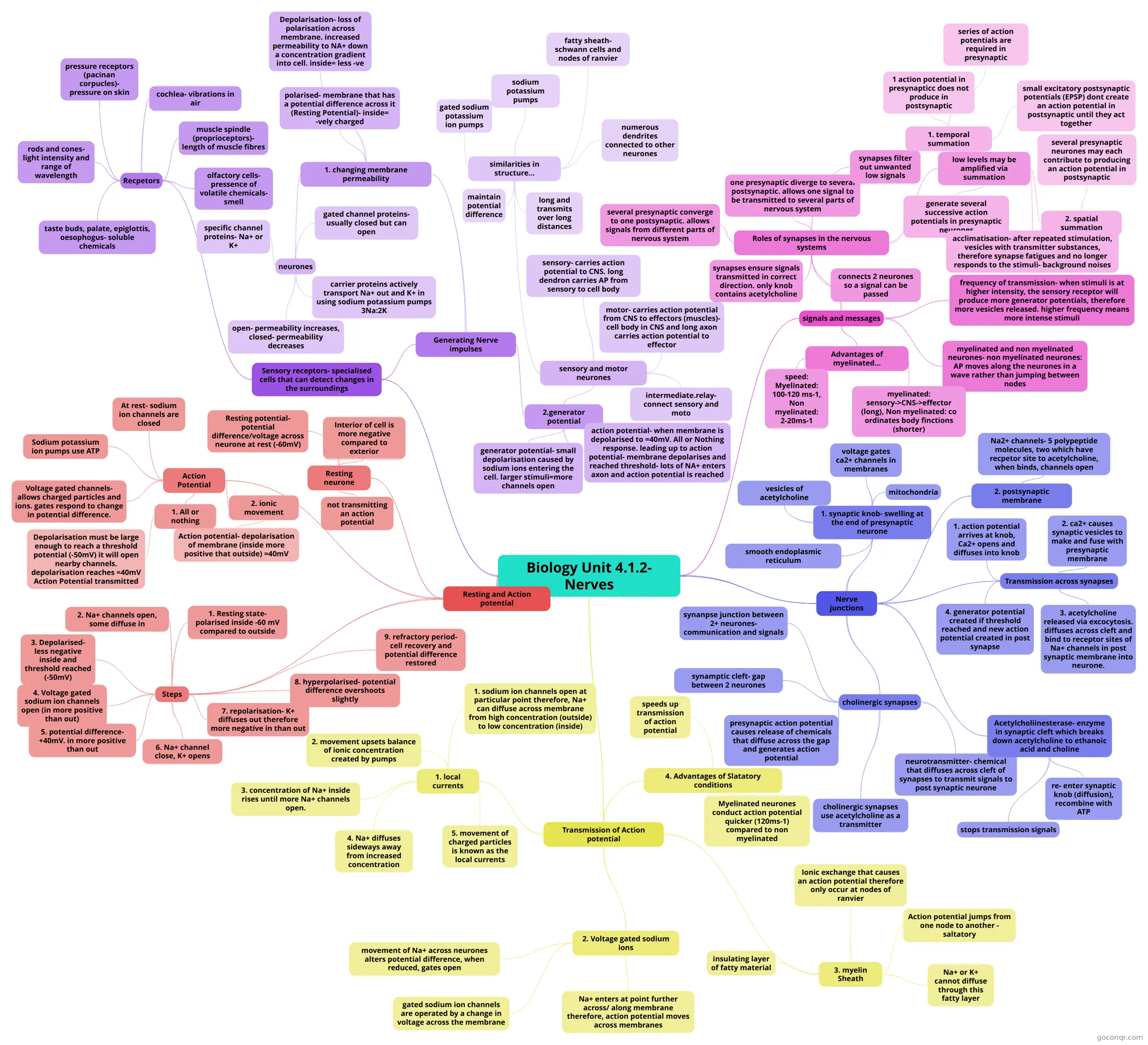
Mind map: Biology unit 4.1.2 nerves
Conteúdo do mapa
Biology Unit 4.1.2- Nerves
Sensory receptors- specialised cells that can detect changes in the surroundings
- Recpetors
- rods and cones- light intensity and range of wavelength
- olfactory cells- pressence of volatile chemicals- smell
- taste buds, palate, epiglottis, oesophogus- soluble chemicals
- pressure receptors (pacinan corpucles)- pressure on skin
- cochlea- vibrations in air
- muscle spindle (proprioceptors)- length of muscle fibres
- Generating Nerve impulses
- 1. changing membrane permeability
- neurones
- specific channel proteins- Na+ or K+
- gated channel proteins- usually closed but can open
- open- permeability increases, closed- permeability decreases
- carrier proteins actively transport Na+ out and K+ in using sodium potassium pumps 3Na:2K
- polarised- membrane that has a potential difference across it (Resting Potential)- inside= -vely charged
- Depolarisation- loss of polarisation across membrane. increased permeability to NA+ down a concentration gradient into cell. inside= less -ve
- neurones
- 2.generator potential
- generator potential- small depolarisation caused by sodium ions entering the cell. larger stimuli=more channels open
- action potential- when membrane is depolarised to =40mV. All or Nothing response. leading up to action potential- membrane depolarises and reached threshold- lots of NA+ enters axon and action potential is reached
- sensory and motor neurones
- sensory- carries action potential to CNS. long dendron carries AP from sensory to cell body
- motor- carries action potential from CNS to effectors (muscles)- cell body in CNS and long axon carries action potential to effector
- intermediate.relay- connect sensory and moto
- similarities in structure...
- long and transmits over long distances
- gated sodium potassium ion pumps
- sodium potassium pumps
- maintain potential difference
- fatty sheath- schwann cells and nodes of ranvier
- numerous dendrites connected to other neurones
- 1. changing membrane permeability
- Recpetors
Resting and Action potential
- Resting neurone
- not transmitting an action potential
- Interior of cell is more negative compared to exterior
- Resting potential- potential difference/voltage across neurone at rest (-60mV)
- Action Potential
- At rest- sodium ion channels are closed
- Sodium potassium ion pumps use ATP
- Voltage gated channels- allows charged particles and ions. gates respond to change in potential difference.
- 1. All or nothing
- Depolarisation must be large enough to reach a threshold potential (-50mV) it will open nearby channels. depolarisation reaches =40mV Action Potential transmitted
- 2. ionic movement
- Action potential- depolarisation of membrane (inside more positive that outside) =40mV
- Steps
- 1. Resting state- polarised inside -60 mV compared to outside
- 2. Na+ channels open, some diffuse in
- 3. Depolarised- less negative inside and threshold reached (-50mV)
- 4. Voltage gated sodium ion channels open (in more positive than out)
- 5. potential difference- +40mV. in more positive than out
- 6. Na+ channel close, K+ opens
- 7. repolarisation- K+ diffuses out therefore more negative in than out
- 8. hyperpolarised- potential difference overshoots slightly
- 9. refractory period- cell recovery and potential difference restored
- Resting neurone
Transmission of Action potential
- 1. local currents
- 1. sodium ion channels open at particular point therefore, Na+ can diffuse across membrane from high concentration (outside) to low concentration (inside)
- 2. movement upsets balance of ionic concentration created by pumps
- 3. concentration of Na+ inside rises until more Na+ channels open.
- 4. Na+ diffuses sideways away from increased concentration
- 5. movement of charged particles is known as the local currents
- 2. Voltage gated sodium ions
- gated sodium ion channels are operated by a change in voltage across the membrane
- movement of Na+ across neurones alters potential difference, when reduced, gates open
- Na+ enters at point further across/ along membrane therefore, action potential moves across membranes
- 3. myelin Sheath
- insulating layer of fatty material
- Na+ or K+ cannot diffuse through this fatty layer
- Ionic exchange that causes an action potential therefore only occur at nodes of ranvier
- Action potential jumps from one node to another - saltatory
- 4. Advantages of Slatatory conditions
- speeds up transmission of action potential
- Myelinated neurones conduct action potential quicker (120ms-1) compared to non myelinated
- 1. local currents
Nerve junctions
- cholinergic synapses
- synanpse junction between 2+ neurones- communication and signals
- synamptic cleft- gap between 2 neurones
- presynaptic action potential causes release of chemicals that diffuse across the gap and generates action potential
- neurotransmitter- chemical that diffuses across cleft of synapses to transmit signals to post synaptic neurone
- cholinergic synapses use acetylcholine as a transmitter
- 1. synaptic knob- swelling at the end of presynaptic neurone
- mitochondria
- smooth endoplasmic reticulum
- vesicles of acetylcholine
- voltage gates ca2+ channels in membranes
- 2. postsynaptic membrane
- Na2+ channels- 5 polypeptide molecules, two which have recpetor site to acetylcholine, when binds, channels open
- Transmission across synapses
- 1. action potential arrives at knob, Ca2+ opens and diffuses into knob
- 2. ca2+ causes synaptic vesicles to make and fuse with presynaptic membrane
- 3. acetylcholine released via excocytosis. diffuses across cleft and bind to receptor sites of Na+ channels in post synaptic membrane into neurone.
- 4. generator potential created if threshold reached and new action potential created in post synapse
- Acetylcholiinesterase- enzyme in synaptic cleft which breaks down acetylcholine to ethanoic acid and choline
- stops transmission signals
- re- enter synaptic knob (diffusion), recombine with ATP
- cholinergic synapses
signals and messages
- Roles of synapses in the nervous systems
- connects 2 neurones so a signal can be passed
- several presynaptic converge to one postsynaptic. allows signals from different parts of nervous system
- one presynaptic diverge to several postsynaptic. allows one signal to be transmitted to several parts of nervous system
- synapses ensure signals transmitted in correct direction. only knob contains acetylcholine
- synapses filter out unwanted low signals
- low levels may be amplified via summation
- generate several successive action potentials in presynaptic neurones
- 1. temporal summation
- 1 action potential in presynapticc does not produce in postsynaptic
- series of action potentials are required in presynaptic
- small excitatory postsynaptic potentials (EPSP) dont create an action potential in postsynaptic until they act together
- 2. spatial summation
- several presynaptic neurones may each contribute to producing an action potential in postsynaptic
- acclimatisation- after repeated stimulation, vesicles with transmitter substances, therefore synapse fatigues and no longer responds to the stimuli- background noises
- frequency of transmission- when stimuli is at higher intensity, the sensory receptor will produce more generator potentials, therefore more vesicles released. higher frequency means more intense stimuli
- myelinated and non myelinated neurones- non myelinated neurones: AP moves along the neurones in a wave rather than jumping between nodes
- Advantages of myelinated...
- speed: Myelinated: 100-120 ms-1, Non myelinated: 2-20ms-1
- myelinated: sensory->CNS->effector (long), Non myelinated: co ordinates body finctions (shorter)
- Roles of synapses in the nervous systems
Informações
- Descrição
- Biology unit 4 Mapa Mental sobre Biology Unit 4.1.2- Nerves, criado por Sarah Pirbhai em 06-05-2013.
- Criado por
- Sarah Pirbhai
- Visualizações
- 142
- Tags
- Avaliação