
Mapa mental
Brucella
Conteúdo do mapa
Brucella
Habitat, nutrients, energy and oxygen
- Habitat
- Zoonotic – passed by contact and by aerosol
- Highly infectious
- Obligate parasites in preferred natural host
- Poor environmental survival
- Few hours unprotected in sunlight
- Days protected by urine/aborted material
- Months protected by damp/cool weather
- Wild animal reservoir
- Species and biotypes
- 7 species
- Urease activity and H2S production
- CO2 requirement
- Capnophilic
- Multiply in host
- Capnophilic
- Sensitivity to dyes (basic fuchsin & thionin)
- Phage typing
- Only for outbreak investigation
- Presence of antigens
- A and M: B. abortus, B. melitensis, B. suis
- R: B. ovis, B. canis
- Small gram -ve coccobacilli
- Ovoid shape
- Non-motile
- Non-sporing
- Catalase +
- Oxidase + (variable)
- Aerobic
- Fastidious (difficult to grow)
- Blood / serum - yes
- BLA - no
- Selective media - yes
- Habitat
Diseases caused
- B. abortus
- Cattle
- Placentitis
- Abortion
- Mastitis
- Orchitis
- Still causes mastitis and abortion when endemic
- Sheep, goats, pigs
- Abortion
- Horses
- Suppurative bursitis (poll evil, fistulous withers)
- Lesions in tendons and joints (arthritic disease)
- Humans
- Undulant fever
- Cattle
- B. melitensis
- Goats, sheep
- Abortion
- Mastitis
- Orchitis
- Cattle
- Abortion
- Humans
- Undulant fever
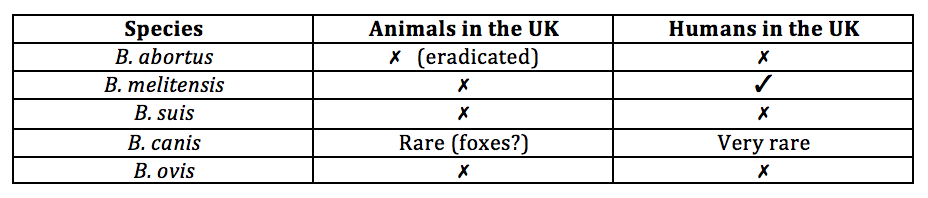
- Tends to be found abroad
- 'Malta fever'
- Undulant fever
- Goats, sheep
- B. suis
- Pigs
- Abortion
- Orchitis
- Infertility
- Arthritis
- Spondylitis
- Horses
- Suppurative bursitis (poll evil, fistulous withers)
- Humans
- Undulant fever
- Pigs
- B. ovis
- Sheep
- Placentitis
- Abortion
- Orchitis
- Infertility
- Epididymitis
- Sheep
- B. canis
- Dogs, foxes
- Abortion
- Epididymitis
- Osteomyelitis
- Spondylitis
- Permanent infertility in males
- Humans
- Undulant fever
- Dogs, foxes
- B. neotomae
- Non-pathogenic
- Found only in the desert wood rat of Utah
- B. maris
- Marine animals
- Proposed new species
- As a group of organisms, they tend to cause abortion
- Major concerns
- Long term udder damage + milk loss
- Arthritis / bursitis
- Zoonotic
- Economic losses
- B. abortus
Process of disease
- Pathogenesis
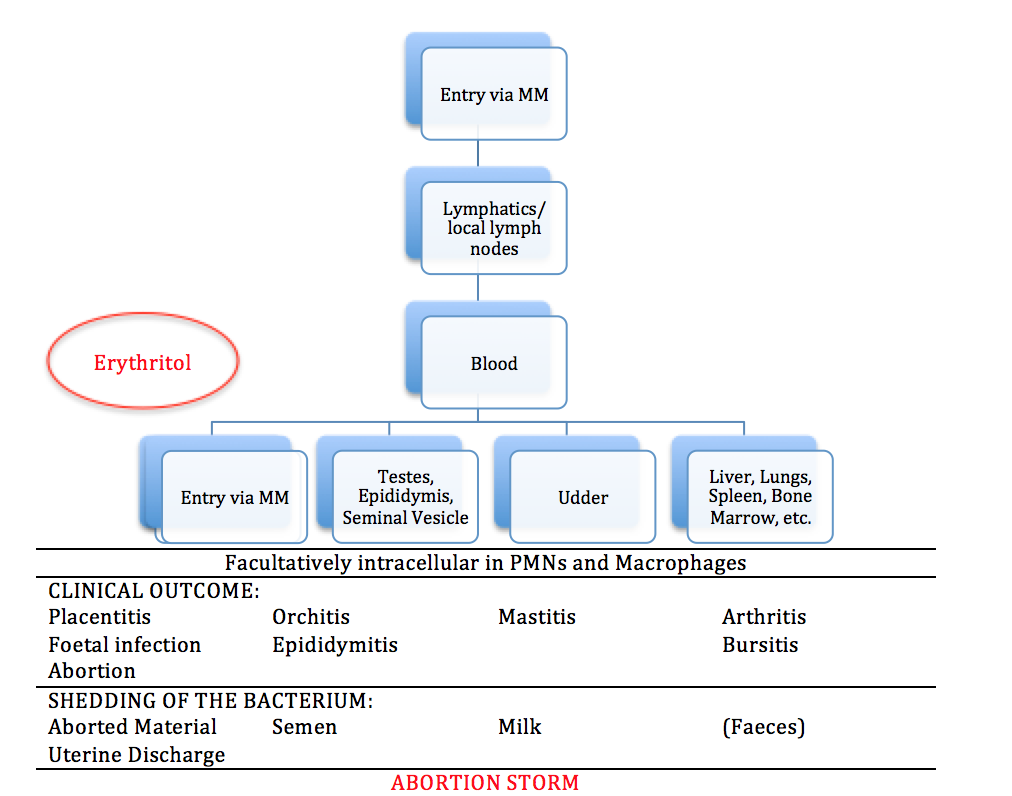
- Predilection for reproductive tracts (RT)
- Erythritol - stimulates growth of B.abortus/melitensis/suis
- High levels in male/female RT
- Absent from human RT
- Not an abortive disease in humans – is instead a joint disease
- Survival in PMNs and macrophages
- Persistence in macrophages
- Swelling, inflammation, haemorrhage
- Predilection for reproductive tracts (RT)
- Immune response
- IgM and IgG
- Cell mediated immune response
- Cleared from genital tract
- Persist in RES and udder
- Recurrent infection
- Carrier animals
- Abort once
- Less severe infection at subsequent pregnancies
- Due to adaptive immune response
- Excrete in udder + uterine discharge
- Calves born to carrier cows
- Infected in utero or via milk
- Prepubescent = relatively resistant
- Reproductive system not developed enough, not enough erythritol for clinical disease
- Develop a good immune response
- Most clear infection and remain R
- ≈ 2% retain latent infection
- Source of infection for others
- Have infected calves themselves
- Routes of infection
- Mucous membranes: usually ingestion
- Via unbroken skin
- Venereally
- To calf in utero
- To calf via milk
- Pathogenesis
Control measures
- Vaccination
- Strain 19
- Used in original eradication scheme
- Live attenuated
- Rarely shed in milk
- Huge doses needed - abortion in cows
- Non-tranmissable
- Female calves @ 2-5 months
- More likely to shed than male calves
- Male calves not vaccinated
- Adults develop persistent antibodies
- Infects humans
- Would persist in the body long enough to cause abortion
- 45/20 (no longer used)
- Killed bacterin (rough mutant)
- No LPS
- Less effective but adults don’t develop persistent antibody levels
- Killed bacterin (rough mutant)
- RB51 (licensed for use in USA)
- Stable rough mutant
- No LPS or flagella, but does have proteins – antibodies recognise this and will recognise the proteins on the true bacteria as a result
- Good protection v abortion
- Ab’s don’t interfere with serological tests
- Stable rough mutant
- Strain 19
- Isolation
- Isolate from blood culture on Castaneda’s medium
- Simultaneous solid and liquid culture
- Prolonged incubation >6 months
- Must be differentiated from Salmonella
- Brucella is urease positive
- Similar antibodies
- B. abortus requires elevated CO2
- Treatment
- Lack of clinical trials
- Antibiotics rarely used – will kill instead
- Poor perfusion into joints, where bacteria are found
- Oxytetracycline and streptomycin has shown efficacy
- Work in people
- Not yet endemic worldwide, so eradication scheme was effective as we are an island
- Testing
- ID infected herds
- ELISA on bulk milk
- Quarterly by APHA
- ELISA on bulk milk
- ID infected individuals
- Bacterial culture
- Direct microscopy
- Immunofluorescence
- Modified Ziehl-Neelsen
- Takes a long time to grow, hence use of this method
- PCR
- Guinea pig inoculation
- Serology
- Slide agglutination (card test, plate test)
- Serum agglutination test (SAT)
- Complement fixation test
- ELISA
- ID infected herds
- Eradication scheme
- Identify infected herds
- Identify infected individuals
- Cull infected individuals
- Compensation (75% of market value)
- Cull infected individuals
- Herd restrictions
- Retested at 8 months and 12 months
- No positives - restrictions lifted
- Positives - culled (with dangerous contacts) + herd tested every 2 months until cleared
- Retested at 8 months and 12 months
- Identify infected individuals
- Regular testing programme
- Dairy herds – monthly
- Beef cattle - every 2 years
- Imported cattle
- Abortions
- Identify infected herds
- NOTIFIABLE
- Common in other parts of the world
- Could be imported
- Vaccination
Imagens e arquivos do mapa
Informações
- Descrição
- BVSc3 AD2 (Specific Bacteria) Mapa Mental sobre Brucella, criado por Jess Pope em 27-12-2016.
- Criado por
- Jess Pope
- Visualizações
- 51
- Tags
- Avaliação