
Mapa mental
Developing new products
Conteúdo do mapa
Developing new products
Terms
- Invention
- Discovery of new ideas and mehods
- Innovation
- Commercializing an invention by bringing it to the market
- Invention
Key success factors in innovation
- Creating and delivering added value
- Speed to market
- Delay increases the risk others getting to the market first
- Consumer priorities may change
- A product's inferior perceived value cannot be compensated for with high communication spending
What is a new product?
- Product replacements (45%)
- Revisions and improvements to existing products (repositioning and cost reductions)
- Additions to existing lines (25%)
- Depth of product mix
- New product lines (20%)
- Move into a new market)
- Width of product mix
- New-to-the-world products (10%)
- Highest risk
- Product replacements (45%)
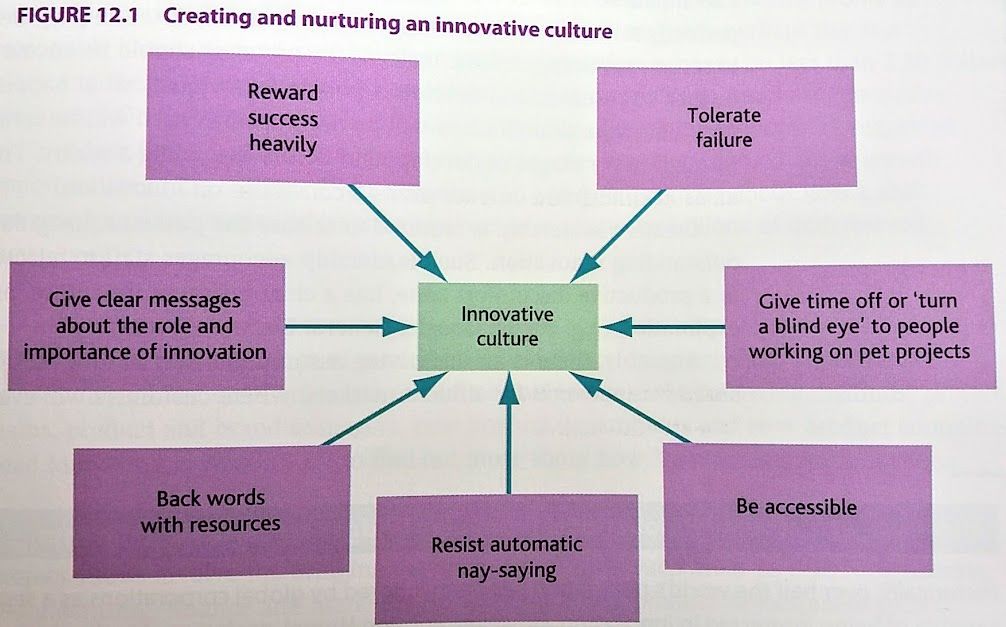
Creating and nurturing an innovative culture
Effective organization for new product development (NPD)
- The importance of teamwork
- The role of marketing directors
- Encourage teamwork
- Improve the provision of marketing information to R&D
- Take R&D people out of the lab
- Develop informal relationships with R&D
- Learn about technology
- Formalize the product development process
- The role of senior management (for improving relationships between marketers and R&D people)
- Make organizational design changes
- Place marketing and R&D next to each other, give them more autonomy
- Show personal interest in NPD
- Provide strategic direction
- Encourage teamwork
- Increase resources
- Understand marketing's importnace
- Make organizational design changes
- Methods
- Project teams
- Cross-functional team for NPD
- Better decision-making
- Shared responsibility
- Advantage from collective expertise
- Helps in preventing "tunnel vision and inflexibility of problem solving"
- Cross-functional team for NPD
- Product and brand managers
- Assignment of product managers to product lines and/or brand managers to individual brands
- Responsible for managing exisitng product lines/brand and developing new ones
- Common in high-volume, relative low-value products such as groceries, toiletries and drinks industries
- Assignment of product managers to product lines and/or brand managers to individual brands
- New product departments and committees
- Oversee the process of NPD review the projects, decide wether to continue them, etc.
- Project teams
Managing the NPD process
- New product startegy
- Setting objectives - target market, market share gain, profitability, technological leadership, resource allocation
- Idea generation
- Brainstorming
- The technique where a group of people generate ideas without initial evaluation; only when the list of ideas is complete is each idea then evaluated
- From the marketing environment
- Brainstorming
- Screening
- Using criteria
- market attractiveness, fitting between product and company objectives, capability of the company to produce and market the product, etc.
- Using criteria
- Concept testing
- Testing new product ideas with potential customers
- Group discussions with questionnaires
- Online marketing research
- Community sites
- Heed functional fixedness
- The tendency of people to evaluate new products in terms of what they already know. Can impede innovation
- Overcome it through the scenario method where the new product concept is explained and visualized to the consumer (scenario: description of how the new product is used in a new to the consumer setting so they appreciate the added value)
- Business analysis
- A review of the projected sales, costs and profits for a new product to establish whether these factors satisfy company obectives
- Break-even analysis
- States the quantity needed to be sold to cover costs
- Used to see if the project is financially feasable
- Sensitivity analysis
- How price, cost and customer acceptance will impact sales revenue and profits
- Product development
- Principles for effective management of cross-functional teams in the product development stage
- Clear mission and objectives
- Organization of team members
- Project plan with a work plan, resource requirements and evaluation objectives
- Project leaders should not only manage the team internally but also externally by keeping in contact with the market
- Responsibilities - shared within the team, but also as individual members of their departments
- Executive sponsorship - a senior management member who is the link between the project team and the top management; also acts as a coach and mentor
- Simultaneous engineering
- The involvement of manufacturing and product development engineers in the same development team in an effort to reduce development time
- Product testing
- Focuses on the functional aspects of the product and on consumer acceptance
- Principles for effective management of cross-functional teams in the product development stage
- Market testing
- The limited launch of a new product to test sales potential
- Simulated market test
- Consumers are put in a simulated market and product penetration (the proportion of consumers who buy the new product at least once) and repeat purchase (the rate of which purchasers buy again) are measured
- Test marketing
- The launch of a new product in one or a few geographic areas chosen to be representative of the intended market
- Gives more accurate sales penetration and repeat purchases estimates
- Benefits
- Facilitates the "go/no go" national launch decision and the effectiveness of the marketing mix
- Problems
- The geographic area(s) may not be representative for the national level, making sales projections more inaccurate
- Competitors may give incentives to distributors to give them more shelf space, and thus denying the new product of some
- Needs to run for some time so repeat purchases can be measured. This way, competitors may go first to the market
- Gain the cooperation of distributors
- Commercialization
- Developing a commercialization strategy for a new product
- Target market
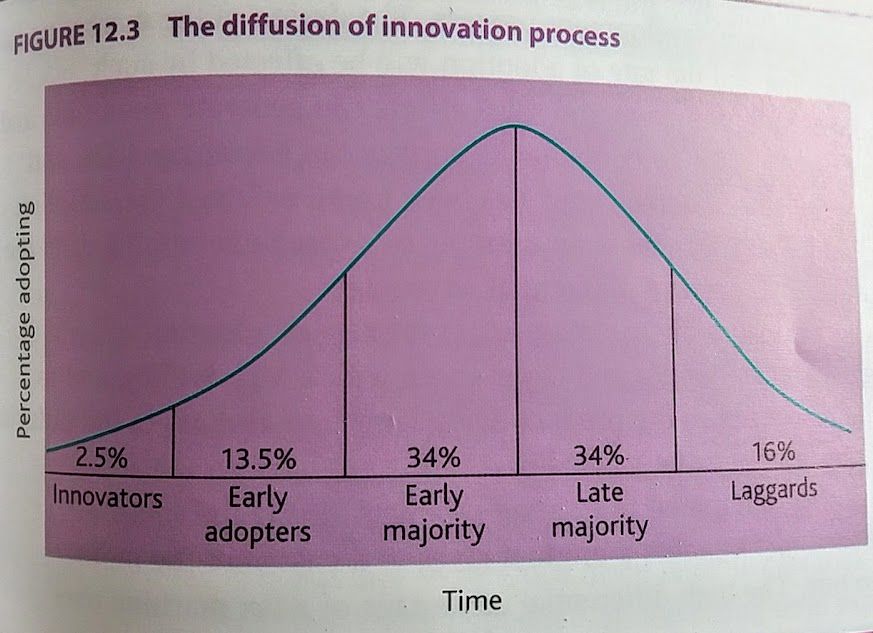
- Diffusion of innovation process
- Connect with product life-cycle
- The process by which a new products spreads through a market over time
- Understand the characteristics of the innovator and early adopter categories to target them at launch. They are the leaders in market acceptance and perception of the product => have a big influence over the success of the new products
- Shows that target group and message need to be modified over time as new categories of customers enter the market
- Diffusion of innovation process
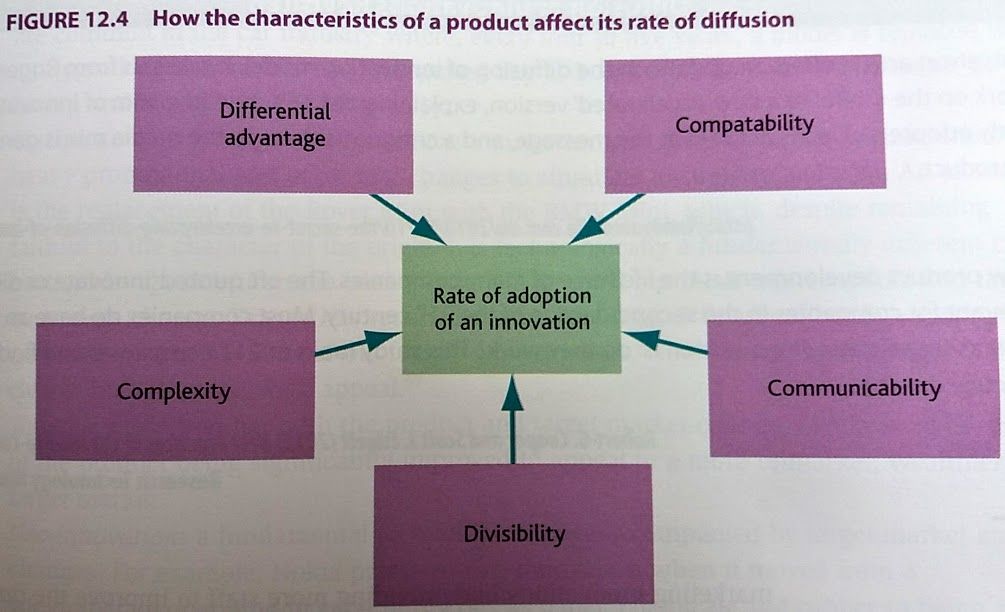
- Differential advantage
- Divisibility
- The degree to which the product can be tried on a limited basis
- Divisibility
- Target market
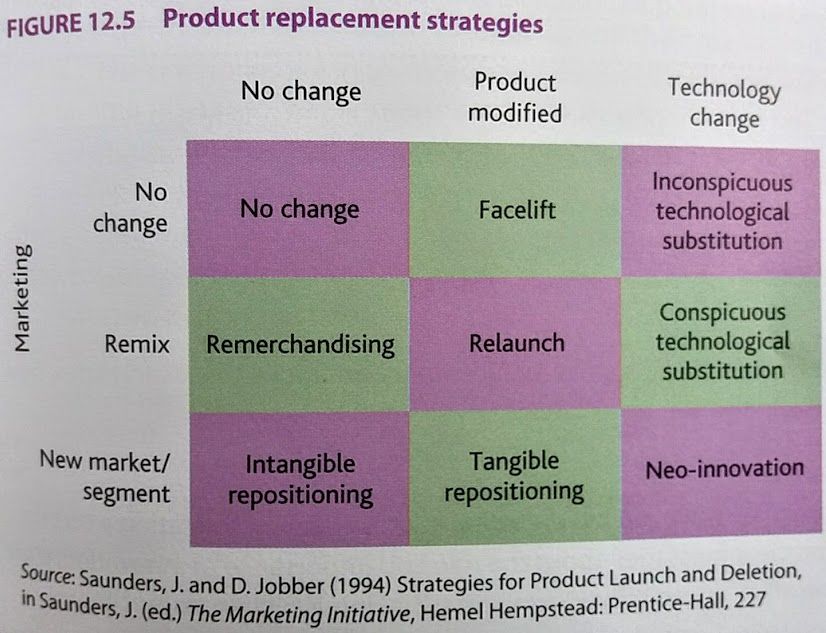
- Product replacement strategies
- Facelift
- Product churning
- A continuous and rapid spiral of new product introductions
- Product churning
- Facelift
- Success factors when commercializing technology
- Being faster to market
- Supplying a wider range of markets
- More product launches
- Using a wider breadth of technologies
- Developing a commercialization strategy for a new product
- New product startegy
Competitive reaction
- Through the marketing mix
- Response is faster in high-growth markets
- Response is dependent on the market share of the introducer and his competitors
- Slower response of competitors when introducing firm has a big market share. Faster response by competitors with bigger market share than the one of the introducing firm
- Response is faster in markets with frequent product changes
- Response time is related to the time needed to develop the new product
Imagens e arquivos do mapa
Informações
- Descrição
- Business/Economics Mapa Mental sobre Developing new products, criado por Snezha Hristova em 19-03-2017.
- Criado por
- Snezha Hristova
- Visualizações
- 8
- Avaliação