
Mapa mental
W.M.K (Context)
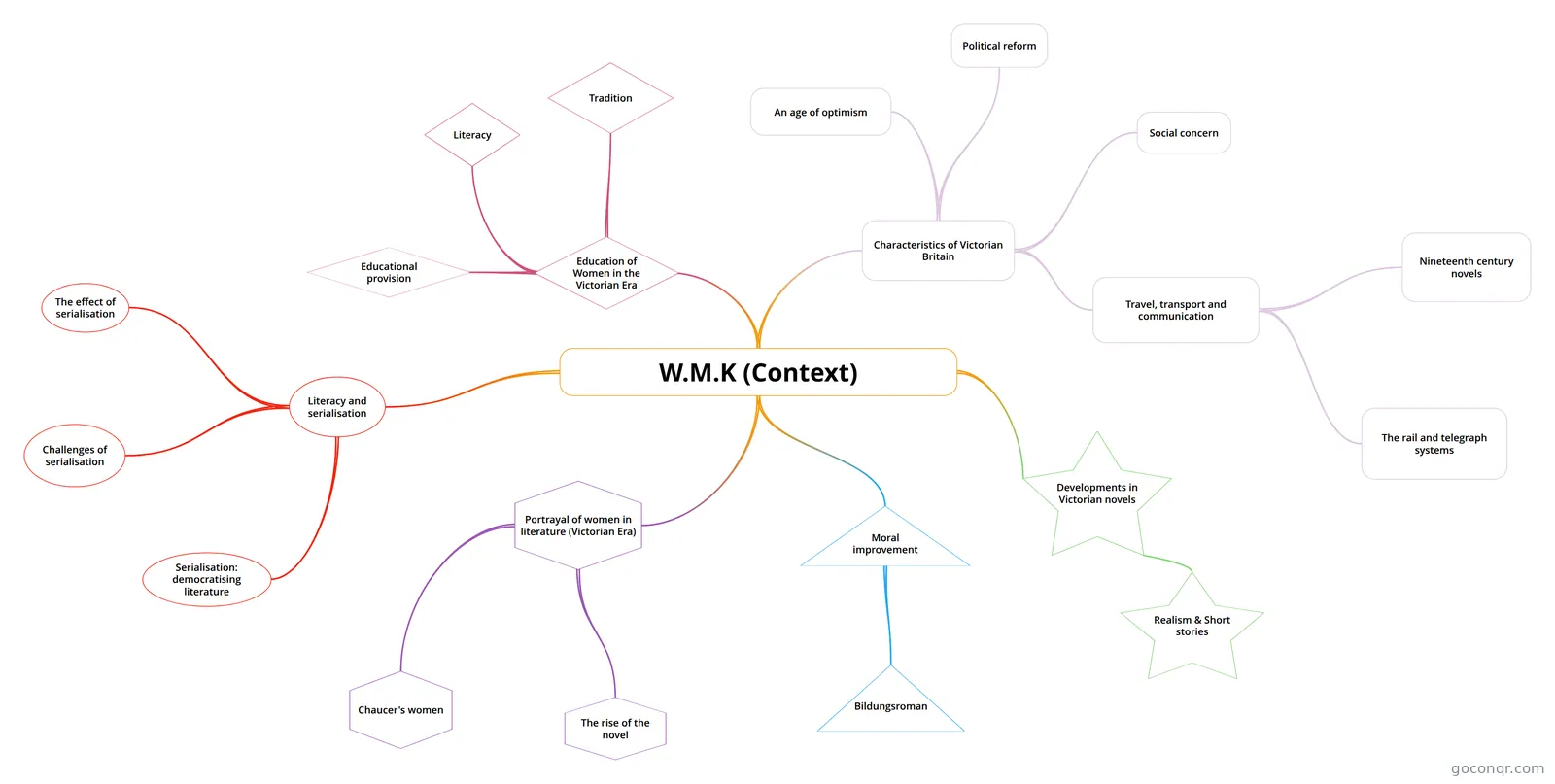
Mind map: Victorian literature context
Conteúdo do mapa
W.M.K (Context)
Literacy and serialisation
- It was Charles Dickens who, in the 1830s, effectively invented a new method of publishing novels in separate monthly or weekly parts, followed by volume publication as the serialisation ended. Other Victorian novelists followed suit.
- The effect of serialisation
- This means of publication makes certain demands on novelists:At the most basic level they had to ensure that each number or instalment was of the correct length They must remember that their readers would be reading the book over a long period of time (in some cases well over a year)This required them to ensure that they kept all the strands of the plot in motion They needed to be sure that characters were quickly recognisable when they reappeared, by the use of appearance, gesture and speech They also had to ensure that readers were encouraged to read the next instalment, by ending each instalment at a moment of tension or anticipation.
- Challenges of serialisation
- Challenges of serialisation Serialisation could be seen to have a damaging effect on a novelist's output, driving them into various kinds of stereotyping and overuse of coincidence to resolve complex plots.Some of the challenges of serialisation include:The need to produce instalments of roughly equal length might lead to padding – unnecessary passages to fill up space. The use of gesture and speech to create characters might lead to caricature and stereotypes. The need for a crisis or climax every few chapters results in over-packed plots too full of incidents. The fact that authors were unable to revise the early instalments once they had been published forced them to invent awkward or improbable situations to explain events and bring their stories to a close.
- Serialisation: democratising literature
- One of the benefits of serialisation was that it made stories available to as wide a readership as possible:Weekly or monthly instalments at a shilling (5p) were affordable by individuals or families who could not buy books (a three volume novel might cost ten shillings and sixpence (52½p) per volume and a one-volume reprint seven shillings and sixpence (37½p) – both prices well above most weekly wages)People sometimes clubbed together to buy the instalments, which were then passed from hand to hand In some cases the instalments would be read aloud in homes or public buildings such as working-men's clubs.
Moral improvement
- Bildungsroman
- A popular literary form in the nineteenth century was the Bildungsroman, a German term meaning the novel of learning or education: Typically, this would dramatise the intellectual and/or emotional education of a young man It provided a model for many well-known European novels of the nineteenth century, such as Charlotte Brontë's Jane Eyre and Charles Dickens's David Copperfield (1849-50). This kind of novel became popular in the nineteenth century following the publication in 1795-6 of J. W. von Goethe's Wilhlem Meister's Lehrjahre (Wilhelm Meister's Apprenticeship) The young main character of such novels has to achieve emotional and intellectual maturity, negotiating a way through the intricacies of social conventions and expectations The main character in such novels undergoes difficulty and suffering as well as pleasure and satisfaction (usually more of the former than the latter) He or she has to learn to observe, understand and judge characters, their actions and surrounding social structure It can thus be used as a means of commenting on, satirizing and challenging established social norms. Such novels may offer opportunities for learning for their readers as well as their central characters.
- Bildungsroman
Portrayal of women in literature (Victorian Era)
- Chaucer's women
- Although women feature strongly in Chaucer's earlier works, such as The Boke of the Duchess and Troilus and Criseyde, we only find three women on the pilgrimage described in The Canterbury Tales: The Wife of Bath The Prioress ‘Another nun' who accompanies her but is hardly mentioned again. The two principal women reflect the only ways that women at the time could achieve independence and status: in the Church or in a trade. The Wife of Bath represents those whose skills, such as weaving, gave them financial independence, though Chaucer's character seems to have grown wealthy mainly by marrying a series of rich old men.It is tempting to see the Wife as a champion of female rights, and her Tale brings out the idea that women should have maistrie over men, but the Wife is of course a character in a story written by a man. She has had five husbands, like the woman of Samaria who is challenged by Jesus (in John 4:17-18), 'withouten oother compaignye in youthe'. Her fifth husband, whom she married for love rather than riches, proved to be less compliant – and very well read. She claims to have put him in his place eventually, but Chaucer enjoys making the Wife recount (and try to refute) all the misogynistic tales with which he has assaulted her.
- The rise of the novel
- Prose narrative emerged in the 18th century novel as a dominant literary form, and with it a much more nuanced portrayal of women. Initially, the novel depicted women as viewed by men, and the typical heroines were either paragons of virtue or of vice: for every Pamela Andrews or Clarissa Harlowe there was a Moll Flanders or a Fanny Hill. Where Defoe, Richardson and Fielding had cleared a path, women novelists soon followed. Fanny Burney, Ann Radcliffe and supremely Jane Austen depicted life and society from a woman's perspective. Women in Dickens have been seen as stereotypes: the harridans, the silly little wives, the femme fatales, but generalisations are dangerous. In his late novel Our Mutual Friend, Lizzie Hexham is a rounded, psychologically believable character. Thackeray's Vanity Fair is noted for the strength of its female roles.Women come into their own supremely in the novels of the Brontë sisters. In Jane Eyre, Charlotte Brontë depicts a woman who takes control of her own destiny – in a way that none of Jane Austen's heroines do, with the possible exception of Fanny Price in Mansfield Park. Two of Mrs Gaskell's novels, Ruth and Mary Barton, focus on the economic realities of women within society. George Eliot believed that duty supplied personal purpose and meaning, which is reflected in many of the female characters in her novels, who are notable for their psychological complexity.
- Chaucer's women
Education of Women in the Victorian Era
- Literacy
- Working-class girls: Literacy rates for girls were low among the working classes, though it gradually increased through the century. Many were apathetic or even hostile to the idea of girls reading. Working-class females generally learnt the basics through a network of voluntary schools, such as church schools, Sunday schools, workhouse schools, and the so-called 'Dame schools' and 'Ragged schools'. Education was haphazard until state intervention and subsidies brought some standards to the grades. After 1870, girls could expect to be given a Primary School education (initially to age 11, then to 13). Tess in Hardy's Tess of the d'Urbervilles, gets up to the sixth standard, which would have enabled her to attend a Teacher Training College, as Hardy's two sisters and cousin did.
- Middle and upper-class girls Middle- and upper-class girls would probably be taught at home, but there were small private schools, some of charitable foundation. Charlotte Brontë depicts her own experience of such a charity school in Jane Eyre. Lowood School is shown as cruel, unsafe and deeply patronising, like the unsanitary school at which two of her sisters had died. From the 1850s, Girls' Grammar Schools and Independent High Schools were set up.
- Tradition
- Although feminist movements at the end of the eighteenth century had tried to set up precedents for women's reading, nineteenth century models for the ideal women concentrated on activity, for instance charity work and above all motherhood. The only reading advocated for women was as part of educating their children or running their households. Mrs. Beeton's Book of Household Management was first published in 1861. Although novel reading was common among leisured women, it was somewhat looked down on, unless the text was of a serious or 'improving' nature.
- Educational provision
- Education was not universal before 1870 and many, particularly in the new industrial slums, were unable to read or write: Ancient schools such as Eton and Winchester had existed for hundreds of years, but were only accessible to the wealthy and powerful, and this period saw the establishment of many more of these public schools There were also old grammar schools, usually in towns and cities, which offered education to some poorer students, but places were limited and they were accessible only to boys There were elementary schools (i.e. infants and primary schools), often set up by either the Church of England or Nonconformist sects Trade unions and other organizations also set up various kinds of educational establishments, aimed at improving the education of adult members of the working classes in growing cities like Birmingham, Liverpool and Manchester Some educational provisions were included in the Factory Acts of the 1830s and 1840s In 1870, the great Education Act was passed, and made a significant start on the provision by the government of universal elementary education.
- Literacy
Developments in Victorian novels
- Many Victorian novelists drew fruitfully on the traditions of fiction to create their novels Sources included fairy stories and folk tales, so that at one level the appeal was to a love of story-telling that might re-connect readers with their childhoodEarly Victorian writers were much influenced by the eighteenth-century novelists and drew on both the form and tone of their picturesque comic narratives
- Realism & Short stories
- However, Victorian novels were also characterised by:A concern with social issues that gave novels an added urgency and contemporary relevance Increasing complexity of plot echoing the new links and relationships formed by a changing urban society The use of serialization to respond to the needs of a more popular readership The enormous popularity and moral status of the novelist in society.
- Short stories had always circulated as a development of the oral tradition, often communicating a moral or providing a snapshot of a character type (for example, Chaucer’s The Pardoner’s Tale). In the first half of the nineteenth century, there was greater experimentation, such as the Gothic tales of Edgar Allan Poe and dramatic incidents captured by Dickens and Scott. Thomas Hardy and Henry James pursued realism with thought-provoking short stories that captured a slice of the exterior and interior life of their protagonistsBeginning in the early nineteenth century, realism was an artistic movement that reacted against the unrealistic situations and characters which had been the basis of Romantic drama and literatureAs opposed to novels, short stories frequently started in the middle of events, rather than providing significant exposition of character and situation. They captured a moment in a person’s life and/or a shift in awareness. They did not always have a ‘closed’ ending but allowed the reader to suppose what might happen next and create their own resolution.
Characteristics of Victorian Britain
- Travel, transport and communication
- The rail and telegraph systems
- From the 1830's a rail network spread throughout Britain, then Europe and America. Trains could travel over 60 m.p.h., and suddenly everywhere in Britain could be reached within a couple of days. It mean that daily newspapers could be delivered the same day to towns and cities within a 200 mile radius of a city. News could now be ‘instant'. Later, the internal combustion engine (cars, buses, taxis) filled in the spaces between the rail networks. The telegraph system developed a little later, the wires following the railway tracks. This meant that people could communicate within hours, not days. Letters could also be transported by train, not taking a lot longer than telegrams, if local. The telephone system gradually took over from telegrams, but not till the 1960's did most people own a telephone.
- Nineteenth century novels
- Earlier nineteenth century novels, such as those by Jane Austen, the Brontës or Charles Dickens record much coach travel. Some of these slow, tiresome journeys were actually quite significant. The railway provided an important plot device and the space of stations and carriages were utilised for dramatic effect. In W.M.K the train station is significant in determining Maisie's fate. It is at the train station in France that Maisie's fear is described to be "broken" and at this train station Maisie lets go of Sir Claude as she is able to see him clear.
- The rail and telegraph systems
- An age of optimism
- The Victorian age was a turbulent period which, in many ways, saw itself as a time of confident progress. Many people believed that Britain was leading the world into a new and better age: More enlightened laws The benefits of wealth created through industrial developmentGreater political stability than in the rest of Europe.Other important beliefs included: Deference to class and authorityRespect for the law The conviction that work is a duty which is good for the soul.
- Social concern
- These changes were not always positive. The daily needs and problems of ordinary people included: poverty, poor housing, ill health, a horrifying level of child mortality, hunger, long hours of grinding labour. The rapid changes of the time benefited some people long before others. The social focus of many Victorian novels posed key moral and social questions about issues such as:The need for schooling and the care of orphans and other deprived children Cruelty to children and the corruption of children by criminals. The problems created by emphasis on social class and newly acquired wealthThe problems created by rapid industrialization and urbanization and the conflict between employers and workers.
- Political reform
- The desire for change was reflected by the activity of Parliament in the second quarter of the 19th Century: The Catholic Emancipation Act of 1829 removed most of the legal disadvantages suffered by Roman Catholics The 1832 Reform Act enabled more men to vote but electors still had to possess a minimum amount of property before they could exercise this right There were several Factory Acts that - among other things - limited the hours children were allowed to work In 1834, the new Poor Law set up the notorious workhouses, where the poor were sent to work for their board and lodging In 1846, the Corn Laws, which kept the price of wheat artificially high, were repealed, and the price of bread fell.
- Travel, transport and communication
Informações
- Descrição
- AS - Level Englilsh Literature (A2 Prose context) Mapa Mental sobre W.M.K (Context), criado por Rebecca Hunter em 22-03-2017.
- Criado por
- Rebecca Hunter
- Visualizações
- 0
- Avaliação