
Mapa mental
Character analysis (T.C.P)
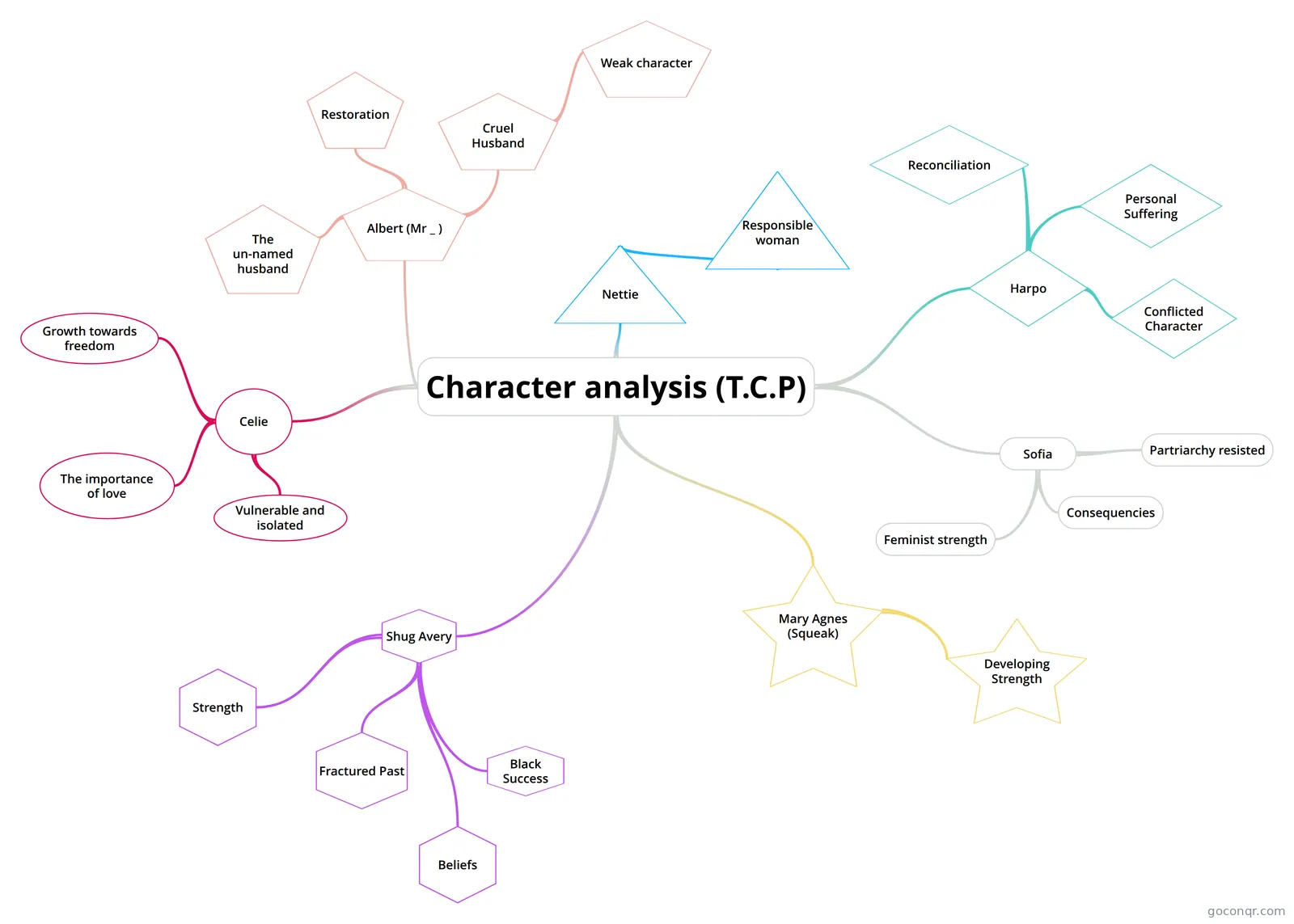
Mind map: The Color Purple character analysis
Conteúdo do mapa
Character analysis (T.C.P)
Celie
- The novel's protagonist, at the beginning of the novel Celie is quiet, passive, and able to express herself only through letters to God. As a teenager she is repeatedly raped by her father (later revealed to be her stepfather), Pa, and gives birth to two children, Olivia and Adam, whom her stepfather gives away and who are raised by a missionary couple. Celie is then married off to Mr. _____, who wants her only for her work ethic and regularly beats her. Celie tries to protect her sister, Nettie, and helps her to run away first from Pa and then from Mr. ____ when both try to rape her, too, at different times. Celie's attempts to get free of the men in her life, to discover her sexuality and to learn to love (both primarily through the female singer Shug Avery), to gain both her social and emotional independence, to find spiritual satisfaction and connection to God, and to find Nettie form the drama of the book, which is constructed as a series of letters between Celie and God, and between Celie and Nettie.
- Vulnerable and isolated
- Celie’s initial letters are addressed to God, because she has literally no one else in her life to speak to. Her mother is inadequate, through illness and mental ill-health, whilst her stepfather, whom she believes to be her birth father, is violent and has abusively fathered two illegitimate children by her. She has no protector. Celie’s mother, we learn later in the novel, is mentally disturbed because her husband (Celie’s father) was murdered in an act of racial hatred, by white men of the community who resented his business success as a storekeeper. Celie’s mother remarried a man called Alphonso, whom Celie calls ‘Fonso’ or ‘Pa’, but is weakened by a series of pregnancies and dies shortly before Celie’s own second illegitimate child is born. It is never made clear in the narrative whether or not Celie’s mother realises that Fonso is the father of Celie’s two children. Believing that Fonso is her natural father and that she has been made a party to incest, Celie is overcome with guilt and determined to keep this secret from everyone but God. Her children are taken away and she suspects that Fonso may have killed at least one of them.
- "I remember once you told me your life made you feel so ashamed, you couldn't even talk about it to God, you had to write, bad as you though you writing was." p.117 "My mama die, i tell Shug. My sister Nettie run away. Mr________ come git me to take care his rotten children. He never ast me nothing bout myself. He clam on top of me and fuck and fuck, even when my head bandaged. Nobody ever love me, I say." p.103 "Dear God, I am fourteen years old. I am I have always been a good girl. Maybe you can give me a sign letting me know what is happening to me" p. 3
- The importance of love
- The only person in the world whom Celie loves is her young sister Nettie, although in order to protect her from Fonso’s lust Celie is forced to send her away. Despite her suffering, Celie is steadfast and loving. When she is loved in return (as she is by her sister and later Shug Avery), she is able to respond and grow. Alice Walker creates a character who is essentially good and remains so throughout the narrative. Celie’s intense love affair with Shug Avery is the catalyst which enables Celie to discover her own sexuality and through this to begin to assert herself. Celie learns from Shug that sex is not something shameful but a generous expression of delight between two people. Her previous experience of intercourse with men has been painful, joyless and humiliating. When she and Shug Avery eventually make love together, Celie begins the process of ‘entering into creation’, that is appreciating the world and the joys that it bestows upon the people who live in it, through nature, companionship and mutual support of one another.
- "I keep hoping he fine somebody to marry. I see him looking at my little sister. She scared. But I say I'll take care of you. With God help." p.5 "I lay there thinking bout Nettie while he [Mr. _____] on top of me, wonder if she safe. And then I think bout Shug Avery. I know what he doing to me he done to Shug Avery and maybe she like it. I put my arm around him." p.14 "Lord, I want to go [to see Shug Avery] so bad. Not to dance. Not to drink. Not to play card. Not even to hear Shug Avery sing. I just be thankful to lay eyes on her." p.26 "But God, I miss you, Celie. I think about the time you laid yourself down for me. I love you with all my heart." p.115
- Growth towards freedom
- Walker presents Celie as a woman who succeeds in freeing herself, body and soul, from the domination of abusive men. At the novel’s start Celie is almost entirely dominated by two abusive males, Fonso and Mr_. By the end of the narrative Celie is self-sufficient, confident and independent, having realised that she does not have to be subservient to men nor conform to traditional ideas of how a woman should behave.
- "You a lowdown dog is what's wrong, I say. It's time to leave you and enter into the Creation." p.180 "I'm pore, i'm black, I may be ugly and can't cook, a voice say to everything listening. But I'm here." p.187 "I am so happy. I got love, I got work, I got money, friends and time." p.194
Shug Avery
- A singer who is considered a "nasty woman" by those in the community, because she has relationships with numerous men, Shug becomes friends (and, later, lovers) with Celie, teaching Celie about sexuality, love, and spirituality in the process. She also carries on a long-standing relationship with Mr. _____, who is married to Celie for much of that time. After leaving Celie, with whom she was living in Memphis, for "one last fling" with a young man named Germaine, Shug returns to Celie and lives in her home in Georgia.
- Fractured Past
- Shug reveals to Celie that her mother never really loved her and would not even touch her, whilst her father made sexual advances. As a result, Shug learned to stand up for herself and left home to make her own way in life, achieving independence at an early age (a direct contrast to Celie’s timidity and lack of self-esteem). Although Shug’s affair with Albert has lasted for many years, she has deserted the three children she bore him, leaving them to be brought up by her parents, who have disowned her because of her chosen lifestyle and what they see as her sinful ways. When Shug performs, she lives up to her name, beguiling the customers, but she can also be savagely sarcastic and quick-tempered. Celie describes Shug at one point as having a mouth that is full of ‘claws’, like a wild animal.
- Black Success
- Untypical for the time in which the novel is set, Shug is a rich and successful black performer, having made enough money to build a large house in Memphis and run a car. Her clothes are elegant and of high quality and she takes pride in her appearance. Walker probably based her character on some of the famous African-American women blues singers of the 1920s and 30s. Shug is described as having very black skin, which at the time was associated with those at the bottom of the African-American social scale, but this only seems to make Shug more determined to make an impact on the people she meets. It may influence Celie’s physical attraction to her, since Celie’s own skin is also extremely dark.
- "She singing all over the country these days. Everybody know her name. She know everybody, too. Know Sophie Tucker, know Duke Ellington, know folks I ain't never heard of. And money. She make so much money she don't know what to do with it." p.101
- Beliefs
- Shug is always too restless to stay in one place for long and could be described as a free spirit. She has many unorthodox views about life, relationships and religion and takes her bisexuality for granted, enjoying sleeping with both men and women. Shug would conventionally be considered ‘immoral’, yet she has respect for God. Instead of fearing his image as a white patriarchal male, she admires him as a spirit that inhabits every aspect of earthly life. She has little time for any religious teaching that she considers to have been inspired by men, especially white men.
- "She say, My first step from the old white man was trees. Then air. Then birds. Then other pope. But one day . . it come to me: that feeling of being part of everything, not separate at all. It sort of like you know what, she say, grinning and rubbing high up on my thigh." p.176 "The thing I believe. God is inside you and inside everybody else. You come into the world with God." p.176 "I believe God is in everything, say Shug. Everything that is or ever was or ever will be." p.176
- Strength
- Shug is sensual, independent and strong willed. She is also sometimes ruthless, telling Celie how she mistreated Albert’s first wife Annie Julia because she was jealous that he was married to someone other than herself. Shug’s description of herself as ‘wild’ and ‘mean’ is not only accurate but surprisingly honest and reveals the level of trust that exists between the two women. Shug confesses that she loves men with passion but never intends to be subordinate to any of them. There are several instances in the novel where she is shown to have ‘masculine’ characteristics. She tells Sofia in Harpo’s juke joint, that Sofia looks like ‘a good time’, a comment that surprises Celie as they are words that a woman would not be expected to say. To Celie, Shug is a great source of strength. Although her morality is unconventional she can at times make a strong moral stand, for example when she succeeds in persuading Albert to stop beating Celie and to attempt to be tender with her instead of just using her as a sex object. It is Shug also who gives Celie an escape route, taking her to Memphis and supporting her financially and emotionally until Celie is able to support herself. In this sense Shug is a symbol of freedom and fulfilment, showing a generosity of spirit that is lacking in many of the men who feature in the narrative.
- "He ain't beat me much since you made him quit, I say." p.101 "She say, I love you, Miss Celie. And then she haul off and kiss me on the mouth." p.103
Nettie
- Celie's more attractive younger sister. Forced to leave first her own home when Pa turns his sexual attention to her and then Mr. _____'s house after he makes sexual advances toward her, Nettie ends up helping out in the household of Reverend Samuel and his wife Corrine. The three of them, and the couple's adopted children Adam and Olivia (who are Celie's biological children), travel to Africa to serve as missionaries to the Olinka people. There, Nettie becomes educated and gains a new spiritual understanding of the world that mirrors Celie's own, and later marries Samuel after Corrine dies of disease. Nettie is later reunited with her sister, and she, as step-mother to Adam and Olivia, introduces the children to their biological mother at the novel's end.
- Responsible woman
- Nettie is the person who ultimately brings up Celie’s illegitimate children, Olivia and Adam, indicating her sense of responsibility. She has a strong sense of duty and an intense loyalty to her family. Even when she fears that her letters will not reach her sister, Nettie never stops writing throughout their separation and constantly refers to the love that exists between them. She regards it as a privilege to be able to watch over Celie’s children as it gives her an opportunity to express that affection. Nettie takes education seriously, seeing it as a means by which African-Americans can escape from an oppressive, restricted lifestyle. She is the more intelligent of the two sisters, her fondness of reading illustrated by her use of a more standard form of English in her letters and careful composition (similar to the style found in missionary magazines of the 1920s and 30s). Her horizons are extended when the well-educated Samuel and Corinne teach her as a trainee missionary and take her with them across the globe to work in Africa.
- "They teach me, and I teach the children and there's no beginning or end to teaching and learning and working- it all runs together." p.120
Sofia
- A strong-minded and physically strong woman, and first wife of Harpo. She does not brook any discrimination from white people or physical or other efforts to control her by men, Sofia is sent to prison for fighting the (white) mayor and his wife. She later serves as maid in the mayor's house for almost twelve years, helping to raise his children. Sofia then returns to Celie's home, where her own children with Harpo no longer recognize her.
- Feminist strength
- Sofia is a strong female character who is determined to assert her independence by rejecting traditional ideas about a woman’s role in African-American society. Although staying in the domestic sphere (rather than forging a career like Shug), she becomes, in effect, the head of the house. Sofia has a natural ability in ‘manly’ activities like heavy outdoor work and domestic repairs and she takes all the domestic decisions, subverting the traditional male-female hierarchy which was traditional in not only African-American, but many white households of the period. Her first appearance in the novel symbolises the nature of her relationship with Harpo, when she comes to Albert’s house leading Harpo by the hand, as though she is ‘going to war’.
- "Sofia look half her size. But she still a big strong girl. Arms got muscle. Legs, too. . . . She got a little pot on her now and give you the feeling she all there. Solid. Like if she sit down on something, it be mash." p.33 "She put a big square piece of wood on the chopping block and chop, chop, she make big flat shingles." p.62 "Some women can't be beat, I say. Sofia one of them." p.61
- Partriarchy resisted
- In a household which followed traditional patriarchal rules, a woman would be expected to obey a husband. Sofia, having been brought up in a male dominated household where she and her sisters literally had to fight off their father, brother and cousins, is not only determined to be independent but also has the physical strength to assert her authority over her husband Harpo. When Harpo tries to beat Sofia, she is more than capable of standing up for herself and inflicting equal damage on her husband. She knows that she has the support of her sisters, who are all big and strong like her and this proves to be significant as the narrative progresses.
- "Harpo want to know how to make Sofia mind." p.35 "I tell her one thing, she do another. Never do what I say. Always backtalk." p.35 "All my life I had to fight. I had to fight my daddy. I had to fight my brothers. I had to fight my cousins and my uncles. A girl child aint safe in a family of men." p.39 "They fight. He try to slap her. What he do that for? She reach down and grab a piece of stove wood and whack him cross the eyes . . . She throw him over her back. He fall bam up gainst the stove." p.37
- Consequencies
- Sofia’s misfortunes figure prominently in the narrative when her short temper results in a lengthy jail sentence for assaulting the town’s white Mayor after he slaps her for being rude to his wife. Sofia is savagely beaten and sentenced to twelve years imprisonment. Ironically, it is Mary Agnes who intercedes with the prison warden and manages to get Sofia’s sentence commuted to serving as a prisoner-maid in the Mayor’s house. However, this is still a kind of slavery and one that embitters Sofia deeply. During her years of confinement, both in prison and in the home of the Mayor, Sofia is fuelled by hatred and murderous thoughts, but also learns from Celie’s example to submit and disassociate herself from what’s happening. In this way she retains her fighting spirit and dignity, despite the brutal and humiliating injustice that she suffers. She cares conscientiously for the Mayor’s children, especially Eleanor Jane who develops a strong bond with Sofia, but cannot bring herself to pretend to love the white people who have humiliated her. When Eleanor Jane presses Sofia to admire her baby, Sofia with great dignity explains why she cannot do so. As a result the two women reach an understanding and a tentative friendship is formed between them. In many ways Sofia is similar to Celie, in that she shows strong endurance and courage in the face of deep suffering, so it is not surprising that the two women form a strong bond of friendship that lasts throughout the novel.
- "Sofia say to me today, I just can't understand it. What that? I ast. Why we ain't already kill them off." p.93 "They put Sofia to work in the prison laundry. All day long from five to eight she washing clothes." p.83 "You know what happens if someone slap Sofia." p.81
Harpo
- Mr. _____'s oldest son, who is raised by Celie. Harpo is an essentially good man, but he drives Sofia, his first wife, away by trying to get her to "mind" (or obey) him. Harpo later marries a woman named Squeak, or Mary Agnes, and opens a jukejoint (bar) on his property in Georgia.
- Conflicted Character
- Harpo is Mr __’s (Albert's) eldest son, the only one of Albert’s children by his first wife to play a significant part in the novel. He exemplifies the constraints that Southern Black society placed on men (as it did on women) to behave and express themselves in ‘normal’ ways. Expected to be physically forceful and relationally dominant, in fact Harpo is given feminine character traits by Walker, making him most at home in the kitchen or undertaking domestic tasks such as caring for his children and nursing his sick father. He is slightly built and (probably owing to his father’s aggressive demeanour) is timid and lacking in confidence. He shares his feelings with Celie about his love for Sofia, crying in her arms, as well as showing obvious affection for his children. Unfortunately, Harpo is a misfit in the male-dominated society of the time. His enjoyment of traditional female work, such as childcare and cooking makes him feel weak and ‘womanish’. His father’s expectations of the way in which men should treat their wives convince Harpo that he needs to beat Sofia in order to make her obey him as head of the household. The eventual result is a savage beating for Harpo at the hands of a furious Sofia. Despite later sound advice from Celie that Harpo should stop trying to assert his authority over his wife and accept the fact that their love for one another is strong, Harpo makes a ludicrous attempt to give himself a bigger physique by eating huge quantities of food. The attempt fails because Sofia, who is supposed to ‘mind’ him, steadfastly continues to beat him up whenever she wants to. Harpo’s inability to break free from the role expected of him by his culture leads to the eventual breakup of his marriage and the loss of his wife and children.
- "He take the baby, give it a kiss, chuck it under it chin." p.34 "But he love cooking and cleaning and doing little things around the house." p.57 "He trying to git as big as you." p.62
- Personal Suffering
- Harpo’s choice of Sofia as a wife suggests that he seeks a strong female role model, possibly as a result of witnessing the murder of his own mother when he was a young boy. In Letter 17, Celie recounts how Harpo is troubled by nightmares about seeing his mother shot. Such an experience could not be anything other than traumatic for a child and understandably has a long-lasting effect. Even token comfort from Celie seems to make a difference to Harpo, as from that point in the narrative he begins to confide in his stepmother. At the same time, Walker often undercuts Harpo’s pain with humour: When comforting him as a teenager, Celie feels as though she is patting a piece of wooden furnitureWhen trying to assert physical dominance over Sofia by eating to increase his size, Harpo ends up vomiting up all the food he has just consumed in front of Celie, who then puts him to bedWhen Sofia takes their children away to live with her sister Odessa, his acute distress means that he picks up his youngest baby’s used nappy to wipe away his tears. By these means, Walker makes Harpo more easily forgiven and understood by the reader and Harpo is one of the few male characters in the novel with whom the reader is able to sympathise.
- Reconciliation
- When Albert falls ill after Celie and Shug desert him, it is Harpo who nurses his father back to health. Despite having previously been intimidated by Albert, Harpo forces his way in. He cleans Albert’s house and spends nights sleeping beside his father to protect him from nightmares. His tenderness reawakens that of Sofia. Shortly afterwards, the couple reconcile and build themselves a new house where they take care of their assorted children together.
- "Harpo went there plenty of nights to sleep with him." p.203 "Well, one night I walked up to tell Harpo something- and the two of them was just laying there on the bed fast asleep. Harpo holding his daddy in his arms." p.203
Albert (Mr _ )
- An abusive husband who emotionally and physically abuses Celie in order to control her. He carries on a relationship with the singer Shug throughout much of their marriage. He has multiple children by multiple women, but his overriding love is for Shug. After both Shug and Celie leave him, Mr. _____ realizes how much he depended on them and how cruelly he acted toward Celie in particular. He "finds religion" and apologizes to Celie, and they close out the novel as friends; Mr. gives Celie a purple frog to symbolize their new friendship.
- The un-named husband
- Albert is known to Celie only as Mr_ until the final letter, when she finally accepts him as a member of her family, although not as a husband. The couple’s marriage is never dissolved, Celie and Albert remaining man and wife, but not living together after Shug Avery and Celie begin their love affair and move to Shug’s home in Memphis. It is not until the end of Letter 89 that Celie acknowledges their changed relationship and uses his Christian name, Albert, signifying that they can now accept one another as friends.
- "The weather cool for the last of June, and sitting on the porch with Albert and Shug feel real pleasant." p.259
- Cruel Husband
- Albert has an appetite for sex and uses Celie to satisfy his desires, without showing her any love and completely disregarding her emotional and physical health. Celie describes her sexual experiences with Albert in terms that suggest an animal doing its ‘business’. The beatings that he inflicts on his wife show Mr _ to be callous; the insults that she endures about her appearance and housekeeping illustrate abusive cruelty. His belief (like that of many African-American men of the time), that his masculinity automatically grants him total power over his wife, justifies the beatings in his eyes. He exercises this power when he tries to stop Celie going to Harpo’s juke joint to hear Shug Avery sing.
- "Sometimes he beat me anyhow, I say, whether I do what he say or not." p.60
- Weak character
- Albert’s need to coerce covers his own weakness – he was never strong enough to stand up to his family or fight for Shug. Consequently he takes out his resentment on anyone he regards as weaker than himself. There is no justification for his treatment of Celie, particularly his spiteful decision to withhold Nettie’s letters from her once he is thwarted by Nettie’s escape. His total indifference to the well-being of his children and his laziness also make the reader judge him negatively. Furthermore, his advice to Harpo to assert physical control over Sofia perpetrates the family’s history of unhappy marriages.
- Restoration
- It is only late in the narrative (from Letter 79 onwards) that Albert’s character begins to change. He discovers feelings in common with Celie once he understands their mutual affection for Shug and by letting go of his oppressive ‘male’ conditioning in this way he is enabled to transform himself into a man who can act naturally, in harmony with his environment rather than coercing it. His love of beauty and creativity re-emerges in his shell collection and shirt designs. His compassion, once solely for Shug, starts to extend to his wider family, whom he learns to appreciate rather than try to dominate. Ultimately he forges a relationship with Celie based on respect, at last valuing her opinions and skills. Although some have suggested that this is in part due to her recently acquired wealth, there is no sign that Albert lacks materially – simply that he seeks affection, realising that no one has ever loved him other than Shug, and that he is accountable for much of that. Walker has defended the way that she depicts African-American men against much criticism by stating that the story is one of redemption. She claims that far from being a negative portrayal of an oppressive male society, the men in the novel are themselves victims of oppression. As descendants of slaves and slave owners, she argues, African-Americans must not only struggle against seeing themselves as the victims of slavery but also fight against a desire to assert themselves as ‘masters’ over others. Her assessment of the character of Albert is that he is a black man who has the ability to change and his ability to love Shug Avery means that he can also find love for himself. In this way she justifies the transformation that takes place in Albert’s character in the latter half of the novel.
Mary Agnes (Squeak)
- Harpo's second wife, Squeak begins the novel as a physically weak and unimposing woman, who comes into her own over the course of the novel. She later leaves Harpo to run off with Grady, Shug's husband, in order to have a singing career. Squeak then returns to Celie's home just before the novel's end.
- Developing Strength
- When Sofia is imprisoned, we see a more resilient aspect of Squeak’s character. Showing the generosity of women towards one another, it is Squeak who visits her white uncle, the prison warden, to try to get Sofia released from prison. Although she is raped by him in the process, she is ultimately successful in getting Sofia transferred to serve as a maid in the Mayor’s household. From this point onwards, Mary Agnes insists that she is called by her given name. Reclaiming it symbolises her new strength and shortly afterwards she begins a singing career in the juke joint. Her singing voice is described as being like ‘panthers if they could sing’, an interesting comparison that suggests the subdued ferocity underneath a sleek wild animal. In the pivotal Letter 74, Mary Agnes joins the other female assertions of independence by declaring that she is moving north to be a professional singer, with Shug’s assistance, while Sofia looks after Susie Q, the child that Mary Agnes had by Harpo. Relatively young and with paler skin (as the product of a mixed race liaison), Mary Agnes is regarded as attractive and becomes a subject of male lust from Shug’s husband Grady, but uses this to her own advantage. For a while, he provides both emotional and financial security. Although she almost succumbs to the lure of constant reefer smoking which dulls her senses and causes concern amongst her friends, ultimately Mary Agnes reclaims her life. She leaves Grady and the plantation in Panama, succeeds in her singing career and eventually moves back to her family in Memphis, collecting Susie Q so that her relatives can take care of her daughter when she’s away. Unlike Shug, but similar to Sofia, her commitment to her offspring is stronger than her loyalty to any man.
Informações
- Descrição
- AS - Level Englilsh Literature (A2 Prose Character analysis) Mapa Mental sobre Character analysis (T.C.P), criado por Rebecca Hunter em 10-04-2017.
- Criado por
- Rebecca Hunter
- Visualizações
- 2
- Avaliação