
Mapa mental
Gauguin (Post Impressionism)
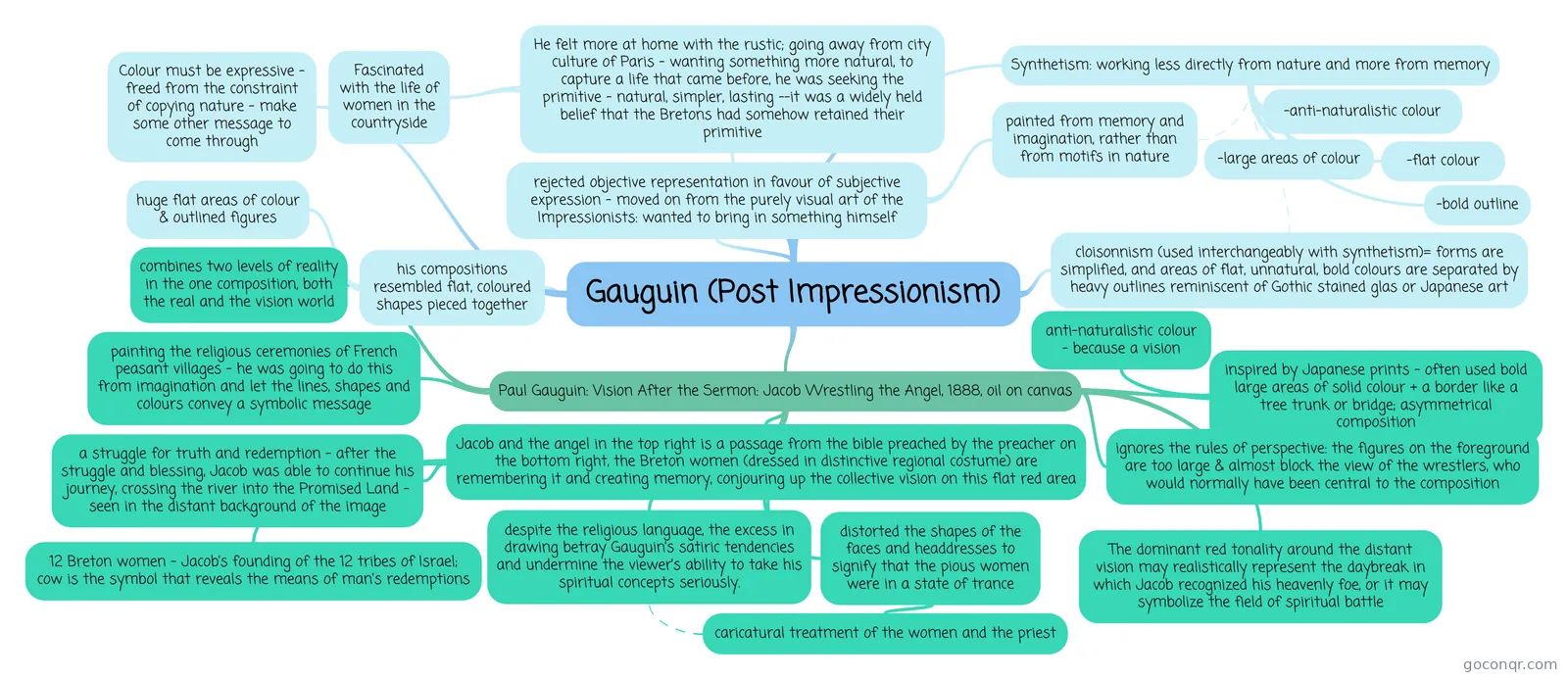
Mind map: Gauguin and Post-Impressionism
Conteúdo do mapa
Gauguin (Post Impressionism)
rejected objective representation in favour of subjective expression - moved on from the purely visual art of the Impressionists: wanted to bring in something himself
- painted from memory and imagination, rather than from motifs in nature
He felt more at home with the rustic; going away from city culture of Paris - wanting something more natural, to capture a life that came before, he was seeking the primitive – natural, simpler, lasting --it was a widely held belief that the Bretons had somehow retained their primitive
- Fascinated with the life of women in the countryside
Colour must be expressive – freed from the constraint of copying nature - make some other message to come through
his compositions resembled flat, coloured shapes pieced together
- huge flat areas of colour & outlined figures
Synthetism: working less directly from nature and more from memory
- -anti-naturalistic colour
- -large areas of colour
- -flat colour
- -bold outline
cloisonnism (used interchangeably with synthetism)= forms are simplified, and areas of flat, unnatural, bold colours are separated by heavy outlines reminiscent of Gothic stained glas or Japanese art
Paul Gauguin: Vision After the Sermon: Jacob Wrestling the Angel, 1888, oil on canvas
- inspired by Japanese prints - often used bold large areas of solid colour + a border like a tree trunk or bridge; asymmetrical composition
- anti-naturalistic colour – because a vision
- ignores the rules of perspective: the figures on the foreground are too large & almost block the view of the wrestlers, who would normally have been central to the composition
- Jacob and the angel in the top right is a passage from the bible preached by the preacher on the bottom right, the Breton women (dressed in distinctive regional costume) are remembering it and creating memory, conjouring up the collective vision on this flat red area
- 12 Breton women – Jacob’s founding of the 12 tribes of Israel; cow is the symbol that reveals the means of man's redemptions
- a struggle for truth and redemption - after the struggle and blessing, Jacob was able to continue his journey, crossing the river into the Promised Land - seen in the distant background of the image
- distorted the shapes of the faces and headdresses to signify that the pious women were in a state of trance
- caricatural treatment of the women and the priest
- combines two levels of reality in the one composition, both the real and the vision world
- painting the religious ceremonies of French peasant villages – he was going to do this from imagination and let the lines, shapes and colours convey a symbolic message
- despite the religious language, the excess in drawing betray Gauguin’s satiric tendencies and undermine the viewer’s ability to take his spiritual concepts seriously.
- The dominant red tonality around the distant vision may realistically represent the daybreak in which Jacob recognized his heavenly foe, or it may symbolize the field of spiritual battle
- inspired by Japanese prints - often used bold large areas of solid colour + a border like a tree trunk or bridge; asymmetrical composition
Informações
- Descrição
- Mapa Mental sobre Gauguin (Post Impressionism), criado por Sandra Porenta em 27-04-2017.
- Criado por
- Sandra Porenta
- Visualizações
- 2
- Avaliação