
Mapa mental
physics P2A
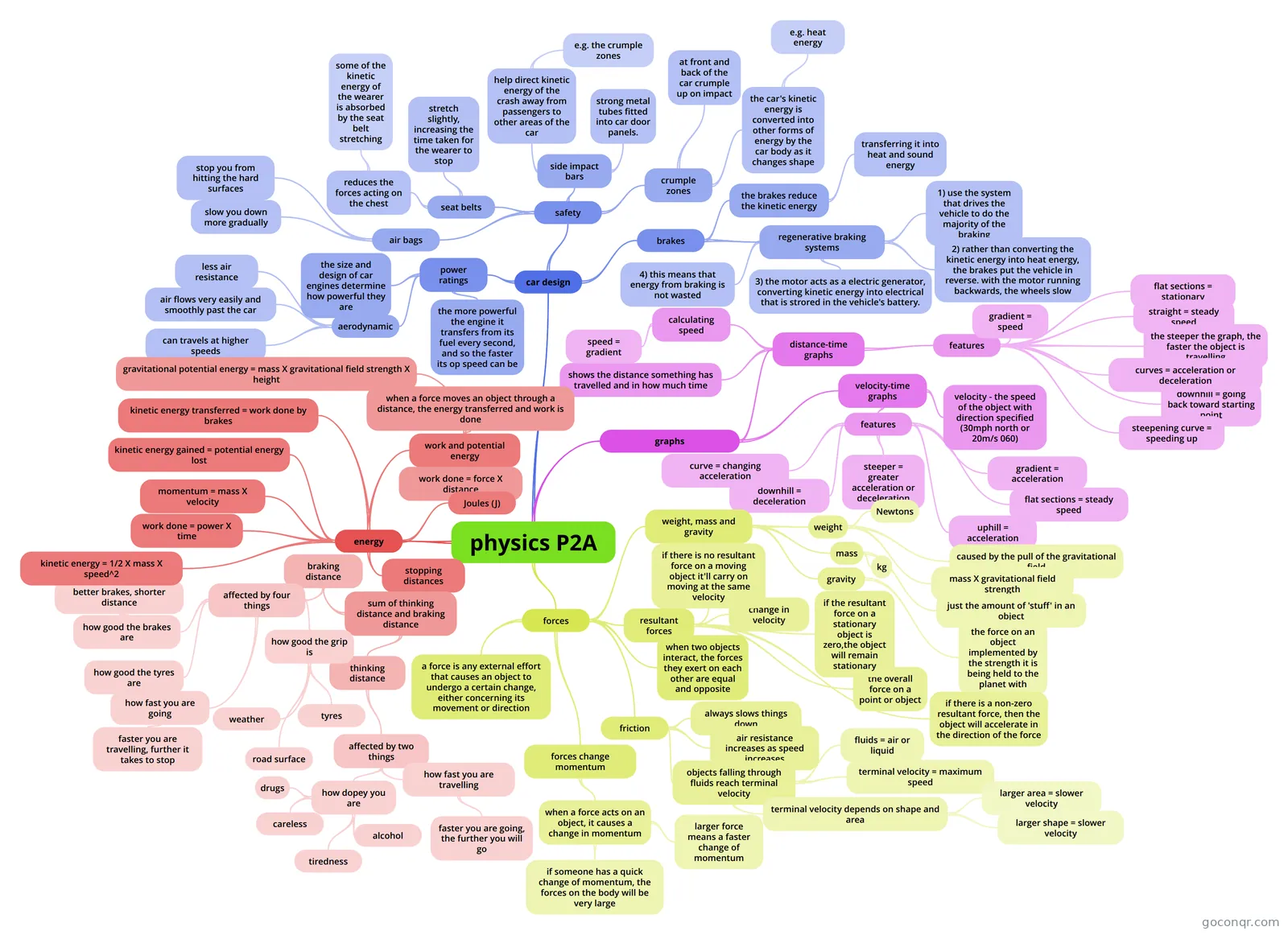
Mind map: physics graphs forces energy and car design
Conteúdo do mapa
physics P2A
graphs
- distance-time graphs
- shows the distance something has travelled and in how much time
- features
- gradient = speed
- flat sections = stationary
- straight = steady speed
- the steeper the graph, the faster the object is travelling
- downhill = going back toward starting point
- curves = acceleration or deceleration
- steepening curve = speeding up
- calculating speed
- speed = gradient
- velocity-time graphs
- velocity - the speed of the object with direction specified (30mph north or 20m/s 060)
- features
- gradient = acceleration
- flat sections = steady speed
- steeper = greater acceleration or deceleration
- uphill = acceleration
- downhill = deceleration
- curve = changing acceleration
- distance-time graphs
forces
- weight, mass and gravity
- weight
- caused by the pull of the gravitational field
- mass X gravitational field strength
- Newtons
- mass
- just the amount of 'stuff' in an object
- kg
- gravity
- the force on an object implemented by the strength it is being held to the planet with
- weight
- resultant forces
- the overall force on a point or object
- change in velocity
- if the resultant force on a stationary object is zero,the object will remain stationary
- if there is no resultant force on a moving object it'll carry on moving at the same velocity
- if there is a non-zero resultant force, then the object will accelerate in the direction of the force
- when two objects interact, the forces they exert on each other are equal and opposite
- friction
- always slows things down
- air resistance increases as speed increases
- objects falling through fluids reach terminal velocity
- fluids = air or liquid
- terminal velocity = maximum speed
- terminal velocity depends on shape and area
- larger area = slower velocity
- larger shape = slower velocity
- a force is any external effort that causes an object to undergo a certain change, either concerning its movement or direction
- forces change momentum
- when a force acts on an object, it causes a change in momentum
- larger force means a faster change of momentum
- if someone has a quick change of momentum, the forces on the body will be very large
- when a force acts on an object, it causes a change in momentum
- weight, mass and gravity
energy
- stopping distances
- sum of thinking distance and braking distance
- thinking distance
- affected by two things
- how fast you are travelling
- faster you are going, the further you will go
- how dopey you are
- tiredness
- drugs
- alcohol
- careless
- how fast you are travelling
- affected by two things
- braking distance
- affected by four things
- how fast you are going
- faster you are travelling, further it takes to stop
- how good the brakes are
- better brakes, shorter distance
- how good the tyres are
- how good the grip is
- road surface
- weather
- tyres
- how fast you are going
- affected by four things
- thinking distance
- sum of thinking distance and braking distance
- work and potential energy
- when a force moves an object through a distance, the energy transferred and work is done
- work done = force X distance
- gravitational potential energy = mass X gravitational field strength X height
- Joules (J)
- kinetic energy = 1/2 X mass X speed^2
- kinetic energy transferred = work done by brakes
- kinetic energy gained = potential energy lost
- work done = power X time
- momentum = mass X velocity
- stopping distances
car design
- brakes
- the brakes reduce the kinetic energy
- transferring it into heat and sound energy
- regenerative braking systems
- 1) use the system that drives the vehicle to do the majority of the braking
- 2) rather than converting the kinetic energy into heat energy, the brakes put the vehicle in reverse. with the motor running backwards, the wheels slow
- 3) the motor acts as a electric generator, converting kinetic energy into electrical that is strored in the vehicle's battery.
- 4) this means that energy from braking is not wasted
- the brakes reduce the kinetic energy
- safety
- crumple zones
- at front and back of the car crumple up on impact
- the car's kinetic energy is converted into other forms of energy by the car body as it changes shape
- e.g. heat energy
- side impact bars
- strong metal tubes fitted into car door panels.
- help direct kinetic energy of the crash away from passengers to other areas of the car
- e.g. the crumple zones
- seat belts
- stretch slightly, increasing the time taken for the wearer to stop
- reduces the forces acting on the chest
- some of the kinetic energy of the wearer is absorbed by the seat belt stretching
- air bags
- slow you down more gradually
- stop you from hitting the hard surfaces
- crumple zones
- power ratings
- the size and design of car engines determine how powerful they are
- the more powerful the engine it transfers from its fuel every second, and so the faster its op speed can be
- aerodynamic
- less air resistance
- air flows very easily and smoothly past the car
- can travels at higher speeds
- brakes
Informações
- Descrição
- Mapa Mental sobre physics P2A, criado por Georgia Sargent em 17-05-2014.
- Criado por
- Georgia Sargent
- Visualizações
- 111
- Tags
- Avaliação